The Value of Different Mechanisms
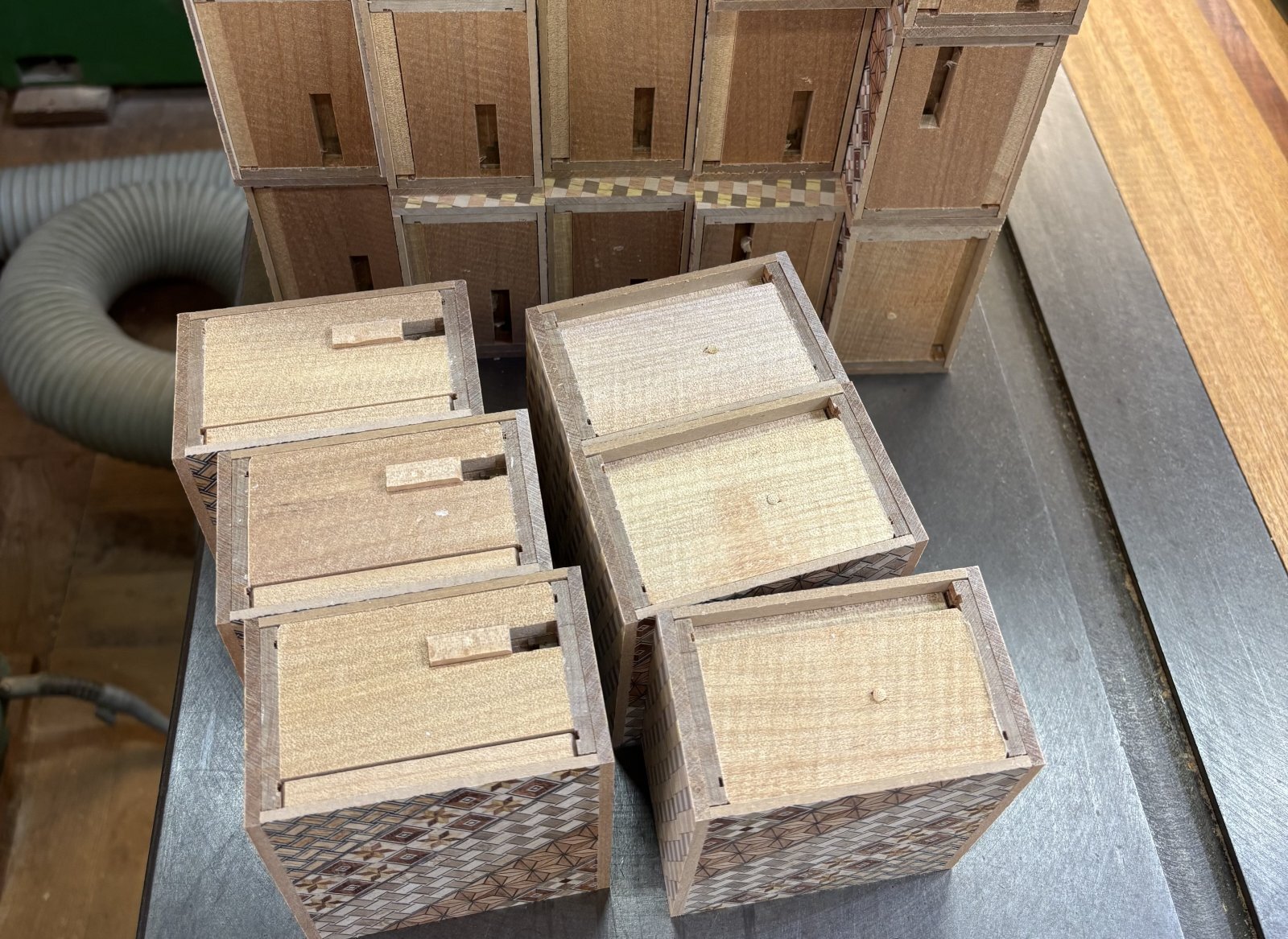
The weather was nice this morning, but it gradually became cloudier, and it looks like we may get a little rain tonight. According to the forecast, today is one of the last relatively dry days for a while, and we can expect more rain in the coming days. With that in mind, I started making the Aruki sliding panels for the custom puzzle boxes this morning. When humidity rises, the dimensions of the parts can change slightly, so it is better to make and install these panels on days with lower humidity. The frame panels had already been made, so I assembled them at the end of the day yesterday before leaving the workshop. I have not attached the internal parts yet, but that can be done later. First, I attach the parts to one box and then use that box as a reference while determining the dimensions for the panels.
Once I had finished making the sliding panels for the custom puzzle boxes, I decided to continue working on the limited puzzle box project instead of setting it aside for now. In the afternoon, I made and attached the side panels, including the sliding key panel. This box will have an 11-step mechanism, but it uses only a single sliding key. Two side panels move, although one side is simply a single-piece panel. This is the first time I have tried fitting a 9-step mechanism using only one sliding key panel. Perhaps the idea came from the 21-step puzzle boxes I made last month..haha. Before that, however, I needed to install the internal pins. I usually use these pins in puzzle boxes with drawers, but this time I am using them in a more conventional puzzle box. Their purpose is similar to that in a drawer box: they prevent a panel from coming out completely. In this design, however, the allowable range of movement is much more critical than in a drawer box, so I had to be very careful when determining the dimensions. The pins are not only there to prevent the panel from coming out. They must also limit the movement precisely enough to stop the bottom panel at the correct position. In other words, the panel must not be allowed to move too far. Because a pin-guided mechanism is slightly less precise than one controlled only by the panels themselves, extra care is required when setting up the dimensions.
I also think this may be influenced by the fact that I have been sharing more observations about old puzzle boxes on my blog and social media lately.Because of the advantages in production efficiency, many puzzle boxes with very similar mechanisms are in circulation. However, I would like to make a few more boxes with slightly different opening sequences. Recently, I have had opportunities to examine several old puzzle boxes. Although their designs vary, the opening sequences are often very similar. That is why I wanted to try something a little different. I cannot change the mechanism completely, and I do not have that many new ideas anyway..haha, but even with the same sliding movements, I can change the order of the moves or the number of steps. Many of the puzzle boxes in my collection are old. Some are 50 or 60 years old, and some are even older. If, many decades from now, someone is collecting old puzzle boxes in the same way, perhaps they will come across one of my boxes and enjoy finding a mechanism that is a little different from the usual style.
I hope you have a good weekend!
Once I had finished making the sliding panels for the custom puzzle boxes, I decided to continue working on the limited puzzle box project instead of setting it aside for now. In the afternoon, I made and attached the side panels, including the sliding key panel. This box will have an 11-step mechanism, but it uses only a single sliding key. Two side panels move, although one side is simply a single-piece panel. This is the first time I have tried fitting a 9-step mechanism using only one sliding key panel. Perhaps the idea came from the 21-step puzzle boxes I made last month..haha. Before that, however, I needed to install the internal pins. I usually use these pins in puzzle boxes with drawers, but this time I am using them in a more conventional puzzle box. Their purpose is similar to that in a drawer box: they prevent a panel from coming out completely. In this design, however, the allowable range of movement is much more critical than in a drawer box, so I had to be very careful when determining the dimensions. The pins are not only there to prevent the panel from coming out. They must also limit the movement precisely enough to stop the bottom panel at the correct position. In other words, the panel must not be allowed to move too far. Because a pin-guided mechanism is slightly less precise than one controlled only by the panels themselves, extra care is required when setting up the dimensions.
I also think this may be influenced by the fact that I have been sharing more observations about old puzzle boxes on my blog and social media lately.Because of the advantages in production efficiency, many puzzle boxes with very similar mechanisms are in circulation. However, I would like to make a few more boxes with slightly different opening sequences. Recently, I have had opportunities to examine several old puzzle boxes. Although their designs vary, the opening sequences are often very similar. That is why I wanted to try something a little different. I cannot change the mechanism completely, and I do not have that many new ideas anyway..haha, but even with the same sliding movements, I can change the order of the moves or the number of steps. Many of the puzzle boxes in my collection are old. Some are 50 or 60 years old, and some are even older. If, many decades from now, someone is collecting old puzzle boxes in the same way, perhaps they will come across one of my boxes and enjoy finding a mechanism that is a little different from the usual style.
I hope you have a good weekend!