14-step Walnut Puzzle Box
It was sunny from the morning today for the first time in a while, and the heat returned. I spent most of the day packing orders, so I didn't get as much workshop work done as usual. Maybe it was because of the heat... haha🤣 Even so, I finished polishing the 4-step Mame puzzle boxes and also prepared the side panels for the upcoming 4-sun puzzle boxes. The Walnut sheets I'll be using for this production also arrived today, so I plan to glue them on tomorrow. The glue I use for attaching these sheets has also been in short supply, so I hurried to buy some the other day.
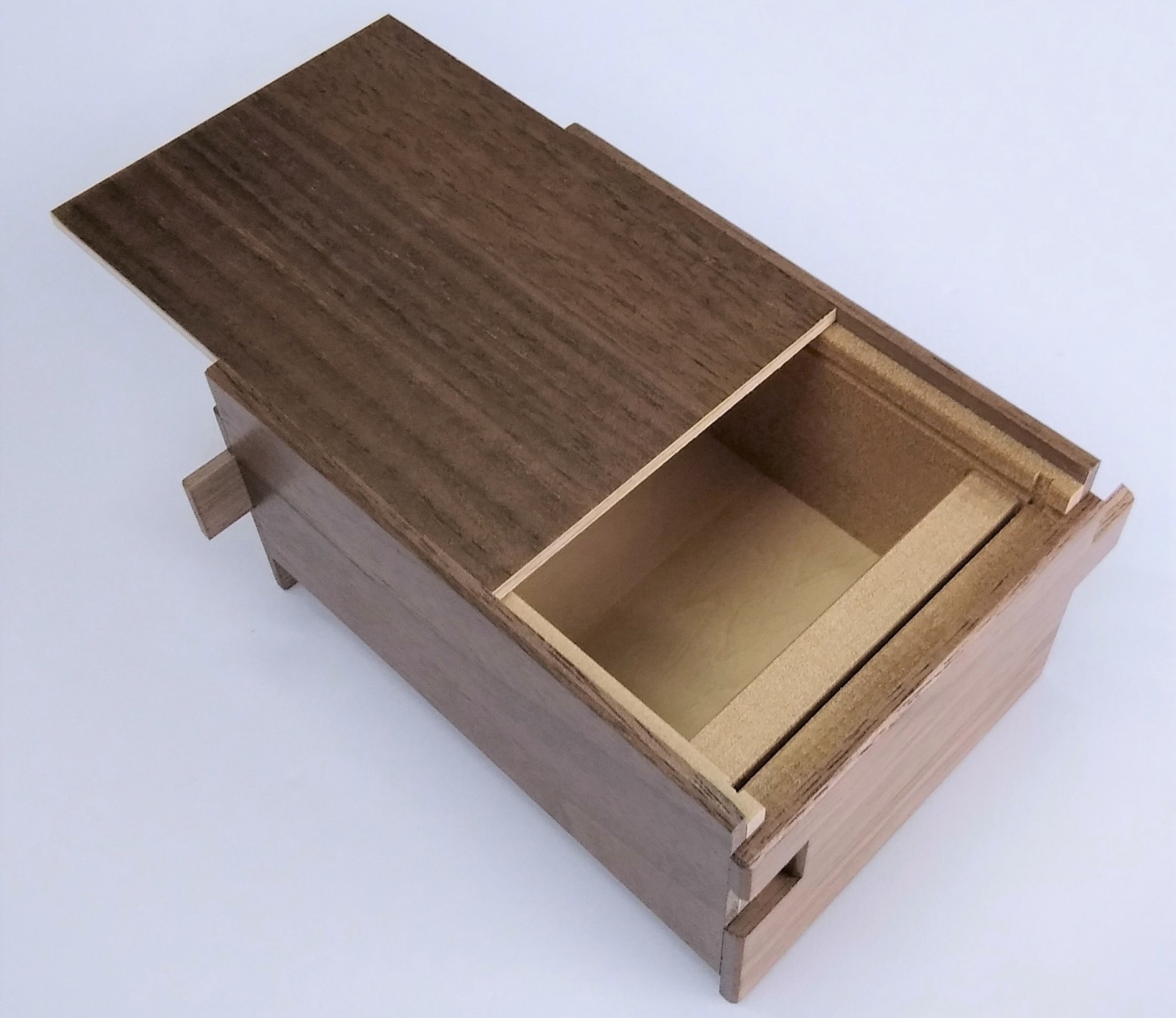
As I mentioned on social media, the box I'm planning to add to my stock this time is the Walnut design shown in the photo. This version has a 14-step mechanism, but I have also made 18-step and 27-step versions in the past. This full Walnut puzzle box has always been popular, and I have received many requests for it over the years. I also make it in the 3-sun size. Making puzzle boxes from Walnut is a little risky and requires more care than boxes covered with traditional Yosegi veneer. This time, however, I received several orders for 4-sun puzzle boxes with Walnut side panels. Since I'll already be making those, I decided to make a few extra and finish them with Walnut top panels as well. Although I call it a full Walnut design, as mentioned above, the top and bottom panels are made by attaching sliced Walnut to plywood. I do not use solid wood for the top and bottom panels because it may warp or shrink.
In the past, I often had problems when making these Walnut side panels, so I selected the wood very carefully this time as well. One possible problem is that the side panels can warp, creating a small gap between the panel and the box. The side panels of a Japanese puzzle box are quite thin, about 3–4 mm thick, and part of each panel is not glued because it needs to move as part of the mechanism. That unglued section is more likely to warp. This is one reason why Yosegi veneer is attached to the side panels. It not only adds decoration but also helps reduce warping. For these solid Walnut side panels, the most important step is choosing the right wood. I use only the most stable sections of the wood for the sliding key panels, and I attach them when the weather conditions are favorable. Considering that, a day like today—with high temperatures but relatively low humidity—is actually ideal for this work.
As I mentioned on social media, the box I'm planning to add to my stock this time is the Walnut design shown in the photo. This version has a 14-step mechanism, but I have also made 18-step and 27-step versions in the past. This full Walnut puzzle box has always been popular, and I have received many requests for it over the years. I also make it in the 3-sun size. Making puzzle boxes from Walnut is a little risky and requires more care than boxes covered with traditional Yosegi veneer. This time, however, I received several orders for 4-sun puzzle boxes with Walnut side panels. Since I'll already be making those, I decided to make a few extra and finish them with Walnut top panels as well. Although I call it a full Walnut design, as mentioned above, the top and bottom panels are made by attaching sliced Walnut to plywood. I do not use solid wood for the top and bottom panels because it may warp or shrink.
In the past, I often had problems when making these Walnut side panels, so I selected the wood very carefully this time as well. One possible problem is that the side panels can warp, creating a small gap between the panel and the box. The side panels of a Japanese puzzle box are quite thin, about 3–4 mm thick, and part of each panel is not glued because it needs to move as part of the mechanism. That unglued section is more likely to warp. This is one reason why Yosegi veneer is attached to the side panels. It not only adds decoration but also helps reduce warping. For these solid Walnut side panels, the most important step is choosing the right wood. I use only the most stable sections of the wood for the sliding key panels, and I attach them when the weather conditions are favorable. Considering that, a day like today—with high temperatures but relatively low humidity—is actually ideal for this work.