Two Differences
Although we are now in the rainy season, it looks like this week will not bring much rain. According to the weather forecast I saw earlier, rainy days are expected to return next week. Today was not particularly humid. The sky was mostly cloudy, but the sun appeared from time to time throughout the day. I went out for a while in the afternoon, but I also continued working on the new puzzle box project that I started yesterday.
I am still in the middle of making the custom puzzle boxes, but somehow my attention keeps shifting toward this new project. There is something enjoyable about making an idea that has just come to mind. I find myself wanting to see how it turns out, so I keep moving ahead with it. Perhaps that is a good thing, but it does mean that the custom boxes for the Japanese market have been left sitting for the moment. For some reason, I have not felt very motivated to work on them. Maybe that is simply the difference between making something because I want to and making something as part of my work. I have already made the frame parts for the custom boxes, but I have not assembled them yet. They are relatively large boxes, about 5-sun in size, and once the frame panels are assembled they take up quite a bit of space. So when I start that stage, I really need to keep the work moving forward..haha. For now, the frame panels are still clamped in place to prevent them from warping. In comparison, the new puzzle box project has been moving along very smoothly. Perhaps that is partly because I am making only about 25 of them. Today, I finished attaching the side panels. Once the panels for the sliding faces are attached, most of the assembly work will already be complete. So far, everything is progressing quite well.
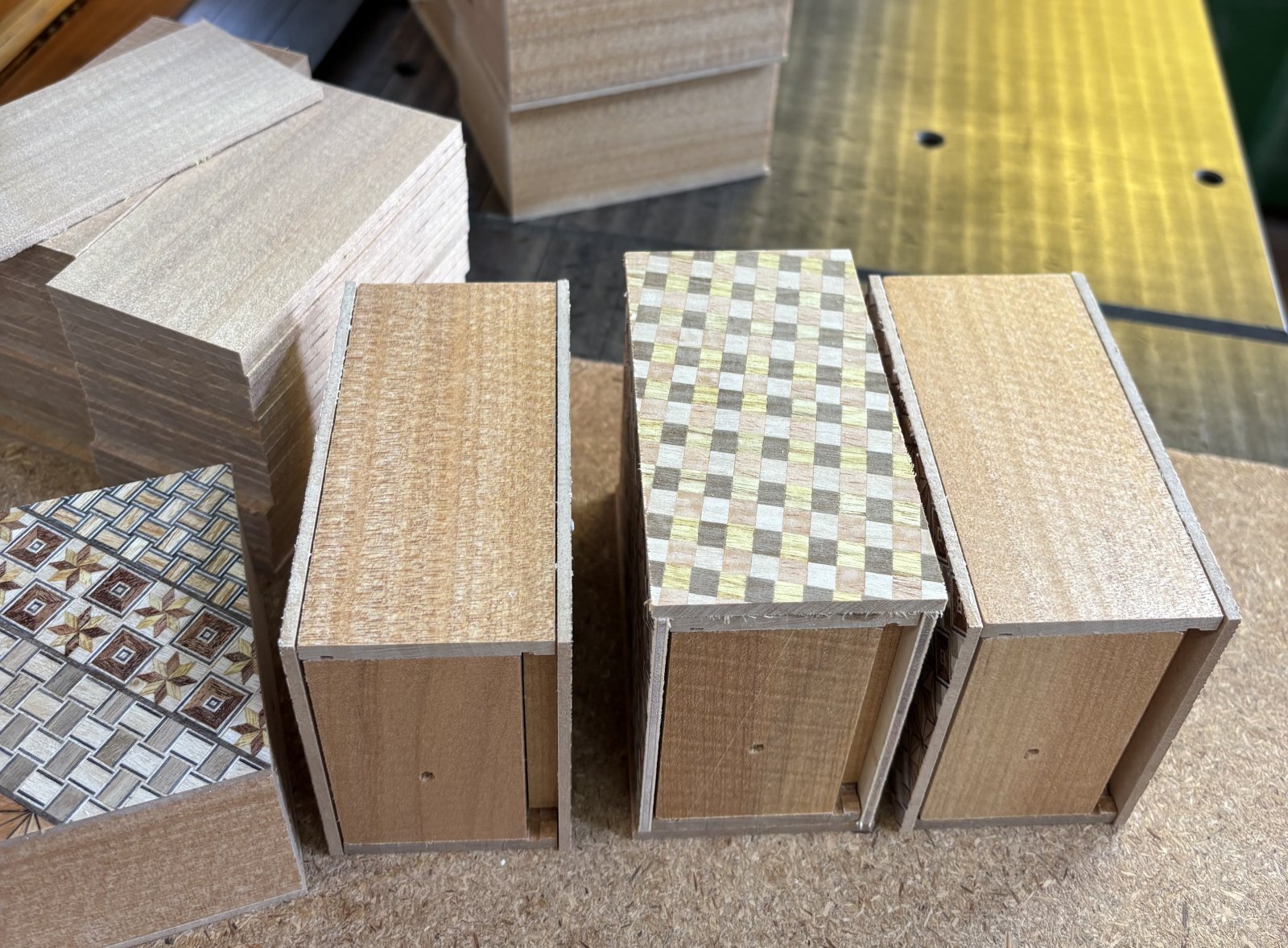
As I worked on the new puzzle box today, there were two things that were different from my usual approach. The first was the way I attached the long side panels. The second was that I used shina plywood in one of the boxes. As shown in the photo, the final step of today's work was attaching the long side panels. This is not a process I have used very often recently. That is because I now usually work with structural parts that already have the side panels attached. The method I used today could be considered the more traditional production sequence, and it is actually the way I used to make puzzle boxes in the past. However, after trying it again this time, I was reminded that it takes more time and that the gluing process is less stable. Each panel must be attached carefully to avoid any misalignment, and that requires a great deal of attention. If I lose concentration even slightly, there is a risk of attaching a panel in the wrong position. Once a panel has been glued out of alignment, it is very difficult to correct, and much of the work done up to that point can be lost. Since I am only making a small number of boxes this time, I decided to use this method again. Even so, it reminded me that my current method of attaching the panels is probably the better approach.
It may be a little difficult to see in the photo, but one of the boxes in the middle uses shina plywood for the top and bottom panels. I used it for only one box because, when cutting the materials, I ended up being one piece of MDF board short, and I happened to have a piece of shina plywood in just the right size. When yosegi is applied, I think shina plywood gives a better appearance. The yosegi sheets are very thin, so the color of the base material shows through slightly. Since MDF board is brown, that color can affect the appearance of the yosegi. Shina plywood is much lighter in color, so the yosegi patterns appear more clearly. However, before the side panels are attached, the excess material from the top and bottom panels must be trimmed away. For that step, MDF board is easier to work with and produces cleaner cut surfaces. Compared to MDF, shina plywood is more likely to become rough along the cut edge and is more difficult to cut cleanly. From a maker's point of view, this reminded me of the practical advantages of MDF board.
For now, I will leave this project at this stage and start spending more time on my other ongoing work.
I am still in the middle of making the custom puzzle boxes, but somehow my attention keeps shifting toward this new project. There is something enjoyable about making an idea that has just come to mind. I find myself wanting to see how it turns out, so I keep moving ahead with it. Perhaps that is a good thing, but it does mean that the custom boxes for the Japanese market have been left sitting for the moment. For some reason, I have not felt very motivated to work on them. Maybe that is simply the difference between making something because I want to and making something as part of my work. I have already made the frame parts for the custom boxes, but I have not assembled them yet. They are relatively large boxes, about 5-sun in size, and once the frame panels are assembled they take up quite a bit of space. So when I start that stage, I really need to keep the work moving forward..haha. For now, the frame panels are still clamped in place to prevent them from warping. In comparison, the new puzzle box project has been moving along very smoothly. Perhaps that is partly because I am making only about 25 of them. Today, I finished attaching the side panels. Once the panels for the sliding faces are attached, most of the assembly work will already be complete. So far, everything is progressing quite well.
As I worked on the new puzzle box today, there were two things that were different from my usual approach. The first was the way I attached the long side panels. The second was that I used shina plywood in one of the boxes. As shown in the photo, the final step of today's work was attaching the long side panels. This is not a process I have used very often recently. That is because I now usually work with structural parts that already have the side panels attached. The method I used today could be considered the more traditional production sequence, and it is actually the way I used to make puzzle boxes in the past. However, after trying it again this time, I was reminded that it takes more time and that the gluing process is less stable. Each panel must be attached carefully to avoid any misalignment, and that requires a great deal of attention. If I lose concentration even slightly, there is a risk of attaching a panel in the wrong position. Once a panel has been glued out of alignment, it is very difficult to correct, and much of the work done up to that point can be lost. Since I am only making a small number of boxes this time, I decided to use this method again. Even so, it reminded me that my current method of attaching the panels is probably the better approach.
It may be a little difficult to see in the photo, but one of the boxes in the middle uses shina plywood for the top and bottom panels. I used it for only one box because, when cutting the materials, I ended up being one piece of MDF board short, and I happened to have a piece of shina plywood in just the right size. When yosegi is applied, I think shina plywood gives a better appearance. The yosegi sheets are very thin, so the color of the base material shows through slightly. Since MDF board is brown, that color can affect the appearance of the yosegi. Shina plywood is much lighter in color, so the yosegi patterns appear more clearly. However, before the side panels are attached, the excess material from the top and bottom panels must be trimmed away. For that step, MDF board is easier to work with and produces cleaner cut surfaces. Compared to MDF, shina plywood is more likely to become rough along the cut edge and is more difficult to cut cleanly. From a maker's point of view, this reminded me of the practical advantages of MDF board.
For now, I will leave this project at this stage and start spending more time on my other ongoing work.