Challenges in making 14-steps aruki panels
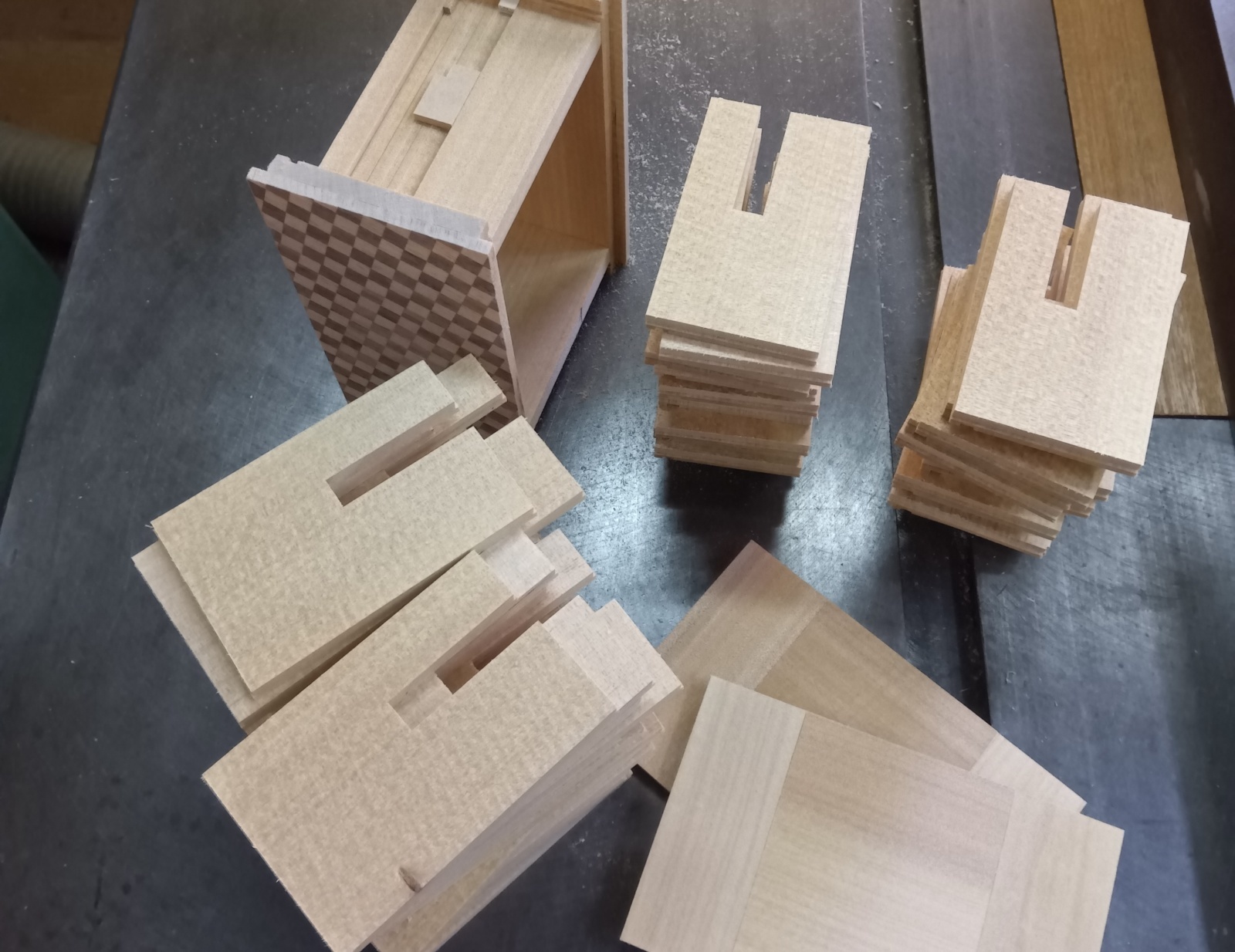
Today was another cold day, but it was sunny. I went out for a while in the afternoon, so I didn’t do a lot of work, but in the morning I made the Aruki moving panels for the 5-sun boxes (photo). As I wrote yesterday, the base for the hashibami-style top Aruki panel was already prepared at this stage, so I worked on it together with today’s side Aruki panels.
Since this is a 14-steps mechanism, there are three types of Aruki panels. A 14-steps mechanism is not a high-step mechanism, but the production has its own difficulties. It is actually a different kind of challenge compared to 18-steps or 27-steps boxes. For 14-steps and 12-steps mechanisms, the top Aruki panel has a small “protrusion” that must catch into the groove of the side Aruki panel. One of the two types of side Aruki panels has a groove, and the protrusion on the top panel fits into that groove.
This part of the work is unexpectedly difficult, and I always need to be very careful when aligning these pieces. If it were only about matching these two panels, it would be just a small challenge. But while aligning these two, I also have to match the sliding-key cuts and the positions of the internal mechanism parts. These are not made to fit perfectly tight; they are made with a little room to allow adjustment. This is because each box is slightly different, and the Aruki panels must fit all of them. As a side note, with other mechanisms such as 18-steps or 27-steps boxes, there is no need to match the panels to each other. You only need to match the sliding-key cuts with the internal mechanism parts. In that sense, production is a little easier. However, because the number of steps is greater, the amount of work is still more than with a 14-steps box.
Matching these two points is quite difficult, and it is hard to complete in a single step. In the end, fine adjustments are always needed. This time too, I made the grooves and the protrusion of the top panel in what I thought was the best position. But after finishing all the work, I widened the groove a little.
The top Aruki panel also needs to be cut to the exact length. I cut it to the correct size beforehand, but after fitting the two panels together, I realized it was slightly too long, so I trimmed it a bit—only about 0.2 mm. The other side Aruki panel must be adjusted so that it almost touches the one-side of the top panel as it slides. Because everything is cut and assembled by hand, it is impossible to make every box exactly the same with no variation. So these kinds of adjustments are natural and necessary. I am sure the craftsmen of the past also did this kind of fine adjustment for every single box. But unlike today, they did it with hand planes, shaving tiny amounts little by little to find the perfect fit.
Since this is a 14-steps mechanism, there are three types of Aruki panels. A 14-steps mechanism is not a high-step mechanism, but the production has its own difficulties. It is actually a different kind of challenge compared to 18-steps or 27-steps boxes. For 14-steps and 12-steps mechanisms, the top Aruki panel has a small “protrusion” that must catch into the groove of the side Aruki panel. One of the two types of side Aruki panels has a groove, and the protrusion on the top panel fits into that groove.
This part of the work is unexpectedly difficult, and I always need to be very careful when aligning these pieces. If it were only about matching these two panels, it would be just a small challenge. But while aligning these two, I also have to match the sliding-key cuts and the positions of the internal mechanism parts. These are not made to fit perfectly tight; they are made with a little room to allow adjustment. This is because each box is slightly different, and the Aruki panels must fit all of them. As a side note, with other mechanisms such as 18-steps or 27-steps boxes, there is no need to match the panels to each other. You only need to match the sliding-key cuts with the internal mechanism parts. In that sense, production is a little easier. However, because the number of steps is greater, the amount of work is still more than with a 14-steps box.
Matching these two points is quite difficult, and it is hard to complete in a single step. In the end, fine adjustments are always needed. This time too, I made the grooves and the protrusion of the top panel in what I thought was the best position. But after finishing all the work, I widened the groove a little.
The top Aruki panel also needs to be cut to the exact length. I cut it to the correct size beforehand, but after fitting the two panels together, I realized it was slightly too long, so I trimmed it a bit—only about 0.2 mm. The other side Aruki panel must be adjusted so that it almost touches the one-side of the top panel as it slides. Because everything is cut and assembled by hand, it is impossible to make every box exactly the same with no variation. So these kinds of adjustments are natural and necessary. I am sure the craftsmen of the past also did this kind of fine adjustment for every single box. But unlike today, they did it with hand planes, shaving tiny amounts little by little to find the perfect fit.