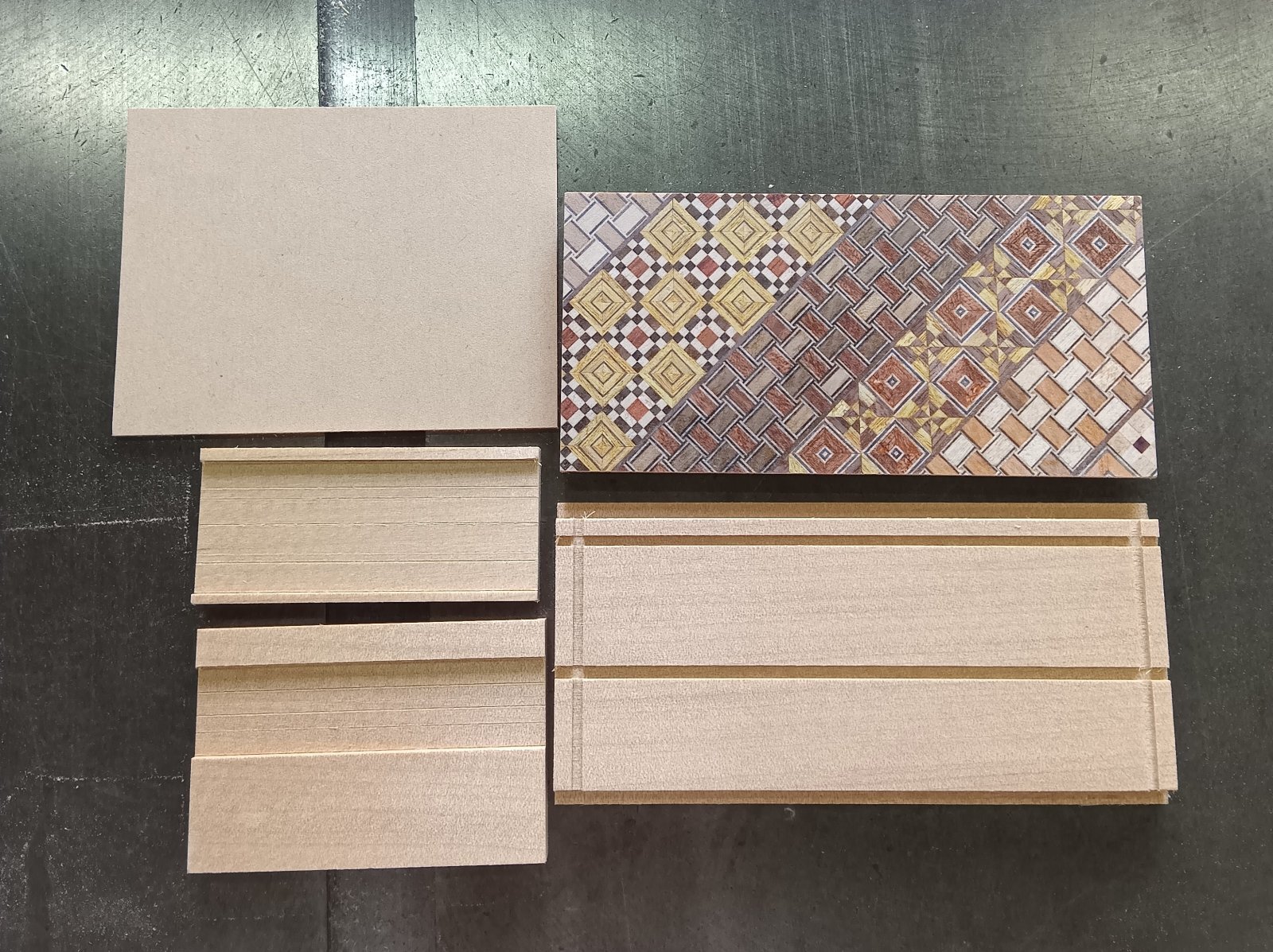
The structural parts of the drawer box
It was another warm and sunny day today. Time flies, and the first week of February is already coming to an end. Since February is a short month, I hope to move forward with the work I have planned in a steady and smooth way. Taking advantage of the mild weather, I did a bit more work using machines. I also finished the final coating on the 3-sun 12-step puzzle boxes today. Next, I will check the mechanisms and then move on to packing the boxes.
Today, I made some of the parts for the 5-sun drawer puzzle boxes. The photo shows the parts for the frame. In addition to the usual long side panels and shaft panels, drawer puzzle boxes also include inner partition boards. Because of this, I cut grooves for those panels first, and then, at the final stage of making the frame parts, I make the panels to match those grooves.
When assembling the frame, the main work is gluing the two long side panels and the shaft panels together. At the same time, the inner partition boards are fitted into their grooves and glued in place as well. The width of the shaft panels determines the overall width of the box, and this dimension must be exactly the same for all boxes.Even though machines are used, the parts are cut by hand while being held and moved, and the boxes are assembled by hand. Because of this, very small differences in size can sometimes occur from box to box. However, these differences are extremely small, usually around 0.1 mm or so. This is important because the Aruki panels are made in batches to match the number of boxes being produced. If the box sizes were significantly different, it would cause serious problems at that stage. For this reason, the width of the shaft panels at this point—especially the horizontal dimension—is extremely important.
For this type of box, there is also an inner partition panel, so if the size of this panel is wrong, it can ruin the very precise dimensions of the shaft panels. This partition panel fits into grooves in the long side panels, but it must be slightly smaller than the width of those grooves. If it is too tight, it will push the shaft panels outward when they are glued, which affects the overall dimensions. This is a very delicate part of the work. At the same time, if the panel is made too short, it can slip out of the grooves, so great care is needed. I always check this by doing a dry fit first, placing the panel into position and confirming the fit. It should sit in the groove and move slightly without resistance. In terms of size, I make it about 0.3 to 0.4 mm shorter. Then I apply glue inside the grooves and fix it in place. Of course, the grooves themselves are made slightly loose, but only enough that it does not look poor. If they are too tight, that again affects the shaft dimensions. The length direction of the panel is even more critical. It must fit perfectly between the two shaft panels, while not pushing them outward from their correct positions. This really has to be exact, and it is always quite difficult...😅 If anything, I think it is better for the panel to stop just a little short rather than pressing strongly against the shaft panels. However, if it is too short, a gap appears between the partition panel and the shaft panels, creating an unattractive interior space.
I wish you a good weekend!
Today, I made some of the parts for the 5-sun drawer puzzle boxes. The photo shows the parts for the frame. In addition to the usual long side panels and shaft panels, drawer puzzle boxes also include inner partition boards. Because of this, I cut grooves for those panels first, and then, at the final stage of making the frame parts, I make the panels to match those grooves.
When assembling the frame, the main work is gluing the two long side panels and the shaft panels together. At the same time, the inner partition boards are fitted into their grooves and glued in place as well. The width of the shaft panels determines the overall width of the box, and this dimension must be exactly the same for all boxes.Even though machines are used, the parts are cut by hand while being held and moved, and the boxes are assembled by hand. Because of this, very small differences in size can sometimes occur from box to box. However, these differences are extremely small, usually around 0.1 mm or so. This is important because the Aruki panels are made in batches to match the number of boxes being produced. If the box sizes were significantly different, it would cause serious problems at that stage. For this reason, the width of the shaft panels at this point—especially the horizontal dimension—is extremely important.
For this type of box, there is also an inner partition panel, so if the size of this panel is wrong, it can ruin the very precise dimensions of the shaft panels. This partition panel fits into grooves in the long side panels, but it must be slightly smaller than the width of those grooves. If it is too tight, it will push the shaft panels outward when they are glued, which affects the overall dimensions. This is a very delicate part of the work. At the same time, if the panel is made too short, it can slip out of the grooves, so great care is needed. I always check this by doing a dry fit first, placing the panel into position and confirming the fit. It should sit in the groove and move slightly without resistance. In terms of size, I make it about 0.3 to 0.4 mm shorter. Then I apply glue inside the grooves and fix it in place. Of course, the grooves themselves are made slightly loose, but only enough that it does not look poor. If they are too tight, that again affects the shaft dimensions. The length direction of the panel is even more critical. It must fit perfectly between the two shaft panels, while not pushing them outward from their correct positions. This really has to be exact, and it is always quite difficult...😅 If anything, I think it is better for the panel to stop just a little short rather than pressing strongly against the shaft panels. However, if it is too short, a gap appears between the partition panel and the shaft panels, creating an unattractive interior space.
I wish you a good weekend!