An Unusual use of a Carpenter’s tool
Today was another cold day. It’s already Friday, and there are only two more weekends left this year. In Japan, many companies will finish work on December 26 this year. That means the New Year holidays will start in just one more week. I was planning my remaining work for the end of the year, and I made sure that I have a job that must be delivered before the year ends. I thought I should start soon, or I might not make it in time 😅 The company I’m delivering to doesn’t finish on the 26th, so delivering on the 29th or 30th should be fine. But the box I need to make is a slightly different size from usual, so I think it’s better to have enough time.
So today I paused the work on the 5-sun boxes and started making the special-order box. I haven’t prepared the wood parts material yet, but I spent the whole day applying yosegi sheets for this box. However, this box does not use traditional yosegi on the top. Instead, it will have a wood inlay design of next year’s Japanese zodiac animal, the horse. As I wrote before, boxes that use wood inlay are often made according to the size of the inlay picture, so the overall size changes each time. This time too, I will make the box to match the size of the horse inlay. Because of that, it doesn’t fit a fixed “sun” size, but it will be roughly the size of a 6-sun box. The side panels and the other outer panels will also use special yosegi that was provided for this project. Today I finished attaching all the panel sheets. The number of boxes I will make is around 30. The mechanism will be a 7-steps puzzle. The customer told me that even a 4-steps mechanism would be fine, since the main feature of this box is the horse wood inlay. But I wanted to add a little more work to it, so I decided to make it a 7-steps mechanism.
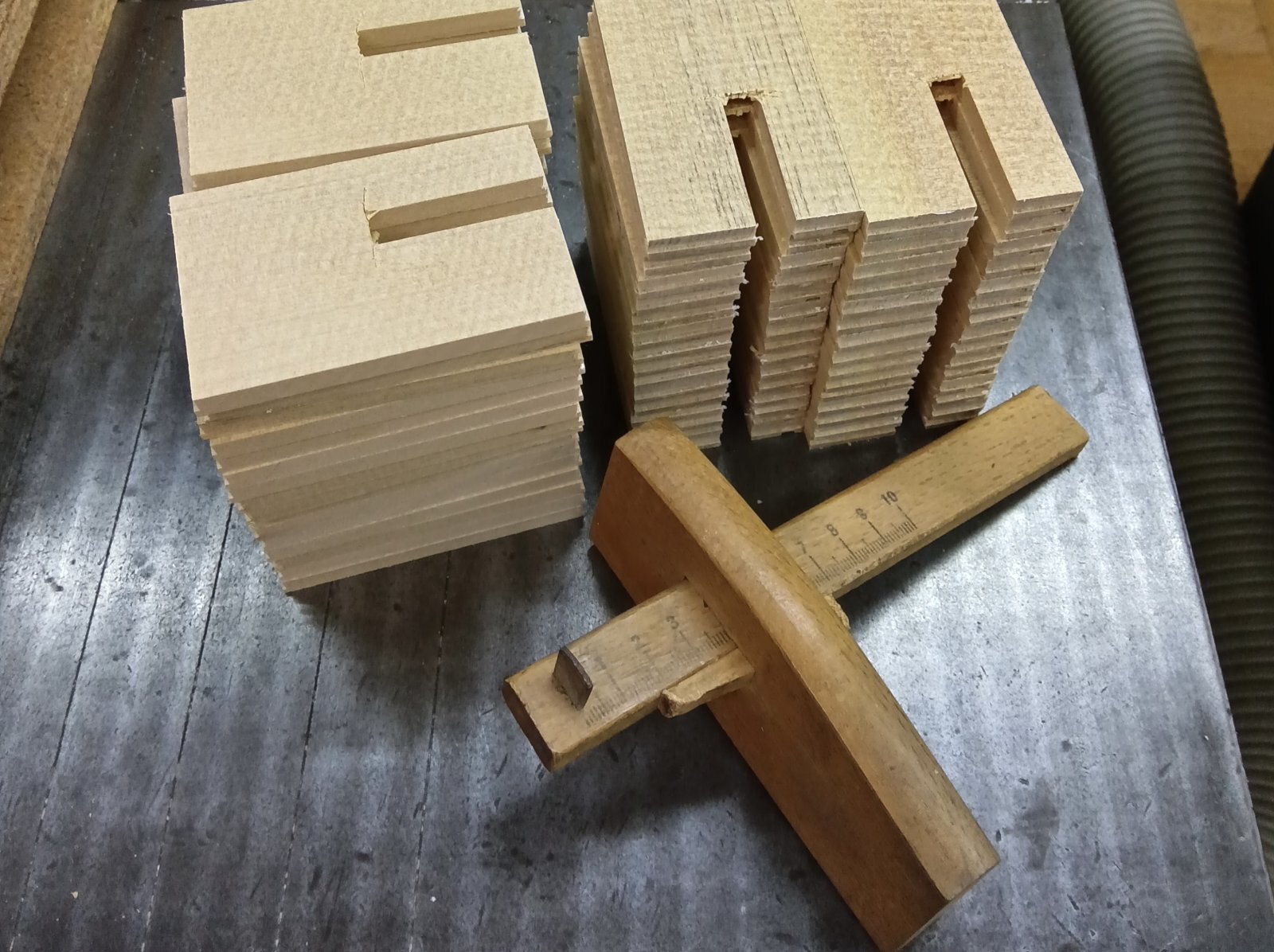
Today I was almost fully busy gluing the yosegi sheets for the special box, but I still managed to do a little work on the 5-sun boxes too. The aruki panels I made yesterday for the 5-sun 14-steps boxes have a cut-out where a small wooden piece passes inside. This shape is the same for all boxes with sliding keys, but for this 5-sun box, the way I make this cut is a bit different from the 4-sun boxes. It's difficult to explain in simple words, but on this box, the stopped part of the cut becomes a little sharp because of the way it must be made. Inside the box, a small wooden “bocchi” (small wooden parts) hits that point to stop the sliding key. If that sharp point stays as it is, the part of cut will slowly dent it, and then the sliding key will start to stop at the wrong position. So today I used a Japanese marking tool called a kehiki (or kebiki - you can see it in the photo) to trim that sharp point and make it flat, so the sliding key will stay in the correct position. The kehiki is originally a carpenter’s tool for marking wood, but I modified it a little so I can use it as a cutting tool. With this tool, I can shave the wood in a perfectly parallel line. By doing this, the sharp corner becomes slightly flat, and the small wooden piece inside will not make a dent when it hits that spot. It works much better as a stopping surface.
Have a good weekend!😄
So today I paused the work on the 5-sun boxes and started making the special-order box. I haven’t prepared the wood parts material yet, but I spent the whole day applying yosegi sheets for this box. However, this box does not use traditional yosegi on the top. Instead, it will have a wood inlay design of next year’s Japanese zodiac animal, the horse. As I wrote before, boxes that use wood inlay are often made according to the size of the inlay picture, so the overall size changes each time. This time too, I will make the box to match the size of the horse inlay. Because of that, it doesn’t fit a fixed “sun” size, but it will be roughly the size of a 6-sun box. The side panels and the other outer panels will also use special yosegi that was provided for this project. Today I finished attaching all the panel sheets. The number of boxes I will make is around 30. The mechanism will be a 7-steps puzzle. The customer told me that even a 4-steps mechanism would be fine, since the main feature of this box is the horse wood inlay. But I wanted to add a little more work to it, so I decided to make it a 7-steps mechanism.
Today I was almost fully busy gluing the yosegi sheets for the special box, but I still managed to do a little work on the 5-sun boxes too. The aruki panels I made yesterday for the 5-sun 14-steps boxes have a cut-out where a small wooden piece passes inside. This shape is the same for all boxes with sliding keys, but for this 5-sun box, the way I make this cut is a bit different from the 4-sun boxes. It's difficult to explain in simple words, but on this box, the stopped part of the cut becomes a little sharp because of the way it must be made. Inside the box, a small wooden “bocchi” (small wooden parts) hits that point to stop the sliding key. If that sharp point stays as it is, the part of cut will slowly dent it, and then the sliding key will start to stop at the wrong position. So today I used a Japanese marking tool called a kehiki (or kebiki - you can see it in the photo) to trim that sharp point and make it flat, so the sliding key will stay in the correct position. The kehiki is originally a carpenter’s tool for marking wood, but I modified it a little so I can use it as a cutting tool. With this tool, I can shave the wood in a perfectly parallel line. By doing this, the sharp corner becomes slightly flat, and the small wooden piece inside will not make a dent when it hits that spot. It works much better as a stopping surface.
Have a good weekend!😄