Making the inner drawer
It was another cold morning today, but during the day the sunshine raised the temperature to around March levels. It looks like it will turn cold again over the weekend, so this warmth feels especially precious ☀️
Today, I worked on the finishing process for the 3-sun 12-step puzzle boxes from the morning. It took about half a day, but I was able to finish it smoothly and then move on to the undercoating process. Boxes with walnut side panels tend to warp more easily, so I am especially careful at this stage. However, because the 3-sun size is small, there was not much effect this time. The panels were stable.
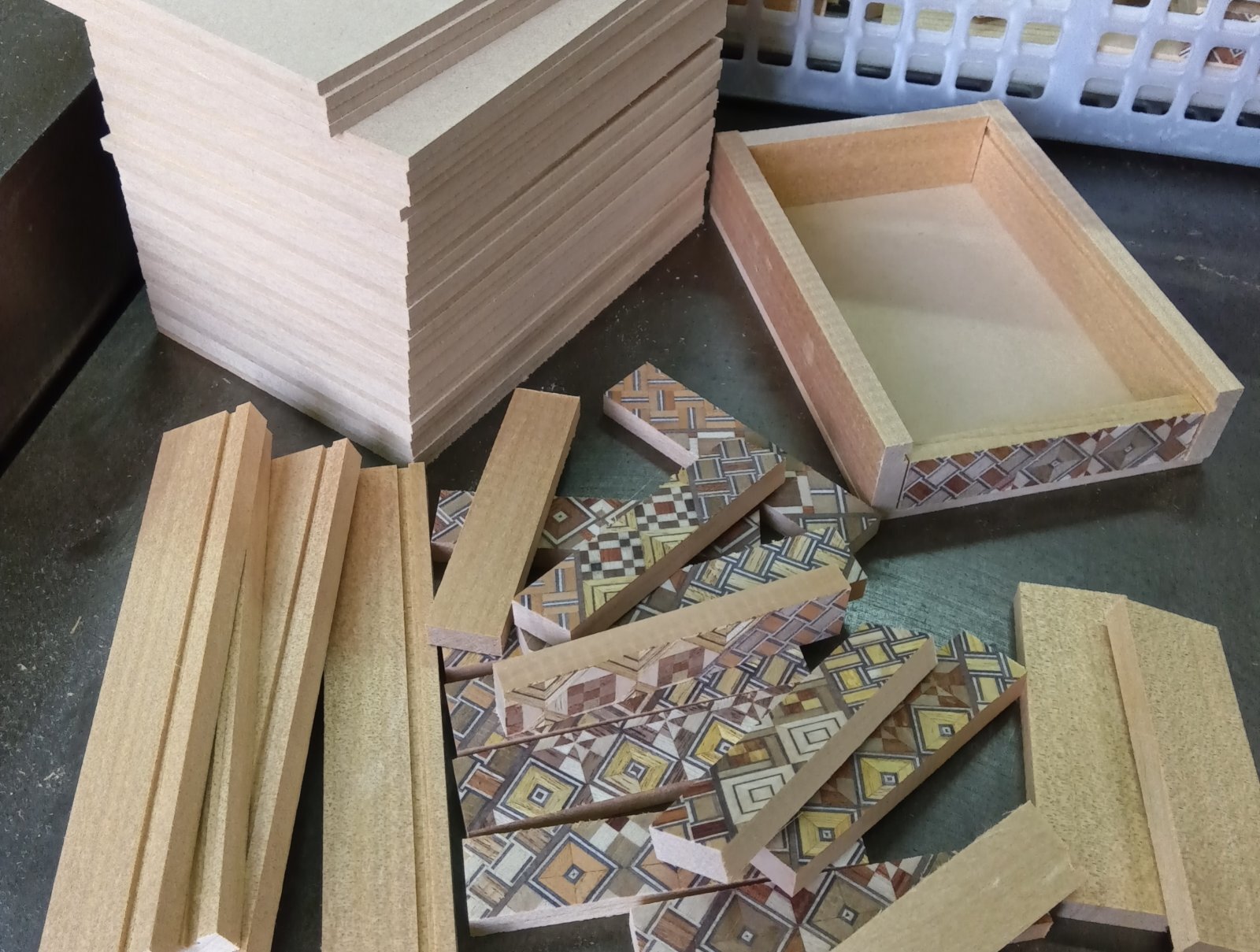
The next project is the 5-sun drawer puzzle boxes. However, since the side panels that I clamped yesterday are better left as they are for now, I decided to start by making the drawers that fit inside the boxes (photo). The main material is agathis wood, and I glue plywood to the bottom. In the early days, I used solid natural wood for the bottom as well, but thin and wide solid boards tend to warp and are not very stable. Because of that, I switched to plywood quite a long time ago. I add a small amount of yosegi work to the front of the drawer. I had a good stock of these yosegi pieces made in the past, but I used the last of them this time. From the next production, I plan to use either solid wood or ichimatsu-pattern yosegi sheets instead of traditional yosegi. Using solid wood is preferable in some ways, because after the frame is assembled, I can sand it properly and evenly. When traditional yosegi is used, sanding must be done very lightly. When assembling the frame, everything has to line up perfectly, because sanding too much will wear away the yosegi pattern. In simple terms, the drawer frame is made by assembling four pieces into a square. If the long side pieces stick out and end up higher than the yosegi panel on the front, there is no way to sand that area down. If all the parts were made from solid wood, I could use coarser sandpaper to remove the raised area and make the frame flat again (within limits, of course). Because of this, when assembling the four frame pieces, I am especially careful to make sure that the front face is perfectly flat.
Up to now, the drawers that fit inside the box have not been finished with any coating. From this time, I am thinking of applying a light finish to them. I also finished the small inner box that fits inside the drawer puzzle box for the first time in the recent production. It may not be a very heavy or thick finish, but I would like to apply it lightly. By doing so, the drawer itself becomes stronger, and it also helps prevent dirt and stains on the parts that are often touched by hand.
Today, I worked on the finishing process for the 3-sun 12-step puzzle boxes from the morning. It took about half a day, but I was able to finish it smoothly and then move on to the undercoating process. Boxes with walnut side panels tend to warp more easily, so I am especially careful at this stage. However, because the 3-sun size is small, there was not much effect this time. The panels were stable.
The next project is the 5-sun drawer puzzle boxes. However, since the side panels that I clamped yesterday are better left as they are for now, I decided to start by making the drawers that fit inside the boxes (photo). The main material is agathis wood, and I glue plywood to the bottom. In the early days, I used solid natural wood for the bottom as well, but thin and wide solid boards tend to warp and are not very stable. Because of that, I switched to plywood quite a long time ago. I add a small amount of yosegi work to the front of the drawer. I had a good stock of these yosegi pieces made in the past, but I used the last of them this time. From the next production, I plan to use either solid wood or ichimatsu-pattern yosegi sheets instead of traditional yosegi. Using solid wood is preferable in some ways, because after the frame is assembled, I can sand it properly and evenly. When traditional yosegi is used, sanding must be done very lightly. When assembling the frame, everything has to line up perfectly, because sanding too much will wear away the yosegi pattern. In simple terms, the drawer frame is made by assembling four pieces into a square. If the long side pieces stick out and end up higher than the yosegi panel on the front, there is no way to sand that area down. If all the parts were made from solid wood, I could use coarser sandpaper to remove the raised area and make the frame flat again (within limits, of course). Because of this, when assembling the four frame pieces, I am especially careful to make sure that the front face is perfectly flat.
Up to now, the drawers that fit inside the box have not been finished with any coating. From this time, I am thinking of applying a light finish to them. I also finished the small inner box that fits inside the drawer puzzle box for the first time in the recent production. It may not be a very heavy or thick finish, but I would like to apply it lightly. By doing so, the drawer itself becomes stronger, and it also helps prevent dirt and stains on the parts that are often touched by hand.