A New Direction for Ichimatsu
Today was a beautiful, sunny autumn day. However, the temperature dropped suddenly, and it felt cold this morning. Snow has already started falling in northern Japan. The air was very dry, making it a good day for work. I moved ahead with tasks I had been unable to do during the humid weather over the past few days. The Aruki sliding panels are already attached to the wide puzzle boxes. I had planned to attach the top and bottom panels today, but I did not get that far. I hope to attach them first thing tomorrow and then move on to attaching the sliding key panels.
To prepare for this, I did make the sliding key panels for the wide puzzle boxes today. Although the top and bottom panels are not attached yet, I temporarily fitted them in place to take the measurements. I make these sliding key panels to fit the boxes in each batch. I measure both the length and width, as there can be slight differences from box to box. Even when I use the same dimensions as usual, I always check the fit against the boxes I am currently making. I posted a photo of them on Instagram today. These sliding key panels are a little wider than usual. When making long panels like these, my biggest concern is whether I can cut them perfectly straight. Of course, I cut in a straight line, but it has to be exact. With my method, I do not smooth or adjust the cut edges afterward with another tool, such as a hand plane, so accuracy at this stage is very important. If the cut curves even slightly, the three parts will not fit together neatly, leaving gaps in the middle or at the ends of the sliding key. I cut the panels with a machine saw that spins at high speed. Friction during cutting can cause a problem we call “hiki-zori,” where the cut edge curves instead of staying straight. To help prevent this, I use a very sharp saw blade and choose the wood carefully. In my experience, this happens more often with harder woods, so I try to select softer wood with straight grain.
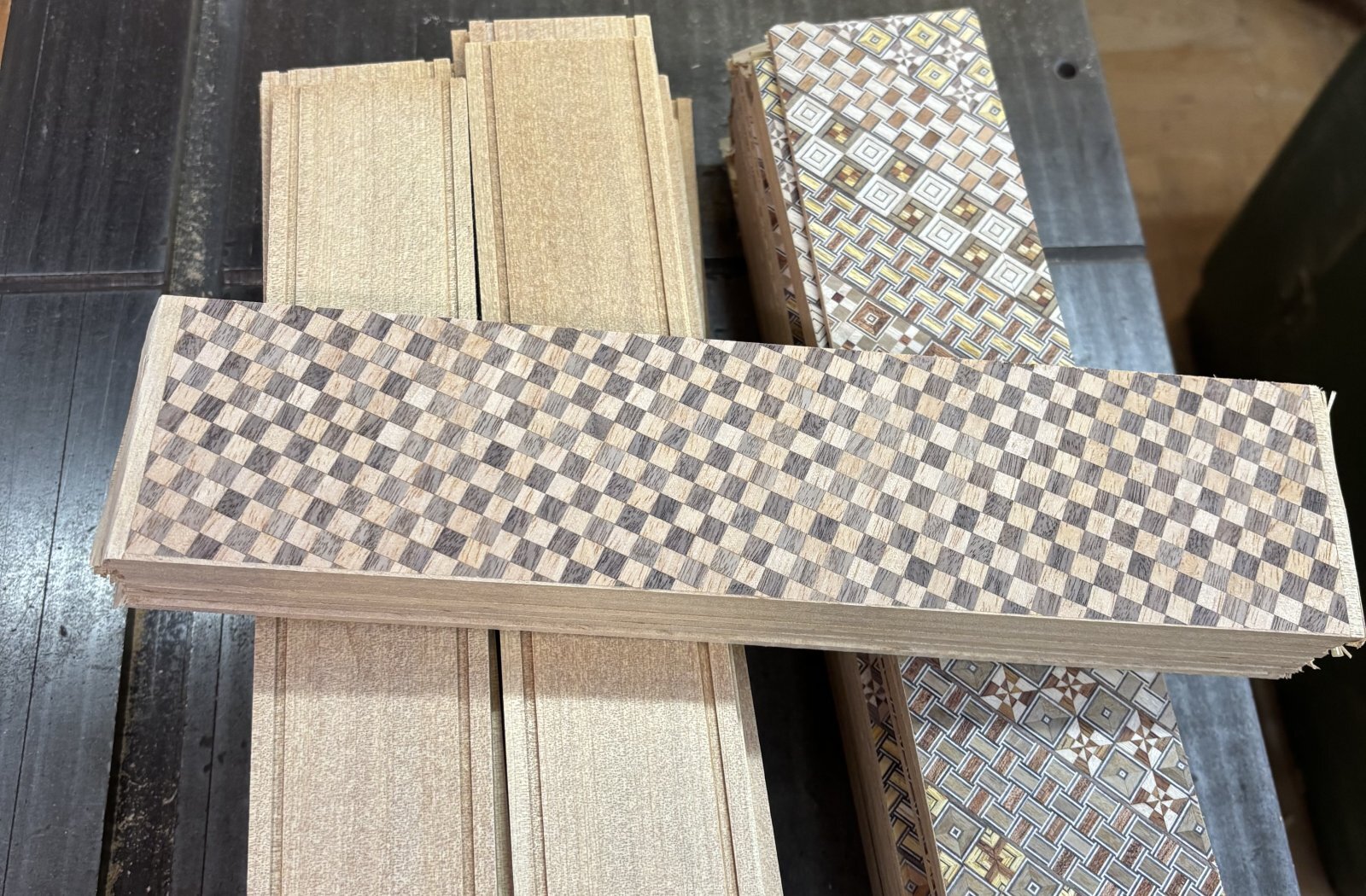
After that, I also prepared the long side panels for my next project, the 5-sun puzzle boxes (photo). I now have very little of this two-color checkered Yosegi left. Once I use up the remaining sheets, I have not yet decided whether I will make more in the same colors. I am thinking of replacing Nyatoh with another wood, so I may use a combination of Walnut and a different wood next time. For the wide boxes I am making now, I have tried a new combination of Walnut and Hō (Japanese Magnolia). It has a darker look, but it also gives the boxes a stronger, more substantial appearance. I will use the remaining sheets for this batch and a few boxes in the next 5-sun batch, which will use them up. This time, I am adding a few boxes with traditional Koyosegi on the top and bottom and this checkered Yosegi on the side panels. Checkered side panels have become a regular feature of my boxes, and more customers seem to like them. Many of the old puzzle boxes I sometimes write about have similar designs. These side patterns were often used on boxes with wood inlay pictures on the top and bottom. Looking at them reminds me that checkered patterns and similar Yosegi designs have been used for a long time. Many of those older patterns have larger, bolder arrangements rather than small checks like these. I have never tried making them, but I imagine they would be difficult to slice. Since these panels are for 5-sun boxes, I will keep them pressed in a vise for a few days to help them stay flat and stable.