Supporting the Sliding Key
It was raining again this morning, but the rain stopped in the afternoon, and the weather is expected to improve. Since the humidity was high, I continued attaching Yosegi sheets and doing similar work, just as I did yesterday. By the evening, the weather had become a little more stable, so I also resumed work on the wide puzzle boxes that I had put on hold.
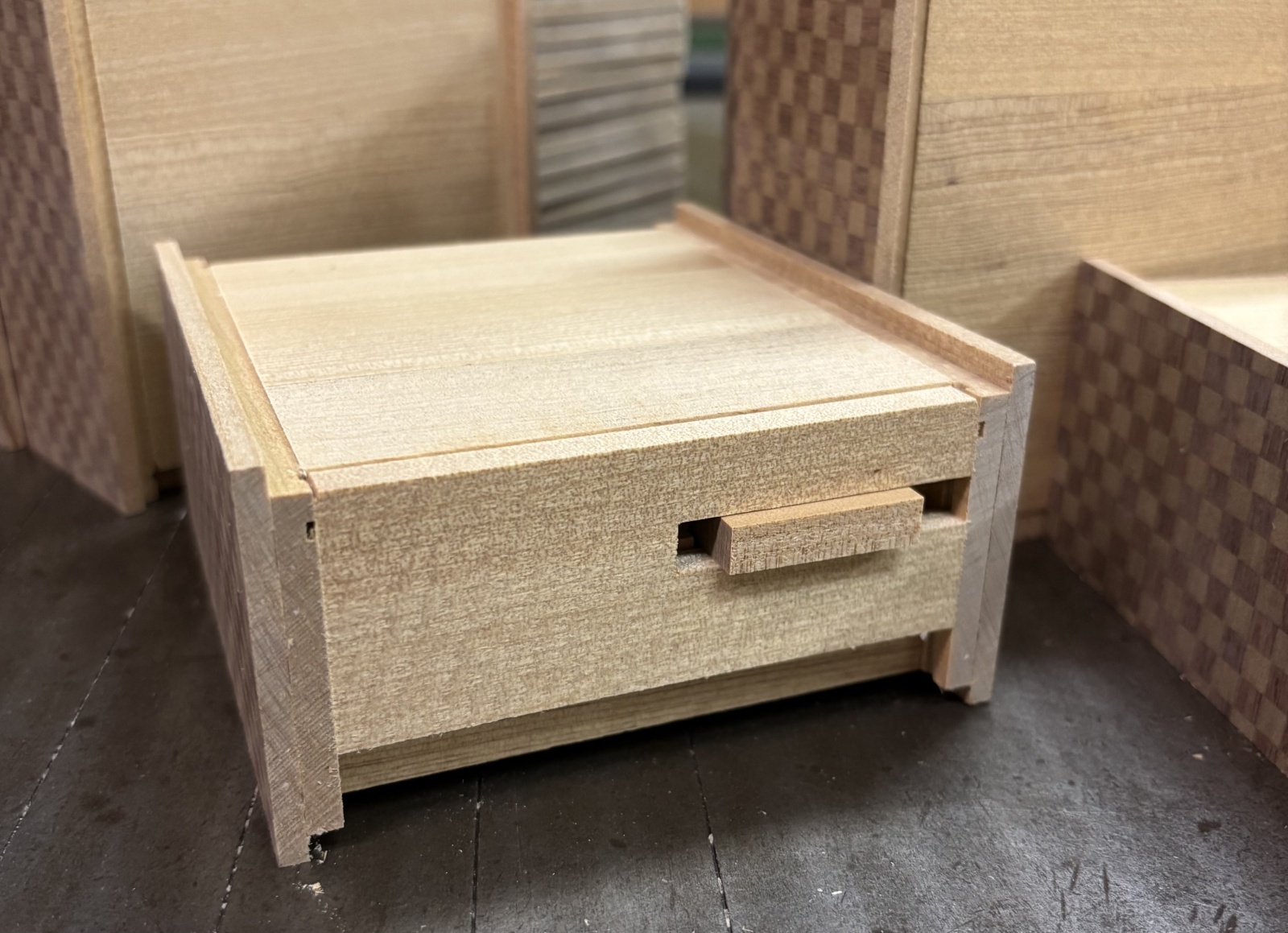
I also attached the Aruki sliding panels, a task I had put on hold. As I mentioned in a recent post, and as you can see in the photo, these panels are wider than usual and look a little like a bar stretching across the box. Keeping such a wide panel balanced as it moves downward is difficult and requires very careful adjustment. First, the movement must not be too stiff. These panels are already difficult to keep balanced, so a tight fit makes it even harder for them to move properly. I attach them with a slightly looser fit than my usual Aruki panels. and Ideally, the panel should move smoothly no matter where you press it. It should slide easily not only when pressed in the middle, but also near either end. For this to happen, the panel must not wobble. I aim to make it slide smoothly along the side panels of the box’s frame. This means carefully adjusting how the Aruki panel makes contact with those side panels.
As you can also see in the photo, this box is quite wide, so I make the small wooden parts inside, called bocchi, as long and narrow as possible. This gives me as much surface area as possible for gluing the sliding keys to them. Each sliding key is glued only to this wooden part and is otherwise free to move, so it can warp quite easily. As you may know, the sliding key panel is divided into three parts. The upper and lower sections help hold the middle sliding key in place, but the fit is not very tight. If it were too tight, the key would not slide. This means that if the middle key warps and lifts up, those sections cannot fully hold it down. If the end of the sliding key warps upward, it can create a height difference between the surfaces of the three panel sections. A gap may also become visible when you look at the sliding key panel from the side. For this reason, I want the wooden part inside to help keep the key flat as much as possible. However, it also has to fit around the internal mechanism, so the length shown in the photo is about the limit for this box.
Since the humidity had dropped a little, I also cut out the top and bottom panels today.