Preventing Yosegi Sheets from Drying Out
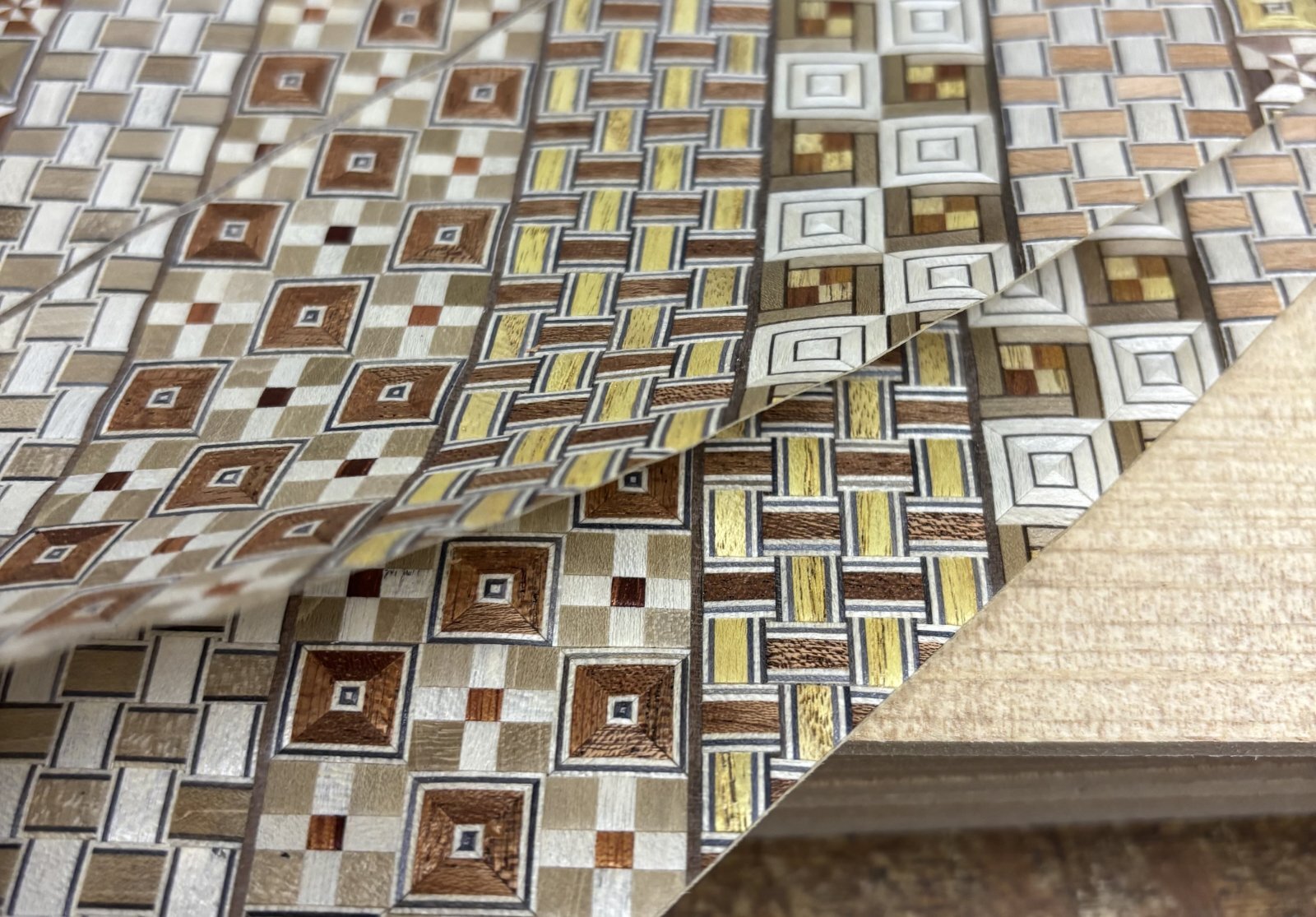
As I mentioned last week, it has been rainy for the past few days, and steady rain has been falling since this morning. The typhoon seems to have weakened into an extratropical low-pressure system, but the rain it brought is still continuing. It is forecast to last until sometime during the day tomorrow. The humidity is very high because of this, so attaching the Aruki sliding panels to the wide puzzle boxes is still on hold. I am hesitant to do this work today as well, so I decided to move ahead with other tasks first. I was out for part of the day, but I did this work during the time I spent in the workshop.
On days like this, working on Yosegi is the best choice, so today I attached Yosegi sheets to the panels for the 5-sun boxes. I had already decided to make 5-sun 27-steps puzzle boxes next. This time, I plan to make a few extra boxes for my own stock along with those requested by customers. The boxes for my stock will combine traditional Yosegi with checkered Yosegi. When I checked when I last made 5-sun 27-steps puzzle boxes, it turned out to be March this year. It has been quite a while, and I have not made 27-steps boxes in other sizes recently either, so I have been receiving requests for them. Although 27 steps is quite a lot, each box has only two sliding keys, just like boxes with fewer steps. Of the puzzle boxes I currently make, this model has the most steps using just two sliding keys.
The photo shows me attaching the Yosegi sheets for these boxes. The sheets are only about 0.2 mm thick, so they must be handled carefully. They are made entirely from natural wood, with the tiny pieces forming the pattern held together by glue. If these glue joints come apart, the pattern can fall to pieces. The main cause is drying. The glue itself hardly dries any further, but the wooden pieces shrink as they dry. Since the sheet is only 0.2 mm thick, it would be more accurate to say that it curls up rather than simply shrinks. The joints between the pieces can then come apart, causing the pattern to fall to pieces. Drying is a major concern, so I never leave the sheets exposed for long. They keep drying out just from being left in the open air. On humid days like today, I feel a little more at ease because there is plenty of moisture in the air. The same is true when slicing Yosegi sheets. Once sliced, they begin drying out right away, so I feel more comfortable doing this work on days with higher humidity. Today, along with the sheets for these 5-sun boxes, I also attached Yosegi sheets to the panels for the Mame puzzle boxes I plan to make afterward.