The Benefits of Engineered Wood
It was very sunny this morning, and the weather forecast said it would become hot. The forecast was right, and it felt like summer during the day. However, by evening, the sky had become completely cloudy, and the clouds were moving quickly, probably because of the typhoon. There are currently three typhoons near Japan, so this unstable weather may continue for a while. Today, I completed the puzzle boxes that I have been making for a special order in Japan. I checked all the mechanisms a short while ago. This was a small production, but I also made two boxes for my own stock. My two boxes have a different design from the boxes for the Hakone market. They feature a red-and-white checkered pattern. I plan to add them to my website around tomorrow.
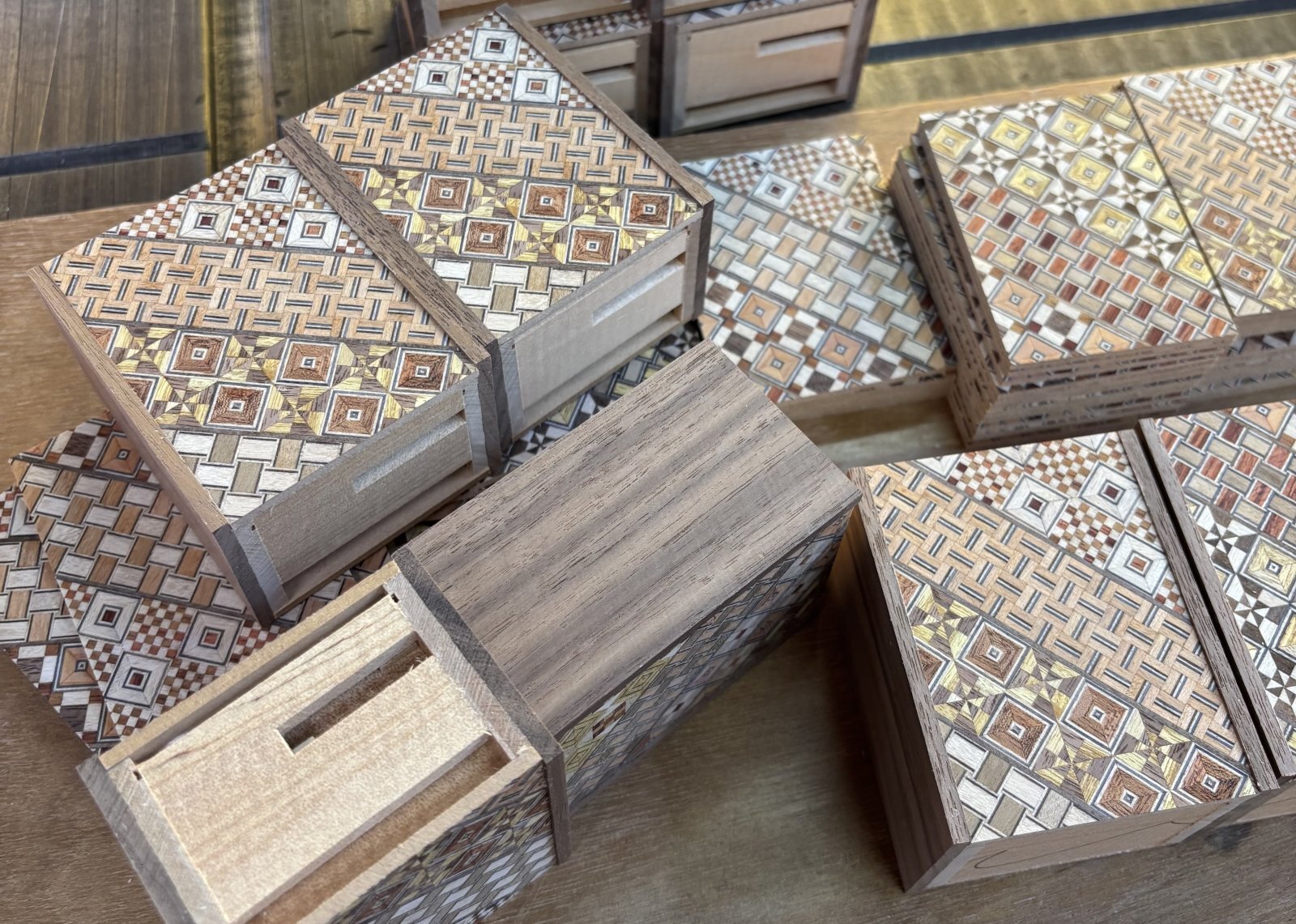
After that, I continued working on the 3-sun 7-step puzzle boxes. Today, I made and attached the Aruki sliding panels, followed by the top and bottom panels. Since I am making about 40 boxes, the work is moving quickly. This design combines popular traditional Yosegi with walnut. It may only be the wood supplier I use, but the price of walnut has gone up again. Walnut is popular, and this kind of hardwood is valuable, so I suppose the price increase cannot be helped. Most walnut comes from North America. I hope the good relationship between our countries will continue and that this beautiful wood will remain available in Japan. Walnut is slightly hard for making Japanese puzzle boxes, but its deep color makes the traditional Yosegi from Hakone stand out beautifully, as you can see in the photo. Boxes covered completely with traditional Yosegi are beautiful, of course, but Yosegi surrounded by natural wood has a different kind of beauty. The natural wood also has an important role in the mechanism, as it helps hide the sliding keys.
Recently, I have been using MDF for most of the top and bottom panels covered with Yosegi. I sometimes use Japanese basswood plywood for 5-sun boxes, but for boxes of 4 sun or smaller, I use MDF almost 100% of the time. On a day like today, this stable material is very helpful. The top and bottom panels are very thin, only about 3 mm thick. Thin wooden panels are easily affected by their surroundings and can quickly expand or shrink. In the past, I used to make these panels by attaching Yosegi sheets to natural Agathis wood, which is the main material used for puzzle boxes. I would carefully adjust the width of each panel during production. However, when I tried to attach it some time later, the fit would sometimes be looser than it had been during the adjustment. When wood is cut and shaped, the balance of moisture inside it changes. Some moisture may leave the panel, causing it to shrink. Of course, I tried to allow for this when making the panels, but it was very difficult to estimate and did not always work as expected. MDF is much less likely to change in this way. It is not completely unaffected, but its movement is much easier to predict. This also means that after the finished box is shipped overseas, it is less likely to be affected by the climate of its destination. MDF has now become a very useful material in my work.
After that, I continued working on the 3-sun 7-step puzzle boxes. Today, I made and attached the Aruki sliding panels, followed by the top and bottom panels. Since I am making about 40 boxes, the work is moving quickly. This design combines popular traditional Yosegi with walnut. It may only be the wood supplier I use, but the price of walnut has gone up again. Walnut is popular, and this kind of hardwood is valuable, so I suppose the price increase cannot be helped. Most walnut comes from North America. I hope the good relationship between our countries will continue and that this beautiful wood will remain available in Japan. Walnut is slightly hard for making Japanese puzzle boxes, but its deep color makes the traditional Yosegi from Hakone stand out beautifully, as you can see in the photo. Boxes covered completely with traditional Yosegi are beautiful, of course, but Yosegi surrounded by natural wood has a different kind of beauty. The natural wood also has an important role in the mechanism, as it helps hide the sliding keys.
Recently, I have been using MDF for most of the top and bottom panels covered with Yosegi. I sometimes use Japanese basswood plywood for 5-sun boxes, but for boxes of 4 sun or smaller, I use MDF almost 100% of the time. On a day like today, this stable material is very helpful. The top and bottom panels are very thin, only about 3 mm thick. Thin wooden panels are easily affected by their surroundings and can quickly expand or shrink. In the past, I used to make these panels by attaching Yosegi sheets to natural Agathis wood, which is the main material used for puzzle boxes. I would carefully adjust the width of each panel during production. However, when I tried to attach it some time later, the fit would sometimes be looser than it had been during the adjustment. When wood is cut and shaped, the balance of moisture inside it changes. Some moisture may leave the panel, causing it to shrink. Of course, I tried to allow for this when making the panels, but it was very difficult to estimate and did not always work as expected. MDF is much less likely to change in this way. It is not completely unaffected, but its movement is much easier to predict. This also means that after the finished box is shipped overseas, it is less likely to be affected by the climate of its destination. MDF has now become a very useful material in my work.