Wood Grain Selection
The typhoon remained offshore until yesterday, but its effects caused rough weather along the coast today. This morning, a coastal road was closed, causing traffic jams and other problems. The weather forecast said it would be a clear autumn day, but our area remained cloudy with occasional light rain. However, the humidity was not too high, so I continued working on the 3-sun 7-step puzzle boxes.
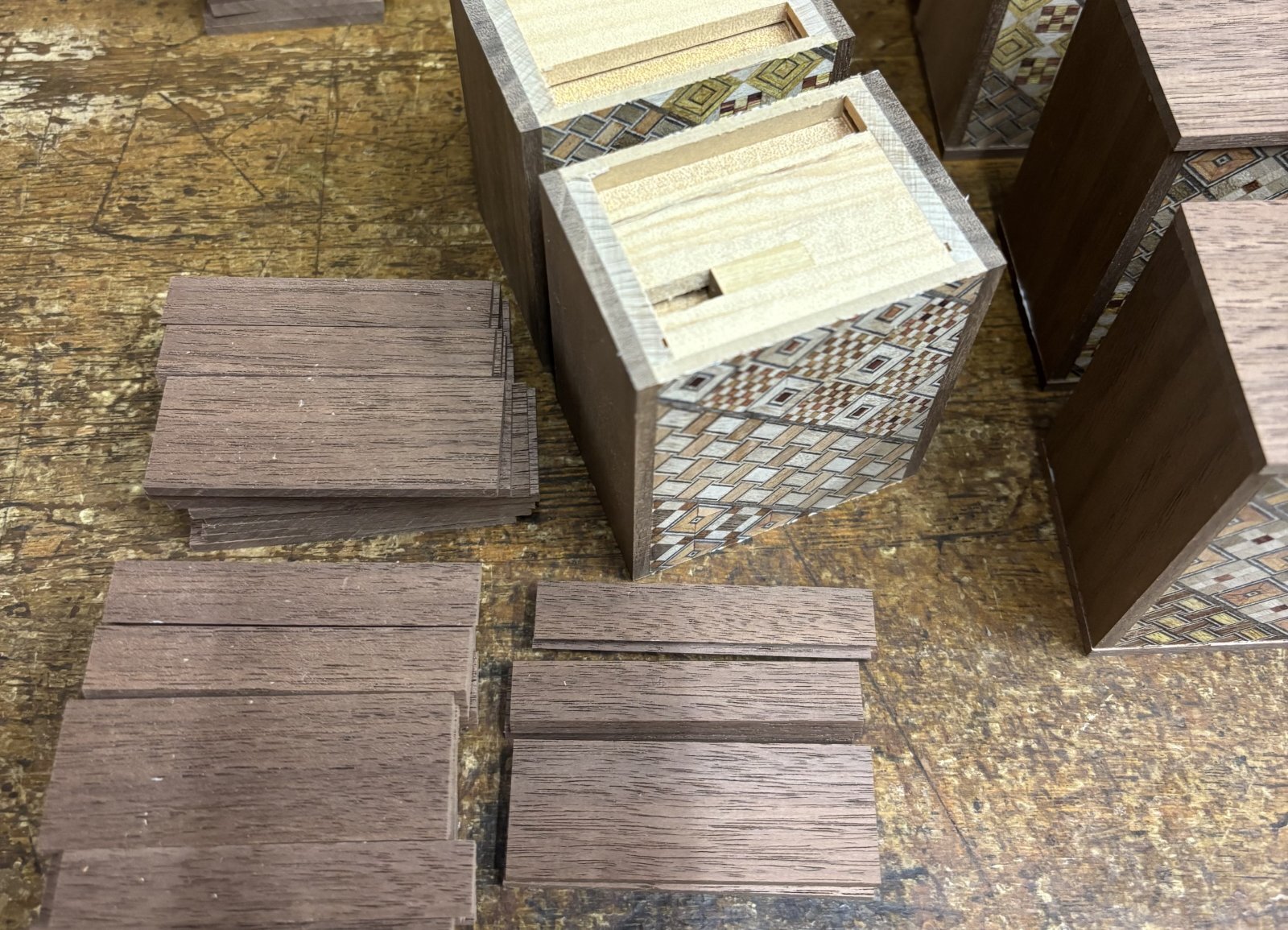
The photo shows the sliding key panels that I made today for these 3-sun 7-step puzzle boxes. Because this is a 7-step mechanism, one side uses a single fixed panel. A Japanese puzzle box usually has sliding key panels on two sides. However, boxes with fewer steps, such as 7-step and 5-step puzzle boxes, can be made with a sliding key panel on only one side. The panel on the other side is fixed and glued to the body of the box so that it does not move. When making these two types of panels, I choose wood with the straightest grain for the moving sliding key panel. Wood with less straight grain is used for the fixed panel.
The wood I purchase does not always have straight grain throughout. Some pieces have curved grain. This is true of every kind of wood and is unavoidable when working with natural materials. It is therefore important to choose the right piece of wood for each part. In Japan, straight grain is called “Masame,” while the other grain pattern is called “Itame.” The reason straight grain is important is that part of the sliding key panel is not fixed to the box. This allows the panel to move. However, because wood is a natural material, the panel may still warp or shrink after it has been attached to the box. If it warps, a gap may appear between the panel and the box. Straight-grained wood is less likely to warp or shrink in this way. For this reason, I try to use straight-grained wood, or Masame, for the moving parts of the mechanism. Of course, wood grain is also a matter of personal taste. In general, curved grain can give wood a bolder and more natural appearance, and many people prefer it. However, when making a Japanese puzzle box, this visual character is often given less importance. Straight and even grain is preferred because it helps keep the mechanism stable. Another reason for paying close attention to the grain is that the panels are thin. Many other types of puzzle boxes are made from thicker wood, but Japanese puzzle boxes use relatively thin panels. This makes them more sensitive to changes in the surrounding climate, so the wood grain must be chosen carefully.
The photo shows the sliding key panels that I made today for these 3-sun 7-step puzzle boxes. Because this is a 7-step mechanism, one side uses a single fixed panel. A Japanese puzzle box usually has sliding key panels on two sides. However, boxes with fewer steps, such as 7-step and 5-step puzzle boxes, can be made with a sliding key panel on only one side. The panel on the other side is fixed and glued to the body of the box so that it does not move. When making these two types of panels, I choose wood with the straightest grain for the moving sliding key panel. Wood with less straight grain is used for the fixed panel.
The wood I purchase does not always have straight grain throughout. Some pieces have curved grain. This is true of every kind of wood and is unavoidable when working with natural materials. It is therefore important to choose the right piece of wood for each part. In Japan, straight grain is called “Masame,” while the other grain pattern is called “Itame.” The reason straight grain is important is that part of the sliding key panel is not fixed to the box. This allows the panel to move. However, because wood is a natural material, the panel may still warp or shrink after it has been attached to the box. If it warps, a gap may appear between the panel and the box. Straight-grained wood is less likely to warp or shrink in this way. For this reason, I try to use straight-grained wood, or Masame, for the moving parts of the mechanism. Of course, wood grain is also a matter of personal taste. In general, curved grain can give wood a bolder and more natural appearance, and many people prefer it. However, when making a Japanese puzzle box, this visual character is often given less importance. Straight and even grain is preferred because it helps keep the mechanism stable. Another reason for paying close attention to the grain is that the panels are thin. Many other types of puzzle boxes are made from thicker wood, but Japanese puzzle boxes use relatively thin panels. This makes them more sensitive to changes in the surrounding climate, so the wood grain must be chosen carefully.