Fixed Axis Panel
A new week begins today, and we are now enjoying the pleasant autumn season. The sky has been a little cloudy, with some light rain in the mornings and evenings. This is probably due to the typhoon. It is expected to pass close to Japan without making a direct hit, so I hope there will be no serious damage. If we do not have any heavy rain, it will be easier for me to plan my production work.
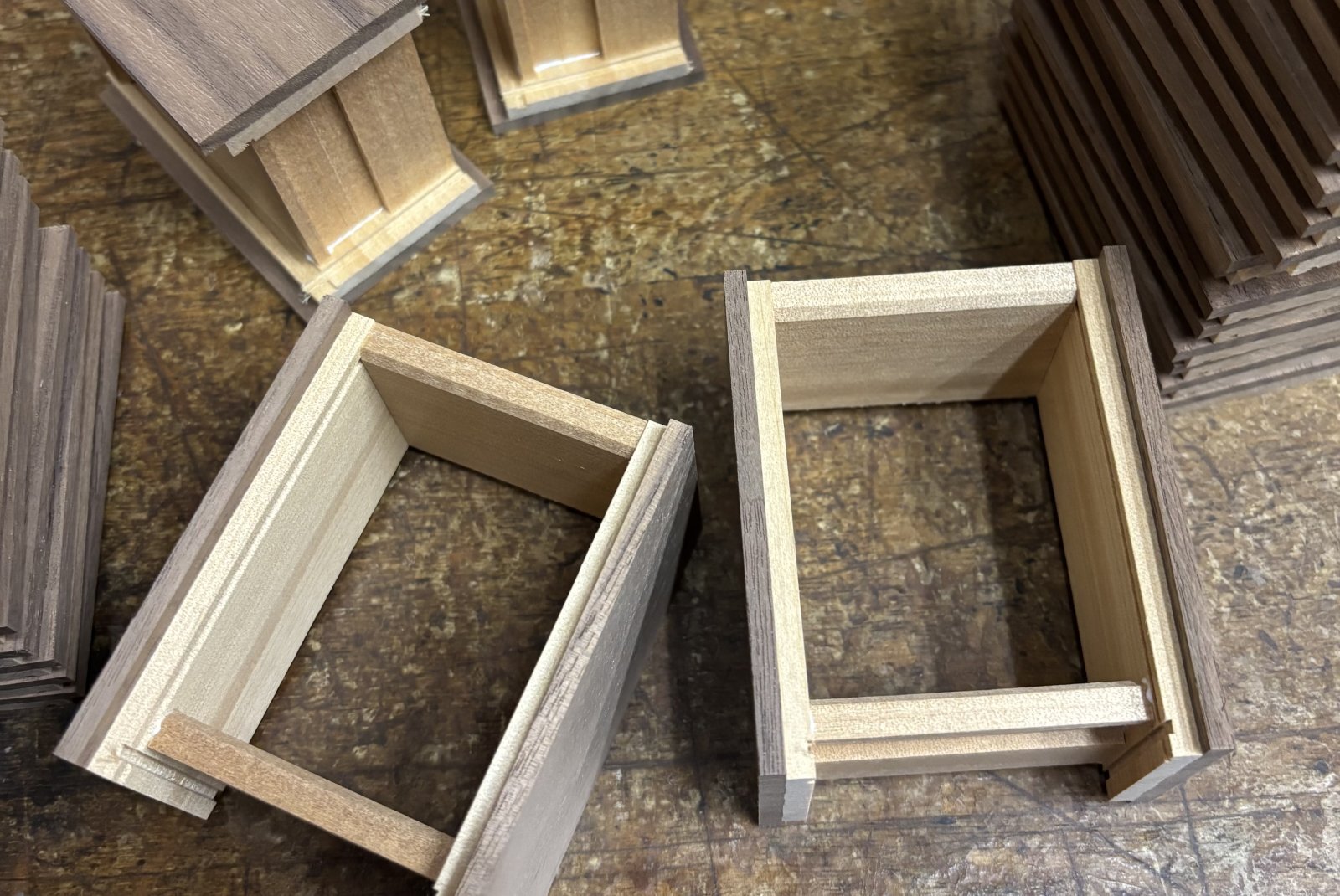
Today, I started working on the 3-sun 7-step puzzle boxes. The preparation had already been completed, so today I made and assembled the frame panels. The mechanism is relatively simple because it opens in seven steps. The photo shows the frame being assembled. One feature of this box is that the axis panel on one side extends to the top of the long side panel, and the mechanism is only built on that side. Since no mechanism is attached to this fixed panel, I do not need to worry about adjusting its movement. However, attaching it perfectly straight is a little difficult. A puzzle box has two axis panels that support the box. Normally, they are attached slightly inside the edges of the long side panels to leave enough space for the Aruki panels. On this box, however, one of the axis panels is attached very close to the outer edge, as shown in the photo. This part is fixed to the long side panel with glue, so I must carefully make sure that it stays exactly at the edge. If it moves even slightly inward, a gap will be visible from above when the outer decorative panel, such as a panel covered with a Yosegi sheet, is attached later. This would prevent the box from having a clean and beautiful finish. However, this axis panel often tends to tilt slightly inward or outward during assembly.
During assembly, I place a ruler against the axis panel to keep it exactly at the edge. However, if a small piece of wood dust gets between the ruler and the panel, the axis panel may tilt inward. If some glue comes out from the panel and sticks to the ruler, the panel may be pulled outward when I remove the ruler. This does not always happen, but it happens fairly easily. For this reason, I first use a little less glue on this axis panel. You may think this could reduce its strength because the axis panel normally needs to be firmly glued. However, when I later attach the outer decorative panel, I can glue the axis panel and the long side panel together again. This adds enough strength. Since this is a fixed panel, all the parts in this area can be firmly glued together without affecting the mechanism. This is one of the special points to consider when making a 7-step puzzle box.
Today, I started working on the 3-sun 7-step puzzle boxes. The preparation had already been completed, so today I made and assembled the frame panels. The mechanism is relatively simple because it opens in seven steps. The photo shows the frame being assembled. One feature of this box is that the axis panel on one side extends to the top of the long side panel, and the mechanism is only built on that side. Since no mechanism is attached to this fixed panel, I do not need to worry about adjusting its movement. However, attaching it perfectly straight is a little difficult. A puzzle box has two axis panels that support the box. Normally, they are attached slightly inside the edges of the long side panels to leave enough space for the Aruki panels. On this box, however, one of the axis panels is attached very close to the outer edge, as shown in the photo. This part is fixed to the long side panel with glue, so I must carefully make sure that it stays exactly at the edge. If it moves even slightly inward, a gap will be visible from above when the outer decorative panel, such as a panel covered with a Yosegi sheet, is attached later. This would prevent the box from having a clean and beautiful finish. However, this axis panel often tends to tilt slightly inward or outward during assembly.
During assembly, I place a ruler against the axis panel to keep it exactly at the edge. However, if a small piece of wood dust gets between the ruler and the panel, the axis panel may tilt inward. If some glue comes out from the panel and sticks to the ruler, the panel may be pulled outward when I remove the ruler. This does not always happen, but it happens fairly easily. For this reason, I first use a little less glue on this axis panel. You may think this could reduce its strength because the axis panel normally needs to be firmly glued. However, when I later attach the outer decorative panel, I can glue the axis panel and the long side panel together again. This adds enough strength. Since this is a fixed panel, all the parts in this area can be firmly glued together without affecting the mechanism. This is one of the special points to consider when making a 7-step puzzle box.