Box Size and Sliding-Key Width
It was sunny again from early this morning. I went out for a while in the afternoon, and it was a refreshing autumn day. However, the weather is expected to gradually worsen again from tonight. Fortunately, the timing was just right yesterday and today, allowing me to make and attach the Aruki sliding panels and the sliding-key panels for the boxes currently in production.
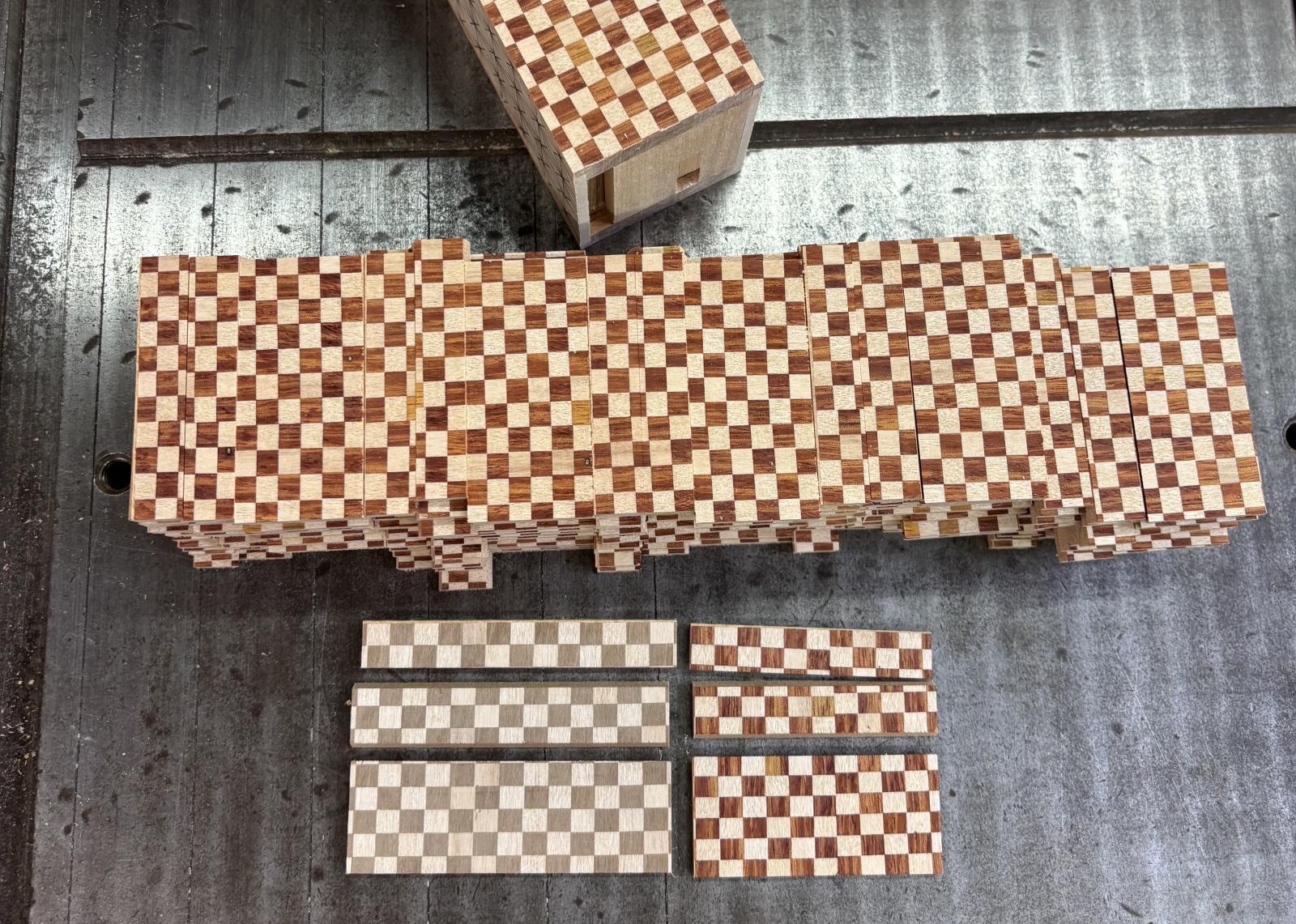
Since I am making only a small number of these boxes, I was able to make the sliding-key panels and machine the box bodies in a single day. The photo shows the sliding-key panels I made this time. As I wrote yesterday, this box has the same height as a 4-sun box, so the aruki panels are also the same thickness. However, the box is narrower, making its proportions closer to those of a 2.5-sun box. I originally planned to make the sliding-key panels the same width as those used for a 4-sun box. However, once I began making them, I felt that they might look slightly too wide. Since the height of the box is the same as a 4-sun box, using the same width would not cause any functional problems. However, because the box itself is narrow, I thought the proportions might not look quite right. In other words, the vertical width of the sliding keys might appear too large in relation to the narrow width of the box.
After checking the dimensions again, I found that it was possible to use sliding-key panels with the same width as those used for a 3-sun box. Whether this is possible depends on the height of the box. When the box height changes, the position of the notch in the aruki panel that holds the small wooden piece called the bocchi also moves slightly up or down. Of the three sections that make up the sliding-key panel, the middle section—the key that actually slides sideways—must be positioned so that it completely covers both the bocchi and its notch. If the height of the box is very different, the position of this key will also change considerably. In this case, however, I found that even with the height of a 4-sun box, the narrower sliding-key panel used for a 3-sun box could just cover the required area. I had never encountered this situation before, so it was a new discovery for me! 😁 I think this was possible mainly because the narrow fixed section at the top of the three-part sliding-key panel has the same vertical width on both the 3-sun and 4-sun versions. In the photo, the smaller panel (for this box) may appear to have a narrower top section because it is being compared with the larger panel (for 4-sun size box), but they are actually the same width. With that issue resolved, I successfully finished attaching the panels to one side today. Since the weather has remained dry since yesterday, I chose the side with the smaller bonding area.
Have a nice weekend!
Since I am making only a small number of these boxes, I was able to make the sliding-key panels and machine the box bodies in a single day. The photo shows the sliding-key panels I made this time. As I wrote yesterday, this box has the same height as a 4-sun box, so the aruki panels are also the same thickness. However, the box is narrower, making its proportions closer to those of a 2.5-sun box. I originally planned to make the sliding-key panels the same width as those used for a 4-sun box. However, once I began making them, I felt that they might look slightly too wide. Since the height of the box is the same as a 4-sun box, using the same width would not cause any functional problems. However, because the box itself is narrow, I thought the proportions might not look quite right. In other words, the vertical width of the sliding keys might appear too large in relation to the narrow width of the box.
After checking the dimensions again, I found that it was possible to use sliding-key panels with the same width as those used for a 3-sun box. Whether this is possible depends on the height of the box. When the box height changes, the position of the notch in the aruki panel that holds the small wooden piece called the bocchi also moves slightly up or down. Of the three sections that make up the sliding-key panel, the middle section—the key that actually slides sideways—must be positioned so that it completely covers both the bocchi and its notch. If the height of the box is very different, the position of this key will also change considerably. In this case, however, I found that even with the height of a 4-sun box, the narrower sliding-key panel used for a 3-sun box could just cover the required area. I had never encountered this situation before, so it was a new discovery for me! 😁 I think this was possible mainly because the narrow fixed section at the top of the three-part sliding-key panel has the same vertical width on both the 3-sun and 4-sun versions. In the photo, the smaller panel (for this box) may appear to have a narrower top section because it is being compared with the larger panel (for 4-sun size box), but they are actually the same width. With that issue resolved, I successfully finished attaching the panels to one side today. Since the weather has remained dry since yesterday, I chose the side with the smaller bonding area.
Have a nice weekend!