Was an Anti-Warping Method Necessary?
The weather changed completely today, and it became a sunny and hot day. It was not as hot as midsummer, but perhaps this was the clear weather that often follows a typhoon. The temperature rose to around 30°C (86°F). October begins today, and autumn will gradually deepen, bringing more comfortable weather. The heat was still a little tiring during the day, but I started making the Aruki panels for the puzzle boxes currently in production.
This puzzle box is a special order, so its size is slightly different from my usual boxes. However, I designed the internal mechanism to be as similar as possible to that of a 4-sun puzzle box. Because the box is very narrow, the sideways movement is similar in distance to that of a 3-sun or 2.5-sun puzzle box.As this is a 14-step puzzle box, it has two Aruki sliding panels on the sides and one Aruki panel on the top that works as the lid. For a box of this size, I would normally make the side Aruki panels about 5 mm thick, as I do for a 3-sun box. However, because this mechanism is based on the 4-sun box, I made them 6 mm thick this time. A wooden panel of this size with a thickness of 6 mm is stable, and its movement is easy to adjust during production. However—and this is one of my little trade secrets—if the movement of a sliding key panel needs to be corrected later, a panel of this size can be rather difficult to readjust. The special adjustment method I use is closely connected to the thickness of the Aruki panel. I also consider this when deciding the usual dimensions of my puzzle boxes.
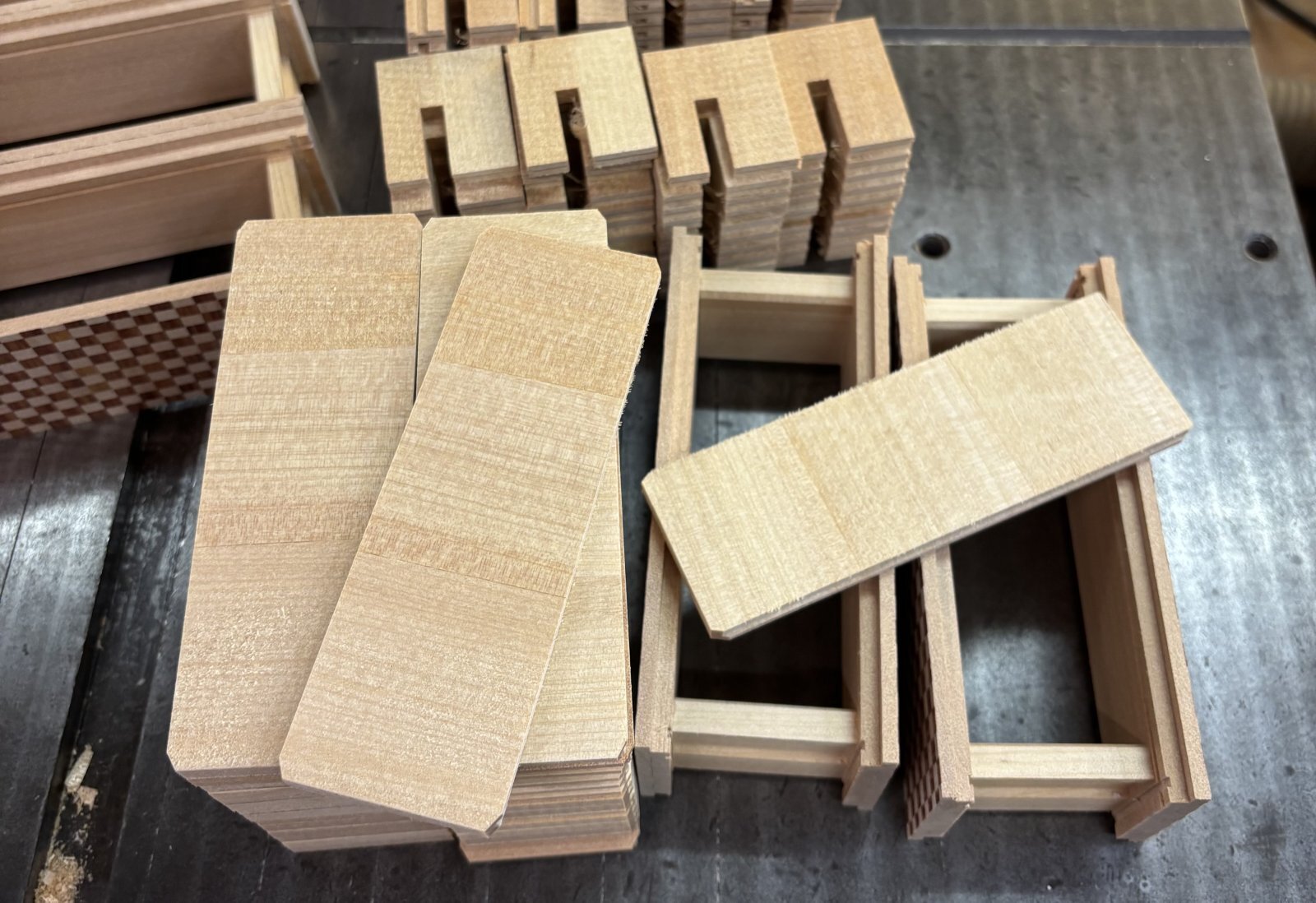
Another part I thought carefully about this time was the top Aruki panel shown in the photo. It is about as long as the panel of a 5-sun puzzle box, but because it is narrow, it has a long and slim shape. For a normal 5-sun puzzle box, I use a technique called Hashibami for the top Aruki panel. This method helps prevent a larger panel from warping and is usually used for puzzle boxes of 5-sun or larger. One board is divided into three parts, and the grain direction of the parts is changed to help keep the panel flat. This box is about 1 cm longer than a 5-sun box, so I considered whether I should use the same anti-warp method. A long panel like this can warp relatively easily when all the grain runs in one direction. In the end, I decided to make it in the same way as the single-panel type used for a 4-sun box. Although I call it a single panel, it is actually made by joining two or three pieces of wood together, so it should be less likely to warp than a panel made from one solid piece. After making it and attaching it to the box, I found that its narrow width gave it good stability. It seems unlikely to warp, and the movement feels very good. If the panel had been thinner, I think it would have been much less stable. With this movement, I felt that the top panel would hold everything firmly in place. Because I have made puzzle boxes in many different sizes, I can feel the stability of the movement when I attach an Aruki panel.
This puzzle box is a special order, so its size is slightly different from my usual boxes. However, I designed the internal mechanism to be as similar as possible to that of a 4-sun puzzle box. Because the box is very narrow, the sideways movement is similar in distance to that of a 3-sun or 2.5-sun puzzle box.As this is a 14-step puzzle box, it has two Aruki sliding panels on the sides and one Aruki panel on the top that works as the lid. For a box of this size, I would normally make the side Aruki panels about 5 mm thick, as I do for a 3-sun box. However, because this mechanism is based on the 4-sun box, I made them 6 mm thick this time. A wooden panel of this size with a thickness of 6 mm is stable, and its movement is easy to adjust during production. However—and this is one of my little trade secrets—if the movement of a sliding key panel needs to be corrected later, a panel of this size can be rather difficult to readjust. The special adjustment method I use is closely connected to the thickness of the Aruki panel. I also consider this when deciding the usual dimensions of my puzzle boxes.
Another part I thought carefully about this time was the top Aruki panel shown in the photo. It is about as long as the panel of a 5-sun puzzle box, but because it is narrow, it has a long and slim shape. For a normal 5-sun puzzle box, I use a technique called Hashibami for the top Aruki panel. This method helps prevent a larger panel from warping and is usually used for puzzle boxes of 5-sun or larger. One board is divided into three parts, and the grain direction of the parts is changed to help keep the panel flat. This box is about 1 cm longer than a 5-sun box, so I considered whether I should use the same anti-warp method. A long panel like this can warp relatively easily when all the grain runs in one direction. In the end, I decided to make it in the same way as the single-panel type used for a 4-sun box. Although I call it a single panel, it is actually made by joining two or three pieces of wood together, so it should be less likely to warp than a panel made from one solid piece. After making it and attaching it to the box, I found that its narrow width gave it good stability. It seems unlikely to warp, and the movement feels very good. If the panel had been thinner, I think it would have been much less stable. With this movement, I felt that the top panel would hold everything firmly in place. Because I have made puzzle boxes in many different sizes, I can feel the stability of the movement when I attach an Aruki panel.