Gluing Two Panels Together
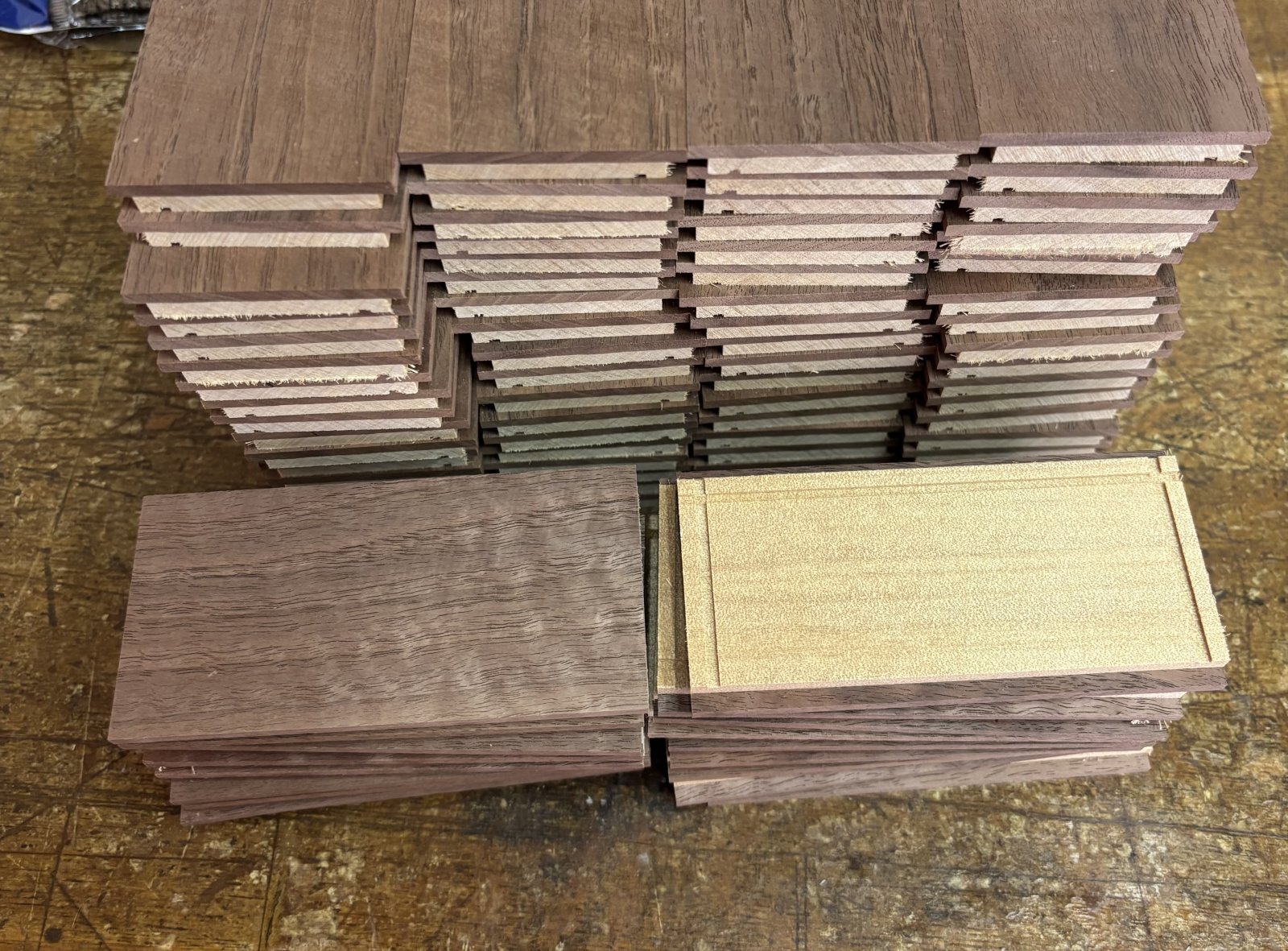
It has been hot since this morning. Today is the last day of July, but it already feels like the peak of summer. With another month or two of this heat still ahead, I think the best thing to do is not to push ourselves too hard. I went out for a while this afternoon, so I only worked during the morning today. I did not get much done, but I made the long side panels for the 4-sun 14-step and 12-step puzzle boxes.
I adjusted the length of the panels that had already been prepared and held in a vise, and then cut the grooves for the Aruki panels(photo).This time, I am making the Walnut design, so the wood attached to the Agathis core is Walnut. In my experience, panels made by combining two different kinds of wood seem more likely to warp than panels made from two pieces of the same wood. I think this is because the two woods have different physical properties, such as hardness and density. One way to compare woods is by their specific gravity, which compares the weight of the wood to the same volume of water. The higher the value, the heavier and harder the wood. Walnut has a specific gravity of about 0.60, while Agathis is around 0.45. Although the numbers may seem close, when you actually handle the wood, you can clearly feel that they are very different materials. In this case, the harder Walnut tends to pull the softer Agathis as the panel changes shape. Harder wood also exerts more force when it warps. For that reason, even though these panels have not yet been assembled into the boxes, I keep them tightly clamped in a vise to prevent unnecessary warping.
Basically, whenever two pieces of wood are glued together, the panel begins to warp. A board that was originally stable is suddenly bonded with glue to another piece of wood with different properties, so it is no longer able to remain perfectly stable...haha. This is even more noticeable when both pieces have their grain running in the same direction. Plywood avoids this problem by crossing the grain. To do that, however, you need three layers, with the middle layer rotated 90 degrees so that the forces balance each other and reduce warping. In this case, I am using only two layers, so that is not possible. That is why it is important to let the panels dry thoroughly and to be careful about how the glue is applied. The key is not to use too much glue. You might think this would make the panel weaker, but as long as the glue is applied to the important areas, it will not come apart. Even so, if you tried to separate the pieces, the wood itself would almost certainly split before the glue failed. Modern adhesives are actually so strong that they have made repairing traditional puzzle boxes more difficult than in the past. Years ago, craftsmen used animal glue, which allowed the panels to be removed more easily, making it possible to repair old puzzle boxes.
Have a great weekend!
I adjusted the length of the panels that had already been prepared and held in a vise, and then cut the grooves for the Aruki panels(photo).This time, I am making the Walnut design, so the wood attached to the Agathis core is Walnut. In my experience, panels made by combining two different kinds of wood seem more likely to warp than panels made from two pieces of the same wood. I think this is because the two woods have different physical properties, such as hardness and density. One way to compare woods is by their specific gravity, which compares the weight of the wood to the same volume of water. The higher the value, the heavier and harder the wood. Walnut has a specific gravity of about 0.60, while Agathis is around 0.45. Although the numbers may seem close, when you actually handle the wood, you can clearly feel that they are very different materials. In this case, the harder Walnut tends to pull the softer Agathis as the panel changes shape. Harder wood also exerts more force when it warps. For that reason, even though these panels have not yet been assembled into the boxes, I keep them tightly clamped in a vise to prevent unnecessary warping.
Basically, whenever two pieces of wood are glued together, the panel begins to warp. A board that was originally stable is suddenly bonded with glue to another piece of wood with different properties, so it is no longer able to remain perfectly stable...haha. This is even more noticeable when both pieces have their grain running in the same direction. Plywood avoids this problem by crossing the grain. To do that, however, you need three layers, with the middle layer rotated 90 degrees so that the forces balance each other and reduce warping. In this case, I am using only two layers, so that is not possible. That is why it is important to let the panels dry thoroughly and to be careful about how the glue is applied. The key is not to use too much glue. You might think this would make the panel weaker, but as long as the glue is applied to the important areas, it will not come apart. Even so, if you tried to separate the pieces, the wood itself would almost certainly split before the glue failed. Modern adhesives are actually so strong that they have made repairing traditional puzzle boxes more difficult than in the past. Years ago, craftsmen used animal glue, which allowed the panels to be removed more easily, making it possible to repair old puzzle boxes.
Have a great weekend!