Choosing the Right Backing Board
Although August has already begun, today is the first weekday of the month. Yesterday was extremely hot—probably the hottest day we have had in quite a while. Today, however, is completely different and has been much cooler. Of course, "cooler" still means a high of around 29°C (84°F), but after the intense heat we have been having recently, it certainly feels much more comfortable.
Today I continued working on the 4-sun 14-step puzzle boxes. I completed everything from making the Aruki panels to attaching the top and bottom panels. This production batch also includes some 12-step puzzle boxes. A few days ago, I wrote that the difference between the 12-step and 14-step mechanisms is very small, allowing them to be made at the same time. The Aruki panels for both versions are also made and attached in the same process. The 12-step boxes in this batch are made-to-order and will have natural wood top and bottom panels, but those parts are not ready yet. So, after attaching the Aruki panels, I will set the 12-step boxes aside for now. From this point on, I will continue working only on the 14-step boxes.
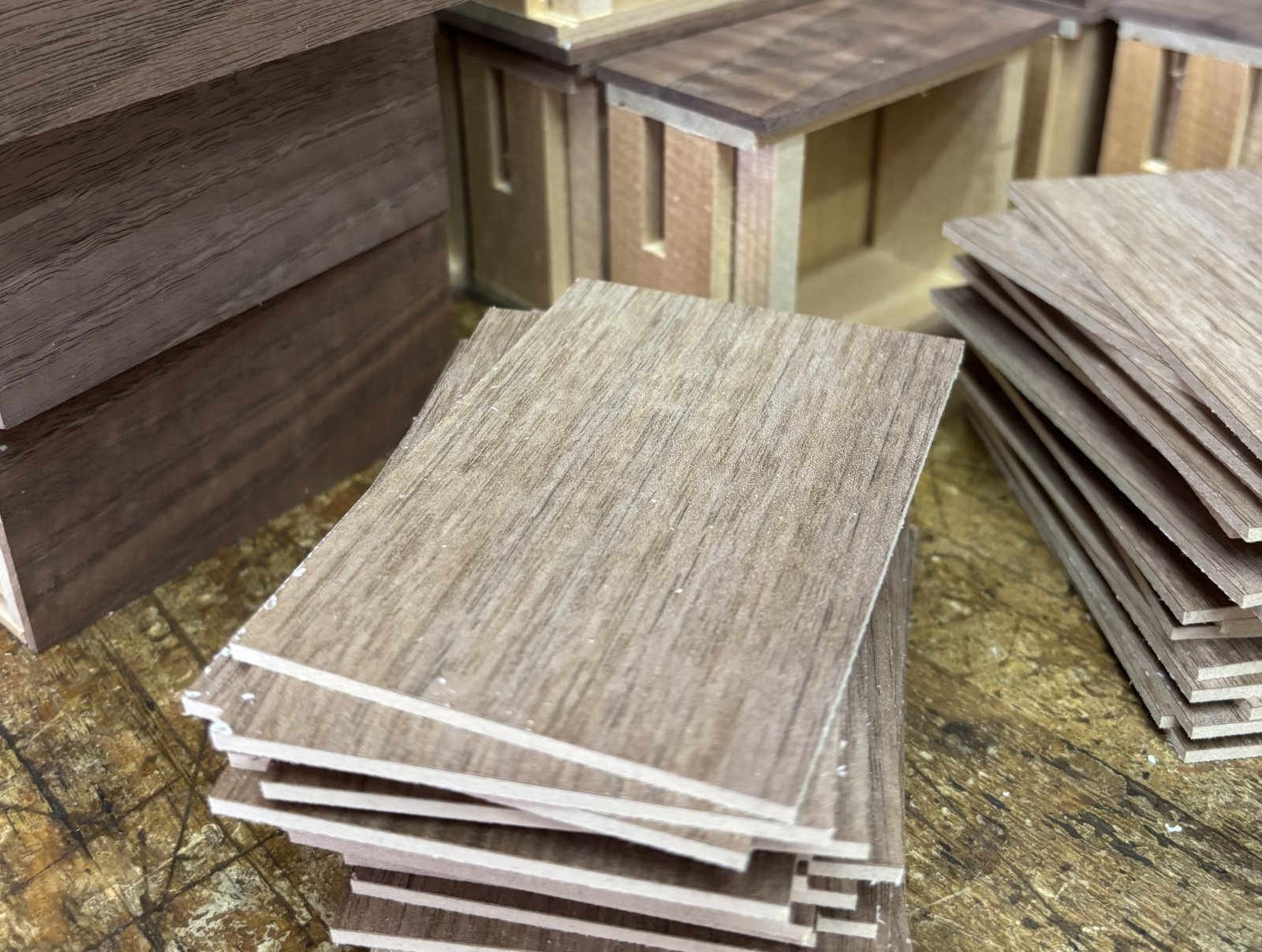
The photo shows the top and bottom panels covered with Walnut veneer. These panels are not made from a single solid piece of wood. Instead, they are made by attaching a thin slice of natural Walnut to a backing panel. In the past, I used plywood made from Basswood (Shina) as the backing material, but recently I have been using MDF board instead. Both materials have their advantages, but I find MDF easier to work with. Basswood plywood produces beautiful colors when Yosegi veneer is applied because it is a very light-colored wood. Since Yosegi veneer is extremely thin, the color of the backing shows through slightly, so a white backing looks better than the brown color of MDF. However, one of the biggest drawbacks of Basswood plywood is that it is more likely to develop mold. Solid wood naturally absorbs and releases moisture, which helps prevent mold from growing. Plywood, on the other hand, exchanges much less moisture with the air, so areas that are touched by hand can become more prone to mold. MDF is also an engineered board, but Basswood plywood seems to have this problem more often. For that reason, as well as its ease of use, I now mainly use MDF board.
Today I continued working on the 4-sun 14-step puzzle boxes. I completed everything from making the Aruki panels to attaching the top and bottom panels. This production batch also includes some 12-step puzzle boxes. A few days ago, I wrote that the difference between the 12-step and 14-step mechanisms is very small, allowing them to be made at the same time. The Aruki panels for both versions are also made and attached in the same process. The 12-step boxes in this batch are made-to-order and will have natural wood top and bottom panels, but those parts are not ready yet. So, after attaching the Aruki panels, I will set the 12-step boxes aside for now. From this point on, I will continue working only on the 14-step boxes.
The photo shows the top and bottom panels covered with Walnut veneer. These panels are not made from a single solid piece of wood. Instead, they are made by attaching a thin slice of natural Walnut to a backing panel. In the past, I used plywood made from Basswood (Shina) as the backing material, but recently I have been using MDF board instead. Both materials have their advantages, but I find MDF easier to work with. Basswood plywood produces beautiful colors when Yosegi veneer is applied because it is a very light-colored wood. Since Yosegi veneer is extremely thin, the color of the backing shows through slightly, so a white backing looks better than the brown color of MDF. However, one of the biggest drawbacks of Basswood plywood is that it is more likely to develop mold. Solid wood naturally absorbs and releases moisture, which helps prevent mold from growing. Plywood, on the other hand, exchanges much less moisture with the air, so areas that are touched by hand can become more prone to mold. MDF is also an engineered board, but Basswood plywood seems to have this problem more often. For that reason, as well as its ease of use, I now mainly use MDF board.