Top Panel Warping and Prevention
The rain that started last night continued all day today. I saw the news saying that the rainy season has entered its second half, but this kind of weather will probably continue until around the middle of this month. The humidity was a little high today, but I started the finishing work on the 4-compartment box in the morning. I have been making this box again since last month after a long time, and there were several moments when I remembered how I made it before. I also clearly remembered the work of rounding the corners during the finishing process. Unlike a usual Japanese puzzle box, this box has sliding keys that can move in either direction when working on the corners. I handled them in the same way I used to do before. The finishing work was completed safely, and in the afternoon I was able to apply the undercoat.
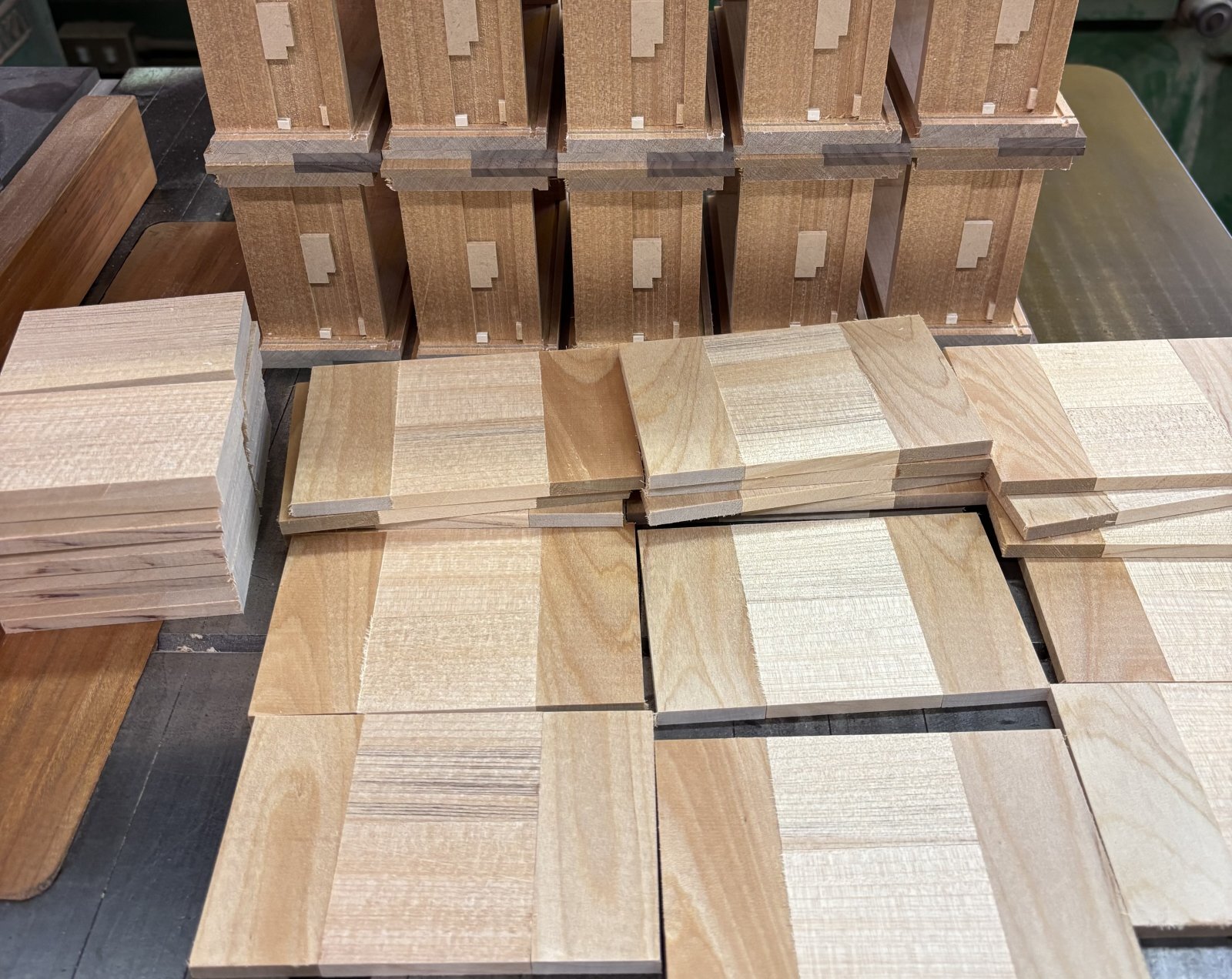
I also prepared the Aruki sliding panels for the 5-sun 7-steps puzzle boxes. Since these are 5-sun boxes, I use a method called Hashibami for the top Aruki panels. As you can see in the photo, two pieces of wood are attached to the left and right sides of one board, with the wood grain crossing in a different direction. This helps make the panel less likely to warp or twist. This method has been used for boxes around 5-sun size and larger for a long time, and it seems to have a certain effect. When making the top Aruki panels for the next smaller size, 4-sun boxes, this method is not used. But during the work, if I stack those panels for a while, I can see that the boards gradually start to warp. Of course, it is not good if they warp too much, so I put a weight on top of them. But these 5-sun panels do not warp at all, even if I leave them as they are. So I think this method really does work. This is not only for this box. It takes one extra step, but when making larger panels, I think it is a good method to use. I will leave these panels as they are today until the glue is completely dry, and I will do the detailed work tomorrow or later.
However, this does not mean that it is okay for 4-sun boxes to warp. So, as I wrote before, I use a method of making one panel from two pieces of wood. Still, the effect is not as strong as Hashibami, so I also expect the top panel to help stop the Aruki panel from warping. Of course, this is also true for 5-sun boxes. The wood grain direction of the top panel crosses the wood grain direction of the Aruki panel underneath, so they do not warp in the same direction. In other words, the wood grain becomes like a cross. That alone has some effect, but in recent years I have been using plywood for the top panels with yosegi attached to them, so I think the effect of preventing warping is even stronger. When I see old boxes where the top panel has become hard to move, in many cases the yosegi panel is warped upward. The stiff movement often seems to be caused by this warping. If I shave the foot part of the panel a little, where the sliding parts fit together, or slightly press the wood down, the movement sometimes becomes better.I think some other measures are also needed for 4-sun boxes.If possible, I think the best way would be to make them like the 5-sun boxes, but...🤔
I also prepared the Aruki sliding panels for the 5-sun 7-steps puzzle boxes. Since these are 5-sun boxes, I use a method called Hashibami for the top Aruki panels. As you can see in the photo, two pieces of wood are attached to the left and right sides of one board, with the wood grain crossing in a different direction. This helps make the panel less likely to warp or twist. This method has been used for boxes around 5-sun size and larger for a long time, and it seems to have a certain effect. When making the top Aruki panels for the next smaller size, 4-sun boxes, this method is not used. But during the work, if I stack those panels for a while, I can see that the boards gradually start to warp. Of course, it is not good if they warp too much, so I put a weight on top of them. But these 5-sun panels do not warp at all, even if I leave them as they are. So I think this method really does work. This is not only for this box. It takes one extra step, but when making larger panels, I think it is a good method to use. I will leave these panels as they are today until the glue is completely dry, and I will do the detailed work tomorrow or later.
However, this does not mean that it is okay for 4-sun boxes to warp. So, as I wrote before, I use a method of making one panel from two pieces of wood. Still, the effect is not as strong as Hashibami, so I also expect the top panel to help stop the Aruki panel from warping. Of course, this is also true for 5-sun boxes. The wood grain direction of the top panel crosses the wood grain direction of the Aruki panel underneath, so they do not warp in the same direction. In other words, the wood grain becomes like a cross. That alone has some effect, but in recent years I have been using plywood for the top panels with yosegi attached to them, so I think the effect of preventing warping is even stronger. When I see old boxes where the top panel has become hard to move, in many cases the yosegi panel is warped upward. The stiff movement often seems to be caused by this warping. If I shave the foot part of the panel a little, where the sliding parts fit together, or slightly press the wood down, the movement sometimes becomes better.I think some other measures are also needed for 4-sun boxes.If possible, I think the best way would be to make them like the 5-sun boxes, but...🤔