Balancing Movement and Support
Today was another very hot and humid day. By late afternoon, it looked as though it might rain. In fact, it rained again last night, and the moisture from the rain has kept the weather very humid. Today I mainly worked on the 4-sun 14-step puzzle boxes. I made and attached the Aruki sliding panels, and then I also made the top and bottom panels.
As I have mentioned many times before, when making Aruki panels, I prefer to use wood that is soft and slightly flexible. This is important for recreating the light, smooth movement that is characteristic of traditional Japanese puzzle boxes.For many years, Japanese Katsura wood was the traditional choice. However, high-quality material has become much harder to obtain, so today I mainly use Agathis from Southeast Asia. Today was another example of this. To recreate the smooth movement of a Japanese puzzle box, it is not only the material of the Aruki panels that matters. The material of the frame panels that support the Aruki panels is also very important. Ideally, the frame should have a certain amount of flexibility as well. However, if the wood is too soft or too light, it can cause other problems. For that reason, I try to choose Agathis with a medium hardness for the frame panels. Since I buy the wood in large quantities, not every piece has the ideal characteristics. Some sections are noticeably harder than others, and deciding where to use those pieces is always a challenge. The best place to use the harder wood is for the axis panels, because their performance is not affected as much by the wood's hardness. Even so, I cannot use all of the harder pieces there. In this batch, some of the slightly harder Agathis has also been used for the frame panels, specifically the long side panels.
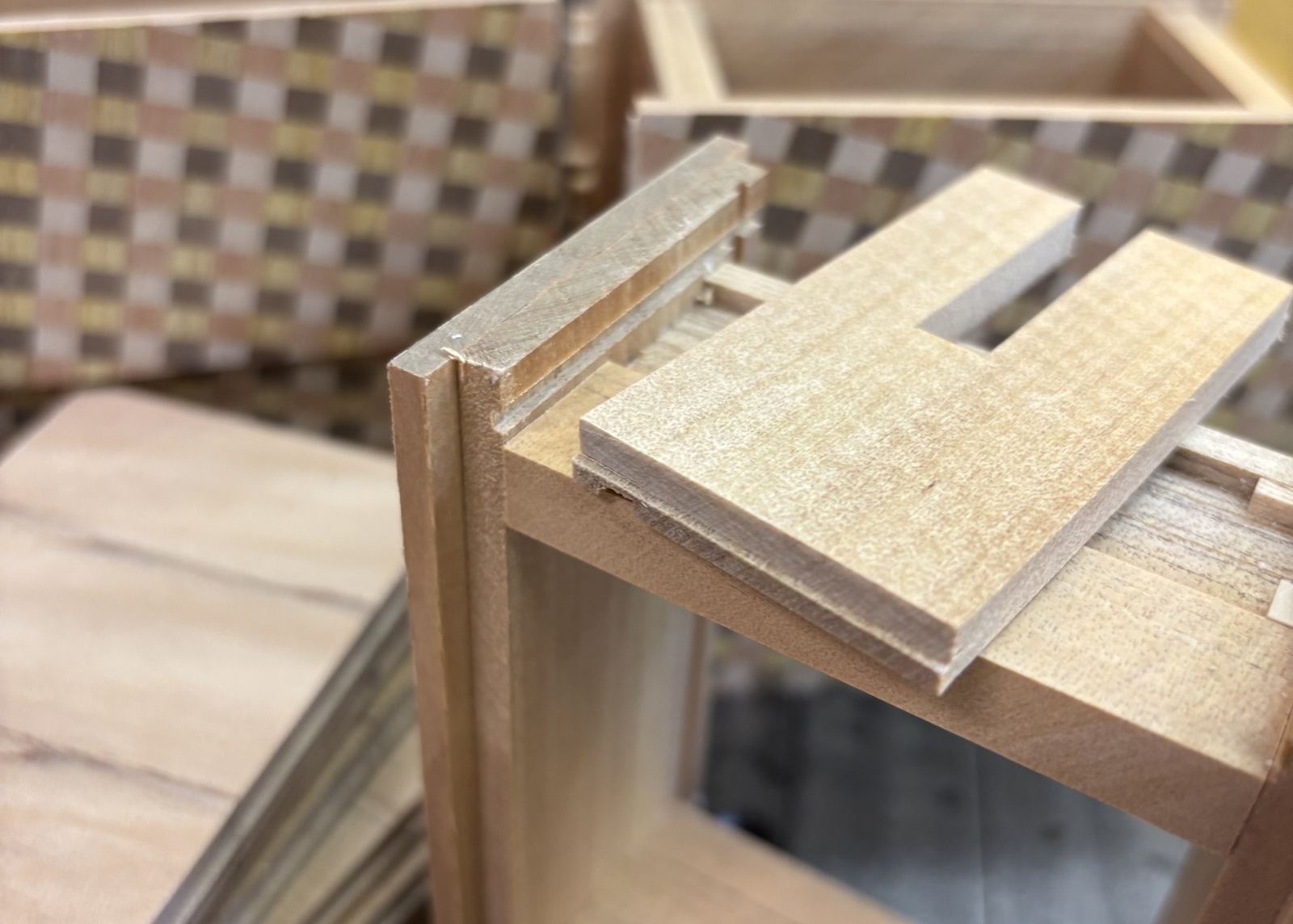
As you can see in the photo, grooves are cut into the body of the box, and the Aruki panels are fitted into these grooves so they can slide. A certain amount of flexibility in the wood is needed to achieve the smooth, natural movement of a Japanese puzzle box. This time, however, the grooves in the body were made from slightly harder wood, so they did not have quite enough flexibility. As a result, I had to rely more on the flexibility of the Aruki panels themselves, which made the adjustment a little more difficult. It does not mean that the finished movement will be poor, but it does mean that fitting and adjusting the panels takes a little more time. When both the Aruki panels and the frame have the right amount of flexibility, the fitting process goes much more smoothly. Of course, wood is a natural material, so it is impossible for every piece to have exactly the same characteristics. Instead, I try to use each piece where it is most suitable and rely on careful fitting and adjustment to achieve the best possible result.
Have a great weekend!
As I have mentioned many times before, when making Aruki panels, I prefer to use wood that is soft and slightly flexible. This is important for recreating the light, smooth movement that is characteristic of traditional Japanese puzzle boxes.For many years, Japanese Katsura wood was the traditional choice. However, high-quality material has become much harder to obtain, so today I mainly use Agathis from Southeast Asia. Today was another example of this. To recreate the smooth movement of a Japanese puzzle box, it is not only the material of the Aruki panels that matters. The material of the frame panels that support the Aruki panels is also very important. Ideally, the frame should have a certain amount of flexibility as well. However, if the wood is too soft or too light, it can cause other problems. For that reason, I try to choose Agathis with a medium hardness for the frame panels. Since I buy the wood in large quantities, not every piece has the ideal characteristics. Some sections are noticeably harder than others, and deciding where to use those pieces is always a challenge. The best place to use the harder wood is for the axis panels, because their performance is not affected as much by the wood's hardness. Even so, I cannot use all of the harder pieces there. In this batch, some of the slightly harder Agathis has also been used for the frame panels, specifically the long side panels.
As you can see in the photo, grooves are cut into the body of the box, and the Aruki panels are fitted into these grooves so they can slide. A certain amount of flexibility in the wood is needed to achieve the smooth, natural movement of a Japanese puzzle box. This time, however, the grooves in the body were made from slightly harder wood, so they did not have quite enough flexibility. As a result, I had to rely more on the flexibility of the Aruki panels themselves, which made the adjustment a little more difficult. It does not mean that the finished movement will be poor, but it does mean that fitting and adjusting the panels takes a little more time. When both the Aruki panels and the frame have the right amount of flexibility, the fitting process goes much more smoothly. Of course, wood is a natural material, so it is impossible for every piece to have exactly the same characteristics. Instead, I try to use each piece where it is most suitable and rely on careful fitting and adjustment to achieve the best possible result.
Have a great weekend!