Natural Wood Design
The weather has become hotter day by day this week, and today it truly felt like midsummer again. The temperature was only around 30°C, but when I went out for a while during the day, it felt much hotter. At first, I thought it might be too hot to do the finishing work. However, I did not want to leave the boxes waiting for too long, so I decided to complete the work quickly in the morning. It took a little longer than usual because this batch included a few custom orders with natural wood top and bottom panels, but I managed to finish everything before noon. These custom puzzle boxes have been requested repeatedly since last year, and I have made this design several times. As I mentioned before, I plan to stop accepting orders for puzzle boxes with natural wood top and bottom panels after this year, so this will probably be the last batch of this design. In the future, I may still make a small number as limited editions from time to time.
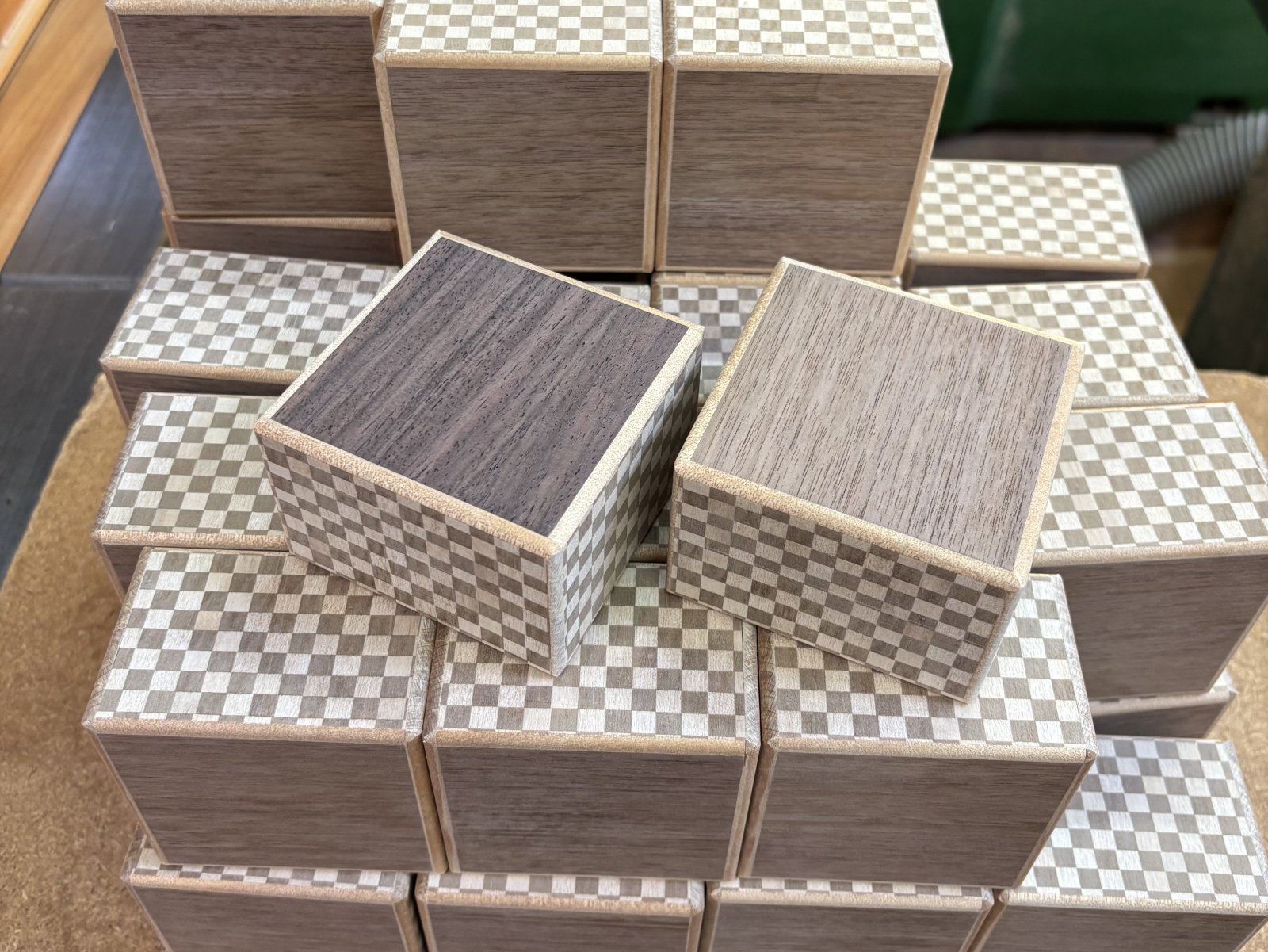
The main version in this batch of Square puzzle boxes is the one shown in the photo. You can see two different designs. The darker one uses Rosewood, and I made only one of those. The reason there is only one is that I had just enough Walnut panels for this batch, but a couple of them had defects in the grain. Instead of making new Walnut panels, I used a Rosewood panel that I had left over from an earlier project. This happens quite often. It is difficult to prepare exactly the right number of panels for every production run. Even if I do, one or two panels may have defects or other problems and cannot be used. Making replacements usually means producing more than I actually need, which leaves extra panels. Because of that, I always keep a few leftover panels from previous projects in my workshop. This time, I used some that were left over from an earlier batch of 4-sun puzzle boxes.
Looking at these boxes now, they may seem quite simple compared with the more decorative Yosegi patterns and natural wood designs that have become so familiar. However, many people actually prefer this simpler style. Twenty or thirty years ago, traditional Japanese Yosegi products were not commonly seen online, so they felt very new and unusual. At that time, puzzle boxes covered entirely with Yosegi were especially popular. Today, however, Yosegi can be found almost everywhere, so it is no longer as uncommon as it once was. Because of that, many people who are mainly interested in the mechanisms of Japanese puzzle boxes now ask for designs that highlight the beauty of the wood itself. Likewise, some people feel that a two-color checkered Yosegi pattern has a more traditional Japanese appearance than the brighter four-color version. Of course, this is simply a matter of personal taste, and neither style is more correct than the other. I hope to continue making designs like this in the future.
The main version in this batch of Square puzzle boxes is the one shown in the photo. You can see two different designs. The darker one uses Rosewood, and I made only one of those. The reason there is only one is that I had just enough Walnut panels for this batch, but a couple of them had defects in the grain. Instead of making new Walnut panels, I used a Rosewood panel that I had left over from an earlier project. This happens quite often. It is difficult to prepare exactly the right number of panels for every production run. Even if I do, one or two panels may have defects or other problems and cannot be used. Making replacements usually means producing more than I actually need, which leaves extra panels. Because of that, I always keep a few leftover panels from previous projects in my workshop. This time, I used some that were left over from an earlier batch of 4-sun puzzle boxes.
Looking at these boxes now, they may seem quite simple compared with the more decorative Yosegi patterns and natural wood designs that have become so familiar. However, many people actually prefer this simpler style. Twenty or thirty years ago, traditional Japanese Yosegi products were not commonly seen online, so they felt very new and unusual. At that time, puzzle boxes covered entirely with Yosegi were especially popular. Today, however, Yosegi can be found almost everywhere, so it is no longer as uncommon as it once was. Because of that, many people who are mainly interested in the mechanisms of Japanese puzzle boxes now ask for designs that highlight the beauty of the wood itself. Likewise, some people feel that a two-color checkered Yosegi pattern has a more traditional Japanese appearance than the brighter four-color version. Of course, this is simply a matter of personal taste, and neither style is more correct than the other. I hope to continue making designs like this in the future.