About the 7-Step Mechanism
Today, like yesterday, it did not rain, but the weather was not very good, and the humidity has been getting higher. My plan yesterday was to attach the panel on one more side of the 4-compartment box today, so I did that work first. With this, the assembly of this box is finished. It looks like it will rain tomorrow, so I will watch the weather and decide whether to start the finishing work or not. So far, the making of the 4-compartment box, which I have not made for a long time, has been going fairly smoothly. I am aiming to finish it this weekend.
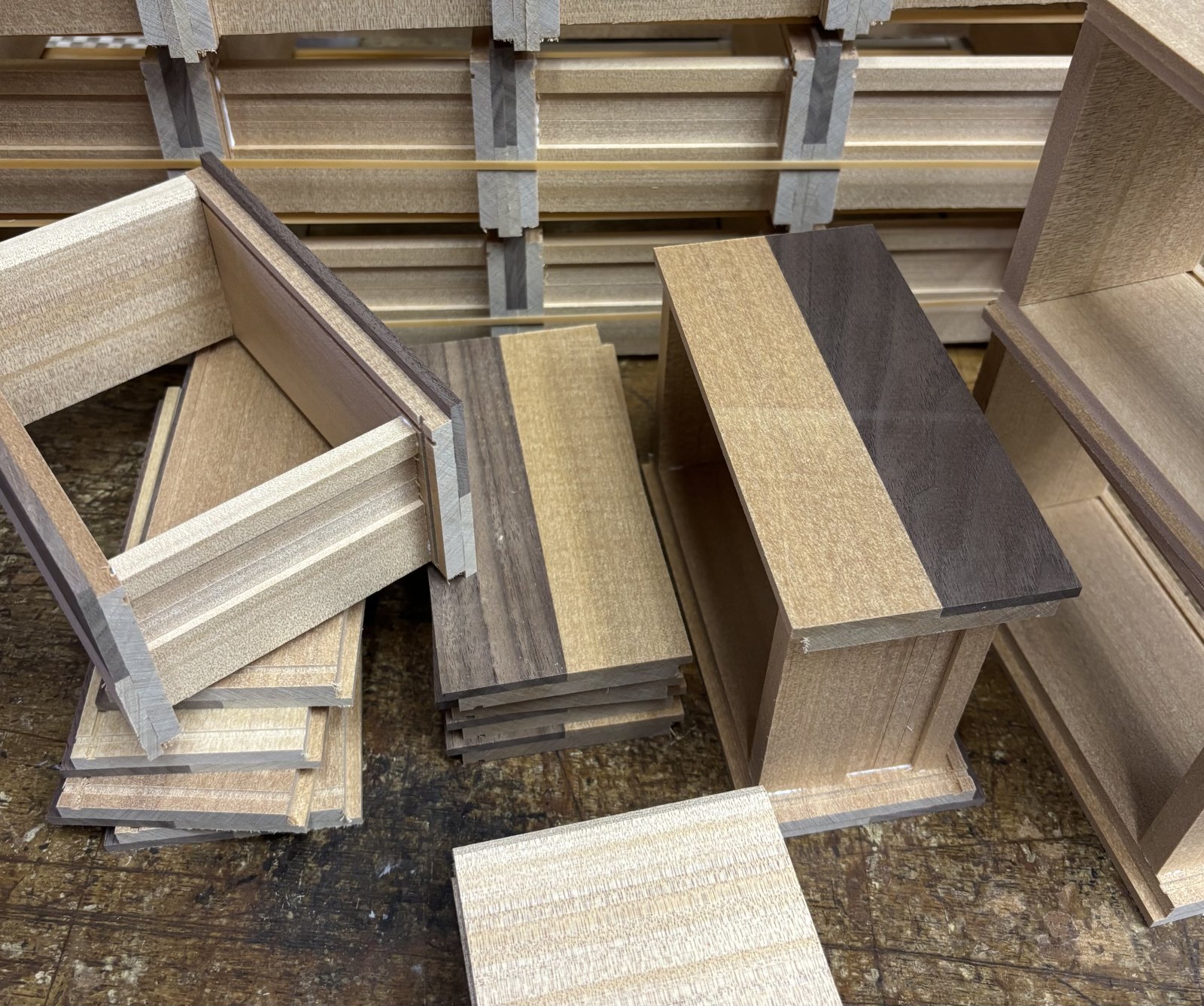
After that, I worked on making and assembling 5-sun 7-steps puzzle boxes. I prepared all the materials and made the axis panels. I had already prepared the side panels the other day, so today I removed them from the vise, where they had been pressed for a long time, and worked on them as well. The parts are shared with the 4-sun boxes, so I already had them in stock. Today, I assembled the frame parts and attached the parts. This time I am only making 20 boxes, so I think the work will move along fairly quickly. The photo shows the box during this assembly work. The 7-steps mechanism has a sliding key panel on only one side, so the structure is not very complicated. The parts are also attached to only one axis panel.
I am not sure if this type of 7-steps mechanism has been made since long ago. But from what I heard from a craftsman who has passed away, this kind of one-side sliding 7-steps mechanism seems to have started being made more recently, maybe within the last 20 years or so. I was told that the traditional 7-steps mechanism has Aruki panels on two sides, and the top Aruki moves as part of the mechanism. However, I have never heard the exact structure. When I think about it, if the model has sliding keys on both sides, the number of steps does not seem to match. In other words, it feels like it would become either a 10-steps,8-steps or 6-steps mechanism. If so, there may be only one way to make it work. One side would have a single board panel without a sliding key, and the side with the sliding key would move 5 steps. Then the lid would open in 7 steps. Is this the traditional 7-steps mechanism? I am not sure. There is also another way. I have done this before, for example when making a 9-steps mechanism. Instead of moving the sliding key first in the usual way, the panel is moved down first, and then the sliding key is moved. By using this kind of order, it can become a 7-steps mechanism. I have not made this type recently, but I often used this method when I first started making Japanese puzzle boxes. By doing this, I could make a different number of steps from the ones that were commonly sold. By the way, this one-side 7-steps mechanism comes from the 10-steps puzzle box with a drawer that I first used as a reference, but without the drawer part. At first, I could not make the version with a drawer, so I often made this 7-steps mechanism as practice.
After that, I worked on making and assembling 5-sun 7-steps puzzle boxes. I prepared all the materials and made the axis panels. I had already prepared the side panels the other day, so today I removed them from the vise, where they had been pressed for a long time, and worked on them as well. The parts are shared with the 4-sun boxes, so I already had them in stock. Today, I assembled the frame parts and attached the parts. This time I am only making 20 boxes, so I think the work will move along fairly quickly. The photo shows the box during this assembly work. The 7-steps mechanism has a sliding key panel on only one side, so the structure is not very complicated. The parts are also attached to only one axis panel.
I am not sure if this type of 7-steps mechanism has been made since long ago. But from what I heard from a craftsman who has passed away, this kind of one-side sliding 7-steps mechanism seems to have started being made more recently, maybe within the last 20 years or so. I was told that the traditional 7-steps mechanism has Aruki panels on two sides, and the top Aruki moves as part of the mechanism. However, I have never heard the exact structure. When I think about it, if the model has sliding keys on both sides, the number of steps does not seem to match. In other words, it feels like it would become either a 10-steps,8-steps or 6-steps mechanism. If so, there may be only one way to make it work. One side would have a single board panel without a sliding key, and the side with the sliding key would move 5 steps. Then the lid would open in 7 steps. Is this the traditional 7-steps mechanism? I am not sure. There is also another way. I have done this before, for example when making a 9-steps mechanism. Instead of moving the sliding key first in the usual way, the panel is moved down first, and then the sliding key is moved. By using this kind of order, it can become a 7-steps mechanism. I have not made this type recently, but I often used this method when I first started making Japanese puzzle boxes. By doing this, I could make a different number of steps from the ones that were commonly sold. By the way, this one-side 7-steps mechanism comes from the 10-steps puzzle box with a drawer that I first used as a reference, but without the drawer part. At first, I could not make the version with a drawer, so I often made this 7-steps mechanism as practice.