Making Parts for a Larger Batch
The new week started after the typhoon had passed, but the morning began with rainy weather. It rained from time to time during the morning, and the humidity was still over 80%. Well, since we are in the rainy season, it is not easy to get good weather. I wanted to continue working on the 4-Compartment Boxes, which are currently on hold, but under these conditions, I was still afraid to take them out of the case. So today, I decided to spend the whole day doing the final coating work for the custom-order boxes. They are slightly larger boxes, and there are a fair number of them, so as expected, the work took the entire day. Fortunately, the rain stopped, and the humidity also began to drop a little in the afternoon. Now, as I am writing this blog in the evening, the sun is out for the first time in a while.
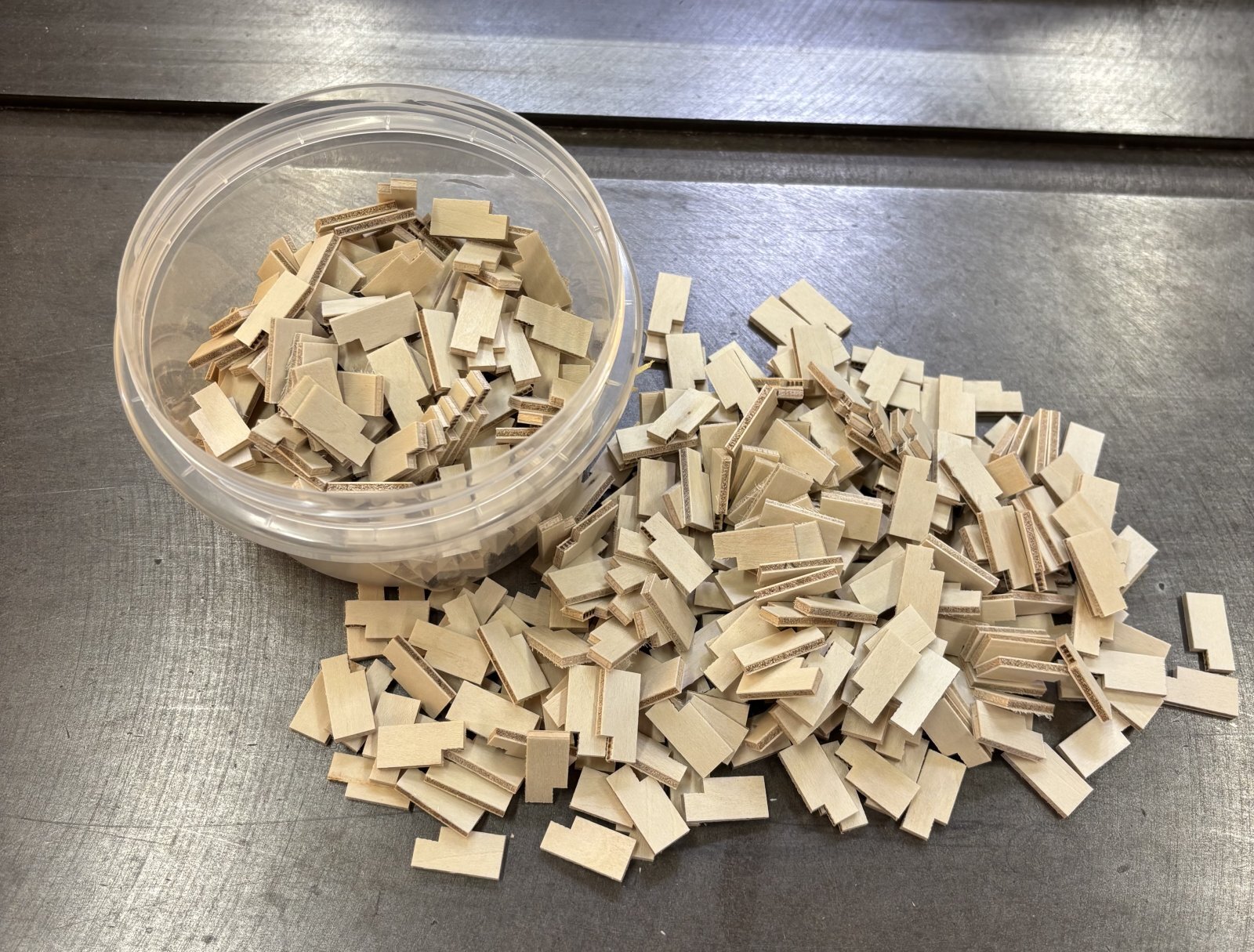
In between that work, I also made the internal parts for the 3-sun boxes that I am planning to produce. This time, I will be making quite a large number, around 120 boxes, so I had run short of almost every part. I made a little extra on purpose. The photo shows the main stair-shaped parts. These may be the most important internal parts in a Japanese puzzle box. Although I call them stair-shaped parts, these are used for 7-step, 10-step, and 12-step mechanisms, so they only have two steps. If a box has Aruki sliding panels on only one side and is made as a 12-step box, the stair-shaped parts would need a few more steps. However, with a 12-step box, if the number of moves is gained through two Aruki panels, the top Aruki panel, and the sliding key, these two steps are enough. The limited 11-step box I made recently has a few more moves concentrated on one side, so even though the total number of moves is not very high, it uses stair-shaped parts with more steps.
As you may be able to see in the photo, I am using shina plywood for these parts this time. There is no special reason, but for the past few years I have been using materials like this kind of plywood for these parts. When there are a few more steps, I sometimes use MDF board instead. I think there may be some concern about the strength of MDF board, but it is possible to process it in a way that increases its strength, so I use it in that way. Actually, shina plywood is stronger, and for a two-step part like this, there is no problem. However, when making very small steps of about 2 to 3 mm, the plywood can sometimes chip. In that respect, MDF board is easier to process. In the past, I also made these parts from natural wood, but it took a lot of time when making them in quantity, so I changed to this method. Originally, this kind of stair-shaped part was carved directly into the axis panel of the puzzle box body with a chisel. However, the axis panels are usually made from agathis or katsura wood, so there are also strength issues with that method. When looking at old Japanese puzzle boxes, many of them have damage or missing sections in this area. So for now, this method seems to be the best choice in many ways.
In between that work, I also made the internal parts for the 3-sun boxes that I am planning to produce. This time, I will be making quite a large number, around 120 boxes, so I had run short of almost every part. I made a little extra on purpose. The photo shows the main stair-shaped parts. These may be the most important internal parts in a Japanese puzzle box. Although I call them stair-shaped parts, these are used for 7-step, 10-step, and 12-step mechanisms, so they only have two steps. If a box has Aruki sliding panels on only one side and is made as a 12-step box, the stair-shaped parts would need a few more steps. However, with a 12-step box, if the number of moves is gained through two Aruki panels, the top Aruki panel, and the sliding key, these two steps are enough. The limited 11-step box I made recently has a few more moves concentrated on one side, so even though the total number of moves is not very high, it uses stair-shaped parts with more steps.
As you may be able to see in the photo, I am using shina plywood for these parts this time. There is no special reason, but for the past few years I have been using materials like this kind of plywood for these parts. When there are a few more steps, I sometimes use MDF board instead. I think there may be some concern about the strength of MDF board, but it is possible to process it in a way that increases its strength, so I use it in that way. Actually, shina plywood is stronger, and for a two-step part like this, there is no problem. However, when making very small steps of about 2 to 3 mm, the plywood can sometimes chip. In that respect, MDF board is easier to process. In the past, I also made these parts from natural wood, but it took a lot of time when making them in quantity, so I changed to this method. Originally, this kind of stair-shaped part was carved directly into the axis panel of the puzzle box body with a chisel. However, the axis panels are usually made from agathis or katsura wood, so there are also strength issues with that method. When looking at old Japanese puzzle boxes, many of them have damage or missing sections in this area. So for now, this method seems to be the best choice in many ways.