Short Top Aruki Panel
Recently, it has been raining almost every evening. It is not the kind of rain that lasts all day, but rather short, heavy showers, which are very common during the Japanese summer. Sometimes, however, these intense downpours can cause flooding and other water damage. Today the weather was unsettled, with rain in the morning followed by occasional sunshine. The temperature was not especially high, at around 29°C, but the humidity was high, making it feel like a typical Japanese summer day. Adding to the atmosphere was the constant sound of cicadas, whose calls always seem to make the summer heat feel even stronger.
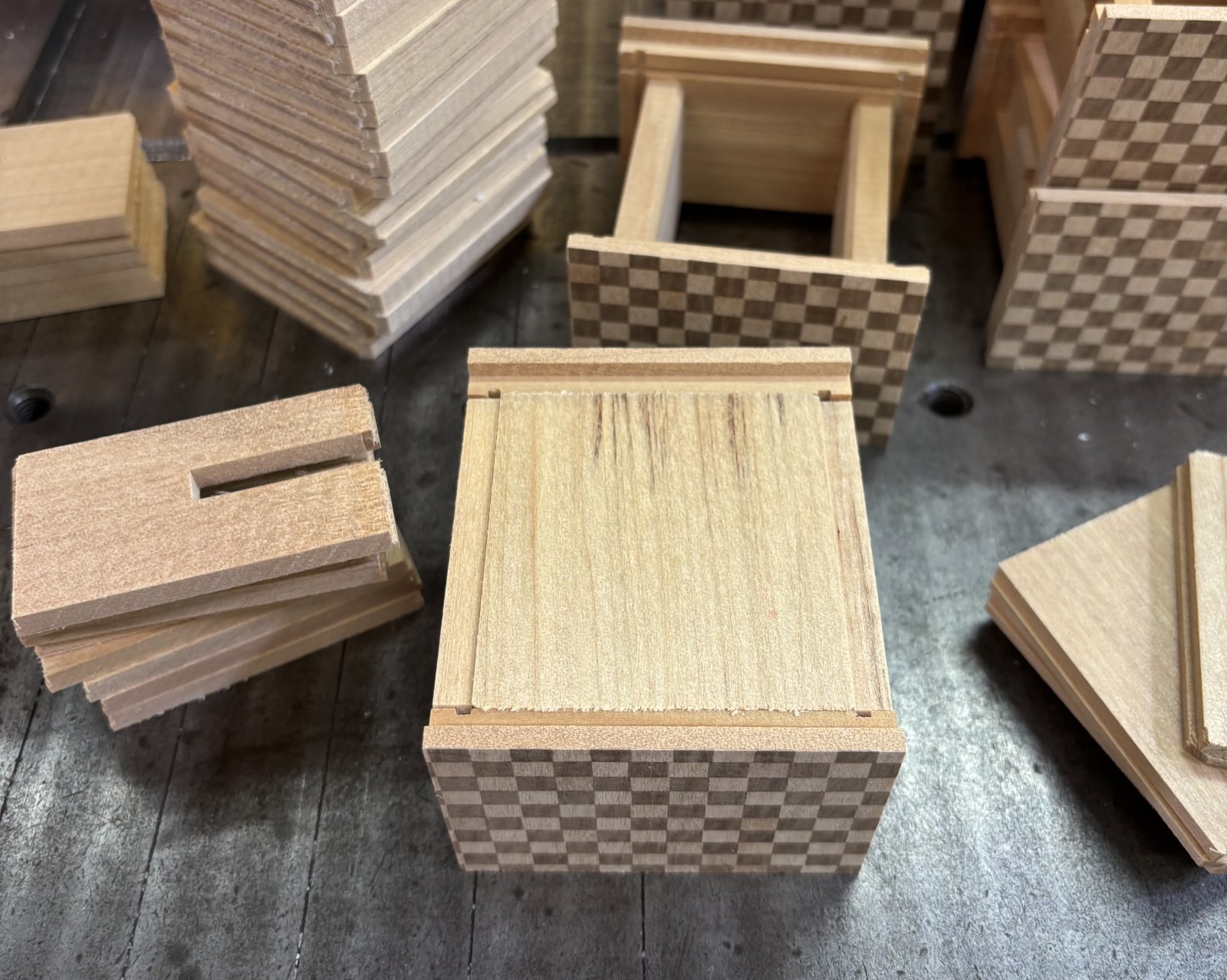
The photo shows the process of attaching the Aruki sliding panels to the Square puzzle boxes. This time I am making the 14-step version, so each box has three Aruki panels. Last year I also made an 18-step version in this size, but for many years the Square puzzle box was available only in the 12-step or 14-step versions. The side Aruki panels are exactly the same as those used on the 4-sun puzzle box. The only difference is the top Aruki panel. As you can see in the photo, it has the same width but is shorter in length, giving it a much more square shape. This top panel has one drawback. It tends to become loose more easily, mainly because of its shorter length. Although it has the same width as the 4-sun version, its length is much shorter, making it almost square. Because of this, the edges that fit into the grooves are also shorter, so the panel has less support. The sliding distance is also shorter, which means the top panel comes off more easily. After being opened and closed many times, the smaller contact area creates less friction, so the panel is more likely to become loose over time.
To reduce this problem, I install the top Aruki panel of this box a little more tightly than usual. I also adjust the contact between the Aruki panel and the frame so that there is slightly more friction. However, this adjustment is very delicate, so I am careful not to overdo it. Increasing the friction between the panel and the frame can create other problems. It can distort the shape of the box, and once the panel is too tight, it is difficult to loosen it later. If the wood expands because of humidity, it can become even tighter. For that reason, I mainly adjust the fit of the panel's edges that slide in the grooves. Even if I make the top panel slightly tighter at this stage, it can still be loosened during the final adjustment. However, just as with increasing friction, making it too tight can also distort the box, so finding the right balance is very important.
This shorter panel also has one advantage. Because it is smaller, it is less likely to warp than the top panel of a 4-sun puzzle box. For that reason, unlike the 4-sun version, I do not need to edge-glue two pieces of wood together. The top Aruki panel of the Square puzzle box can be made from a single piece of wood.
The photo shows the process of attaching the Aruki sliding panels to the Square puzzle boxes. This time I am making the 14-step version, so each box has three Aruki panels. Last year I also made an 18-step version in this size, but for many years the Square puzzle box was available only in the 12-step or 14-step versions. The side Aruki panels are exactly the same as those used on the 4-sun puzzle box. The only difference is the top Aruki panel. As you can see in the photo, it has the same width but is shorter in length, giving it a much more square shape. This top panel has one drawback. It tends to become loose more easily, mainly because of its shorter length. Although it has the same width as the 4-sun version, its length is much shorter, making it almost square. Because of this, the edges that fit into the grooves are also shorter, so the panel has less support. The sliding distance is also shorter, which means the top panel comes off more easily. After being opened and closed many times, the smaller contact area creates less friction, so the panel is more likely to become loose over time.
To reduce this problem, I install the top Aruki panel of this box a little more tightly than usual. I also adjust the contact between the Aruki panel and the frame so that there is slightly more friction. However, this adjustment is very delicate, so I am careful not to overdo it. Increasing the friction between the panel and the frame can create other problems. It can distort the shape of the box, and once the panel is too tight, it is difficult to loosen it later. If the wood expands because of humidity, it can become even tighter. For that reason, I mainly adjust the fit of the panel's edges that slide in the grooves. Even if I make the top panel slightly tighter at this stage, it can still be loosened during the final adjustment. However, just as with increasing friction, making it too tight can also distort the box, so finding the right balance is very important.
This shorter panel also has one advantage. Because it is smaller, it is less likely to warp than the top panel of a 4-sun puzzle box. For that reason, unlike the 4-sun version, I do not need to edge-glue two pieces of wood together. The top Aruki panel of the Square puzzle box can be made from a single piece of wood.