Symmetrical Sliding Keys
This morning, there was a large earthquake in the northern part of Japan, in the Tohoku region. The seismic intensity was upper 6, so it was a very strong earthquake. The epicenter was about 800 kilometers away from my workshop, but I could still feel the shaking. It seems that the intensity in our area was around 2. It happened at 7:30 in the morning, so many people were probably already awake, commuting, or having breakfast. It seems there was quite a lot of confusion, but I sincerely hope that there has not been any serious damage. During the rainy season, landslides are also something we have to worry about.
This morning, the rain that started late last night was still continuing. It is still raining now, and because of the approaching typhoon, it seems that the rain will continue until around Sunday. The humidity has already been around 80% since the morning. During a typhoon, the air contains even more moisture, so I decided to postpone attaching the sliding key panels for the 4-Compartment Boxes for a little while. With this much humidity, attaching the panels feels a little risky. Because of that, the completion date will probably be delayed by a few days.
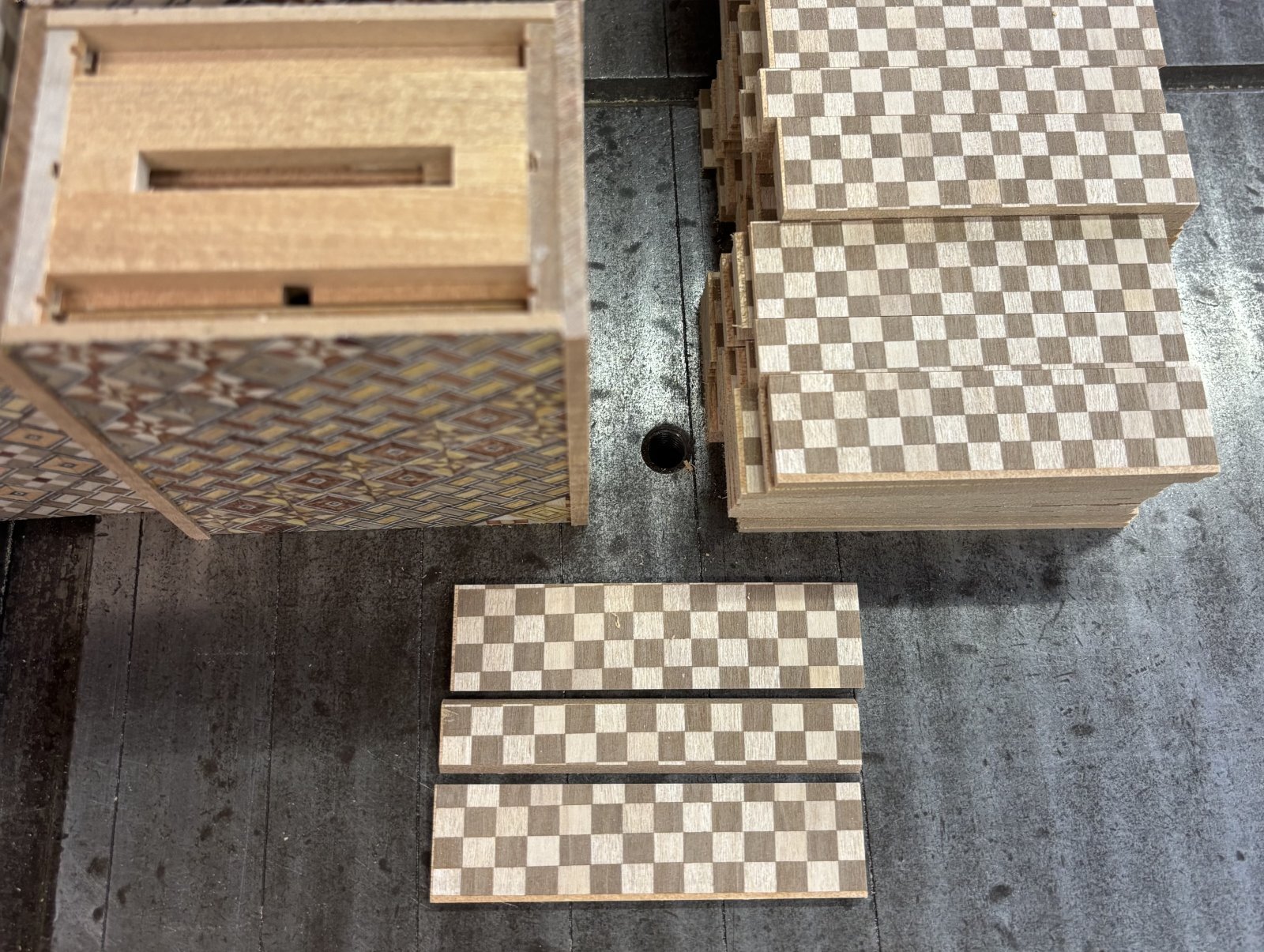
Because the humidity is high, I stored the box bodies in a dehumidified case. However, I did make the sliding key panels themselves. The photo shows the completed panels. The sliding key panel is made by dividing a single board into three parts. As you can see in the photo, the sliding key panel for this box has a symmetrical layout, with the upper and lower sections being the same size. In other words, the panels above and below the center sliding key have the same dimensions. In the photo, they may look slightly different in size, but that is just an optical illusion caused by the pattern of the panels... haha. Since this box is designed to open in either direction, the glue surface for the internal Aruki sliding panels is small on both the upper and lower sides. To secure as much glue area as possible, the sliding key is made narrower than on a typical Japanese puzzle box.
While making today’s sliding keys, I also made another new discovery. It may affect the way I make, or more specifically cut, sliding keys in the future — in a good way. When cutting a single board in two separate steps, the Yosegi sheet would sometimes peel slightly during the second cut. This problem tends to be more noticeable with a simple checkered pattern like this one. Through today’s cutting work, I think I may have found a way to prevent it. It feels a little late to discover this now... haha. I would like to try it again in another production run next time.
This morning, the rain that started late last night was still continuing. It is still raining now, and because of the approaching typhoon, it seems that the rain will continue until around Sunday. The humidity has already been around 80% since the morning. During a typhoon, the air contains even more moisture, so I decided to postpone attaching the sliding key panels for the 4-Compartment Boxes for a little while. With this much humidity, attaching the panels feels a little risky. Because of that, the completion date will probably be delayed by a few days.
Because the humidity is high, I stored the box bodies in a dehumidified case. However, I did make the sliding key panels themselves. The photo shows the completed panels. The sliding key panel is made by dividing a single board into three parts. As you can see in the photo, the sliding key panel for this box has a symmetrical layout, with the upper and lower sections being the same size. In other words, the panels above and below the center sliding key have the same dimensions. In the photo, they may look slightly different in size, but that is just an optical illusion caused by the pattern of the panels... haha. Since this box is designed to open in either direction, the glue surface for the internal Aruki sliding panels is small on both the upper and lower sides. To secure as much glue area as possible, the sliding key is made narrower than on a typical Japanese puzzle box.
While making today’s sliding keys, I also made another new discovery. It may affect the way I make, or more specifically cut, sliding keys in the future — in a good way. When cutting a single board in two separate steps, the Yosegi sheet would sometimes peel slightly during the second cut. This problem tends to be more noticeable with a simple checkered pattern like this one. Through today’s cutting work, I think I may have found a way to prevent it. It feels a little late to discover this now... haha. I would like to try it again in another production run next time.