Structure and the bottom panel
The cold weather is continuing today, but it does not look like it will snow anymore. There is still a little snow left on the roads that has not melted, but it seems that the roads can be used normally. However, because the amount of snow that fell was very unusual for this area, many sections of the nearby highways are still closed. As a result, the local roads are in great confusion, and there are very serious traffic jams. Yesterday, the heavy traffic did not ease until around midnight, and today, even before sunrise, it became another day of severe congestion. It seems that this situation will continue for a while. As it happens, tomorrow is a national holiday in Japan called “National Foundation Day.” In a situation like this, people who do not have to go to work may be feeling a little relieved.
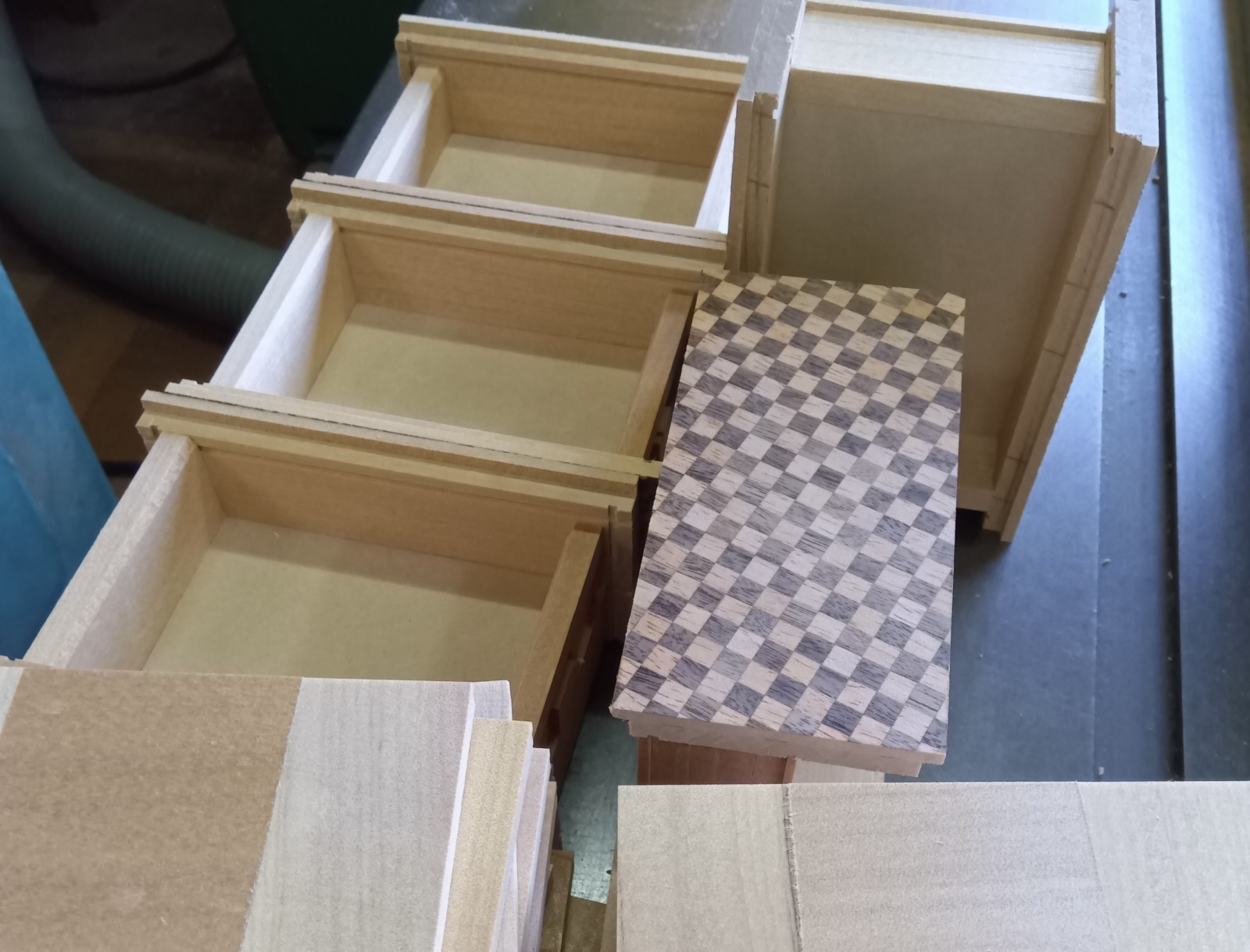
Today I mainly worked on the 5-sun puzzle box with drawers. I was behind schedule all day today, but I made and installed the Aruki panels. As you can see slightly in the upper part of the photo, the structural part of this puzzle box with drawers has a somewhat unusual shape. Of the two shaft panels, one does not extend all the way to the bottom of the box and stops partway. Because of this, an open space is created on the side of the box. The drawer fits into this open space and comes out from there. This is a unique structure, but it also has a small structural weakness. In that open area, there is no shaft panel to hold down the bottom panel, so the panel is left in a floating state. If I am not careful during production, this lack of support can cause the panel to warp. This is one point that requires special attention when making this type of box.
Normally, the top and bottom panels of the box are made with a thickness of about 3 mm. Three millimeters is certainly easy to warp, but because of the movement of the mechanisms, the panels cannot be made much thicker. In this box, the mechanism affects only the top panel, so in theory the bottom panel could be made thicker to prevent warping. However, because of the yosegi sheets and the production process, it is quite difficult to make only the bottom panel thicker. Usually, these top and bottom panels are fitted slightly tight in all puzzle boxes. They are installed so that they fit inside the box, and by making the width just a little wider, I adjust the stiffness of the movement not only through the Aruki panels, but also at this fitting point. When the panels are installed a little tight, they tend to bend slightly in the middle. In the case of the top panel and in other puzzle boxes, this is controlled by gluing the panel to the Aruki panels or shaft panels to hold it down. However, in this puzzle box with drawers, that open area makes this impossible. Because the bottom panel cannot be held down there, it becomes more likely to warp. For this reason, only for this 5-sun puzzle box with drawers, I cut the bottom panel a little looser before installing it. If it is made too loose, gaps will appear on the sides, so the key point is to make it just tight enough to lightly rub. Warping is especially likely to occur with solid wood, so I think using plywood for this part is a good choice.
Today I mainly worked on the 5-sun puzzle box with drawers. I was behind schedule all day today, but I made and installed the Aruki panels. As you can see slightly in the upper part of the photo, the structural part of this puzzle box with drawers has a somewhat unusual shape. Of the two shaft panels, one does not extend all the way to the bottom of the box and stops partway. Because of this, an open space is created on the side of the box. The drawer fits into this open space and comes out from there. This is a unique structure, but it also has a small structural weakness. In that open area, there is no shaft panel to hold down the bottom panel, so the panel is left in a floating state. If I am not careful during production, this lack of support can cause the panel to warp. This is one point that requires special attention when making this type of box.
Normally, the top and bottom panels of the box are made with a thickness of about 3 mm. Three millimeters is certainly easy to warp, but because of the movement of the mechanisms, the panels cannot be made much thicker. In this box, the mechanism affects only the top panel, so in theory the bottom panel could be made thicker to prevent warping. However, because of the yosegi sheets and the production process, it is quite difficult to make only the bottom panel thicker. Usually, these top and bottom panels are fitted slightly tight in all puzzle boxes. They are installed so that they fit inside the box, and by making the width just a little wider, I adjust the stiffness of the movement not only through the Aruki panels, but also at this fitting point. When the panels are installed a little tight, they tend to bend slightly in the middle. In the case of the top panel and in other puzzle boxes, this is controlled by gluing the panel to the Aruki panels or shaft panels to hold it down. However, in this puzzle box with drawers, that open area makes this impossible. Because the bottom panel cannot be held down there, it becomes more likely to warp. For this reason, only for this 5-sun puzzle box with drawers, I cut the bottom panel a little looser before installing it. If it is made too loose, gaps will appear on the sides, so the key point is to make it just tight enough to lightly rub. Warping is especially likely to occur with solid wood, so I think using plywood for this part is a good choice.