The popularity of drawer boxes
Because of the heavy snow that fell yesterday, some roads were closed today, and the other roads were extremely crowded. I arrived at the workshop close to the night. It felt like I just came to check on the workshop for a short time. Our area usually does not get much snow, but something like this seems to happen about once every ten years. About ten years ago, we had a similar heavy snowfall, and at that time I bought tools for shoveling snow. I did not use them at all back then, because I bought them after the snow had already passed. This time, however, they were very useful. Snow shoveling tools made especially for snow are really amazing, and very different from a normal shovel. They make it easy to remove snow. When I think about people in snowy regions doing this kind of work every day, I feel that the difficulty is something we cannot easily imagine.
I am currently working on 5-sun 10-steps puzzle boxes with drawers. The frame parts are already assembled, and I am about to start making the Aruki panels. I am making the usual traditional yosegi type, and also a small number of boxes with a combination of traditional yosegi and ichimatsu yosegi. These puzzle boxes can be sold for overseas shops. Puzzle boxes with drawers have fewer steps than other types, but they are still very popular today. Speaking of drawers, in the Netflix series "House of Ninjas", which focuses on ninjas, the yosegi puzzle box that is stolen from the exhibition hall was also a 5-sun puzzle box with drawers. Maybe the way the drawer comes out, instead of just opening the box normally, gives a special feeling that is different from other puzzle boxes. The first puzzle box with drawers that I used as a reference had a feature called a “sound drawer.” When the drawer was pulled out, it made a sound like a bird singing. This is a type that has existed for a long time. Inside the box, a coiled piano wire catches on a small projection on the drawer, and that is how the sound is made. In those days, the drawers usually had a bird design made with wood inlay. It was like a small performance, as if the bird was singing. Old Japanese puzzle boxes were very carefully made, and many of them feel mysterious and full of ideas.
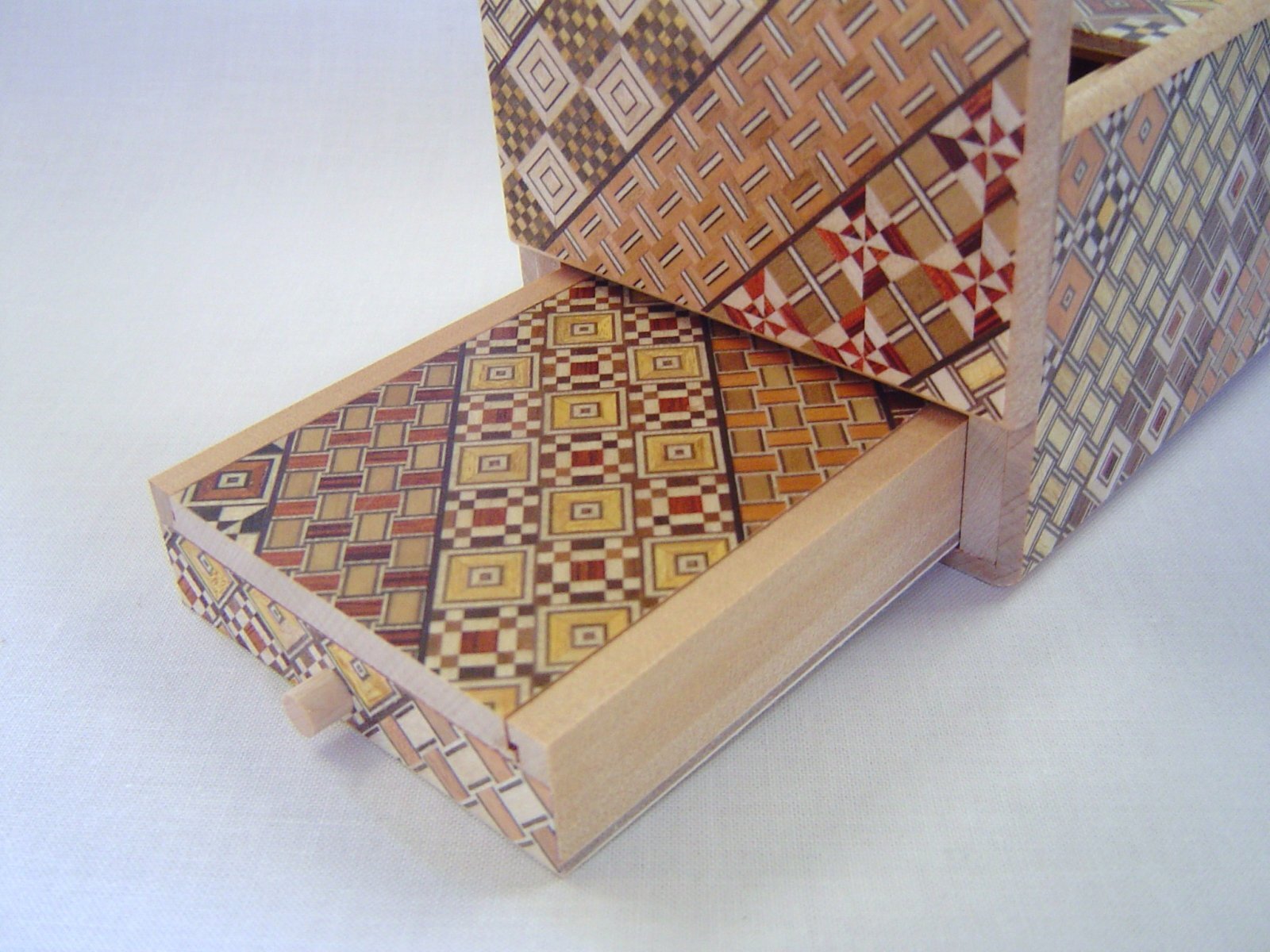
At the same time, I am also making the inner drawers that are stored inside the boxes. My puzzle boxes with drawers do not have this kind of sound or wood inlay, but I always try to make the drawer part as carefully as possible (The photo shows a type from around 2010.) Because of that, this time I decided to add a light finish to the drawer, even though I have not applied any finish to the drawers before. I have not decided exactly how to do it yet, but it will probably be a light finish, not a strong one like the finish on the outer box. Someday, I would like to make a drawer with sound like this, but it is quite difficult. To do that, the structure needs to be changed a little. The drawer should not come out completely. It needs to stop partway, and space must be made under the drawer for the mechanism. A long time ago, I heard about this sound mechanism from someone who knew how to make it and had made it before. They told me that even winding the wire that makes the sound requires skill and is not easy. I feel that this kind of mechanism is not only part of Japanese puzzle boxes (himitsu-bako), but also has the feeling of trick boxes. In the past, there were many different kinds of trick boxes in this area, and this tradition seems to be connected to that history as well.
I am currently working on 5-sun 10-steps puzzle boxes with drawers. The frame parts are already assembled, and I am about to start making the Aruki panels. I am making the usual traditional yosegi type, and also a small number of boxes with a combination of traditional yosegi and ichimatsu yosegi. These puzzle boxes can be sold for overseas shops. Puzzle boxes with drawers have fewer steps than other types, but they are still very popular today. Speaking of drawers, in the Netflix series "House of Ninjas", which focuses on ninjas, the yosegi puzzle box that is stolen from the exhibition hall was also a 5-sun puzzle box with drawers. Maybe the way the drawer comes out, instead of just opening the box normally, gives a special feeling that is different from other puzzle boxes. The first puzzle box with drawers that I used as a reference had a feature called a “sound drawer.” When the drawer was pulled out, it made a sound like a bird singing. This is a type that has existed for a long time. Inside the box, a coiled piano wire catches on a small projection on the drawer, and that is how the sound is made. In those days, the drawers usually had a bird design made with wood inlay. It was like a small performance, as if the bird was singing. Old Japanese puzzle boxes were very carefully made, and many of them feel mysterious and full of ideas.
At the same time, I am also making the inner drawers that are stored inside the boxes. My puzzle boxes with drawers do not have this kind of sound or wood inlay, but I always try to make the drawer part as carefully as possible (The photo shows a type from around 2010.) Because of that, this time I decided to add a light finish to the drawer, even though I have not applied any finish to the drawers before. I have not decided exactly how to do it yet, but it will probably be a light finish, not a strong one like the finish on the outer box. Someday, I would like to make a drawer with sound like this, but it is quite difficult. To do that, the structure needs to be changed a little. The drawer should not come out completely. It needs to stop partway, and space must be made under the drawer for the mechanism. A long time ago, I heard about this sound mechanism from someone who knew how to make it and had made it before. They told me that even winding the wire that makes the sound requires skill and is not easy. I feel that this kind of mechanism is not only part of Japanese puzzle boxes (himitsu-bako), but also has the feeling of trick boxes. In the past, there were many different kinds of trick boxes in this area, and this tradition seems to be connected to that history as well.