A sliding key made from walnut wood
The cold days continue, but now that it is already February, I have several plans, and I would like to work through them one by one. Today, I finished gluing the top and bottom panels of the 3-sun 12-step puzzle boxes that I am currently making. From tomorrow, I plan to start attaching the sliding key panels. This time, I am making a slightly larger number of boxes, so it is difficult to finish all the preparation for attaching the sliding key panels in just one day. Because of that, while gluing the top and bottom panels today, I also made the sliding key panels that will be attached tomorrow. I have not attached the small wooden pieces (bocch) yet, but those parts are already prepared. After attaching them, I will shave the gluing surfaces and then glue the panels one side at a time.
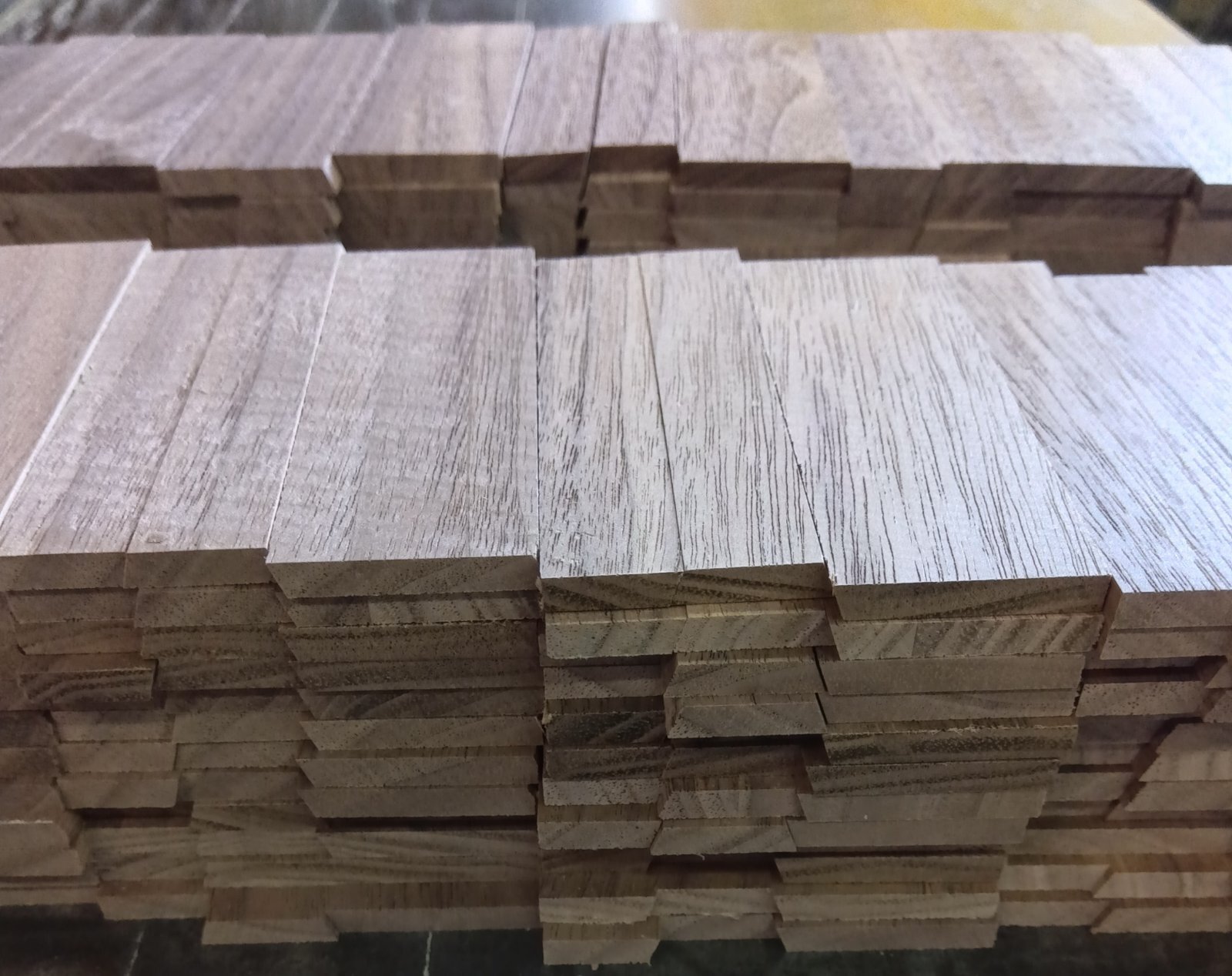
The photo shows the sliding key panels for the 3-sun boxes that I made today. They are all made from walnut wood. Making these panels from walnut requires more care than using yosegi boards. These panels tend to warp easily, and walnut wood is especially prone to warping. For this reason, boards such as agathis wood, with yosegi sheets already glued on the surface, are usually more suitable. The yosegi sheet also helps prevent the board from warping. However, when making these panels from solid wood like walnut, it is better to use straight-grain boards or softer parts of the wood with less character. Even when using the same walnut wood, I choose and use different parts for the side panels of the box (the long sides) and for these panels. This is because, due to the structure of the puzzle box, this panel is different from the top and bottom panels and the long side panels. Part of the board (about one third of it) is not fixed to the box, and that free section is especially likely to warp.
When you look at the panel from the side, the part in the middle of a single board is the sliding key that actually moves (it may be a little hard to see). This section is cut at an angle, and because of that angle it acts as a stopper, so the sliding part does not come out of the panel. If it were cut in a straight line, the sliding key in the middle would fall out, because the sliding key is not fixed at all inside the box. Of course, it needs to move freely. This angled cut can be made steeper or gentler, but for now I feel that this angle works well. I am not measuring it exactly, but it is probably around 20 degrees. If the angle is too gentle, the sliding key comes out more easily, and if the angle is too steep, the corner of the sliding key is more likely to chip. Depending on the type of wood, it might be good to change this angle slightly.
The photo shows the sliding key panels for the 3-sun boxes that I made today. They are all made from walnut wood. Making these panels from walnut requires more care than using yosegi boards. These panels tend to warp easily, and walnut wood is especially prone to warping. For this reason, boards such as agathis wood, with yosegi sheets already glued on the surface, are usually more suitable. The yosegi sheet also helps prevent the board from warping. However, when making these panels from solid wood like walnut, it is better to use straight-grain boards or softer parts of the wood with less character. Even when using the same walnut wood, I choose and use different parts for the side panels of the box (the long sides) and for these panels. This is because, due to the structure of the puzzle box, this panel is different from the top and bottom panels and the long side panels. Part of the board (about one third of it) is not fixed to the box, and that free section is especially likely to warp.
When you look at the panel from the side, the part in the middle of a single board is the sliding key that actually moves (it may be a little hard to see). This section is cut at an angle, and because of that angle it acts as a stopper, so the sliding part does not come out of the panel. If it were cut in a straight line, the sliding key in the middle would fall out, because the sliding key is not fixed at all inside the box. Of course, it needs to move freely. This angled cut can be made steeper or gentler, but for now I feel that this angle works well. I am not measuring it exactly, but it is probably around 20 degrees. If the angle is too gentle, the sliding key comes out more easily, and if the angle is too steep, the corner of the sliding key is more likely to chip. Depending on the type of wood, it might be good to change this angle slightly.