Thickness of the Aruki panel
Today was another cold day. In the afternoon, it started to rain, and the weather became even worse. I only made a little progress with my work today, but I have already started moving on to the next production. As I wrote yesterday, the next project will be 3-sun 12-step puzzle boxes. These are being made by request, but I also plan to prepare a small amount of stock for this site. Today, after preparing the wood, I continued by getting the other materials ready, except for the side panels. These include the shaft panels and the panels for three different types of Aruki. In the end, this production will probably be around 70 boxes. That is quite a large number for me to make 😅
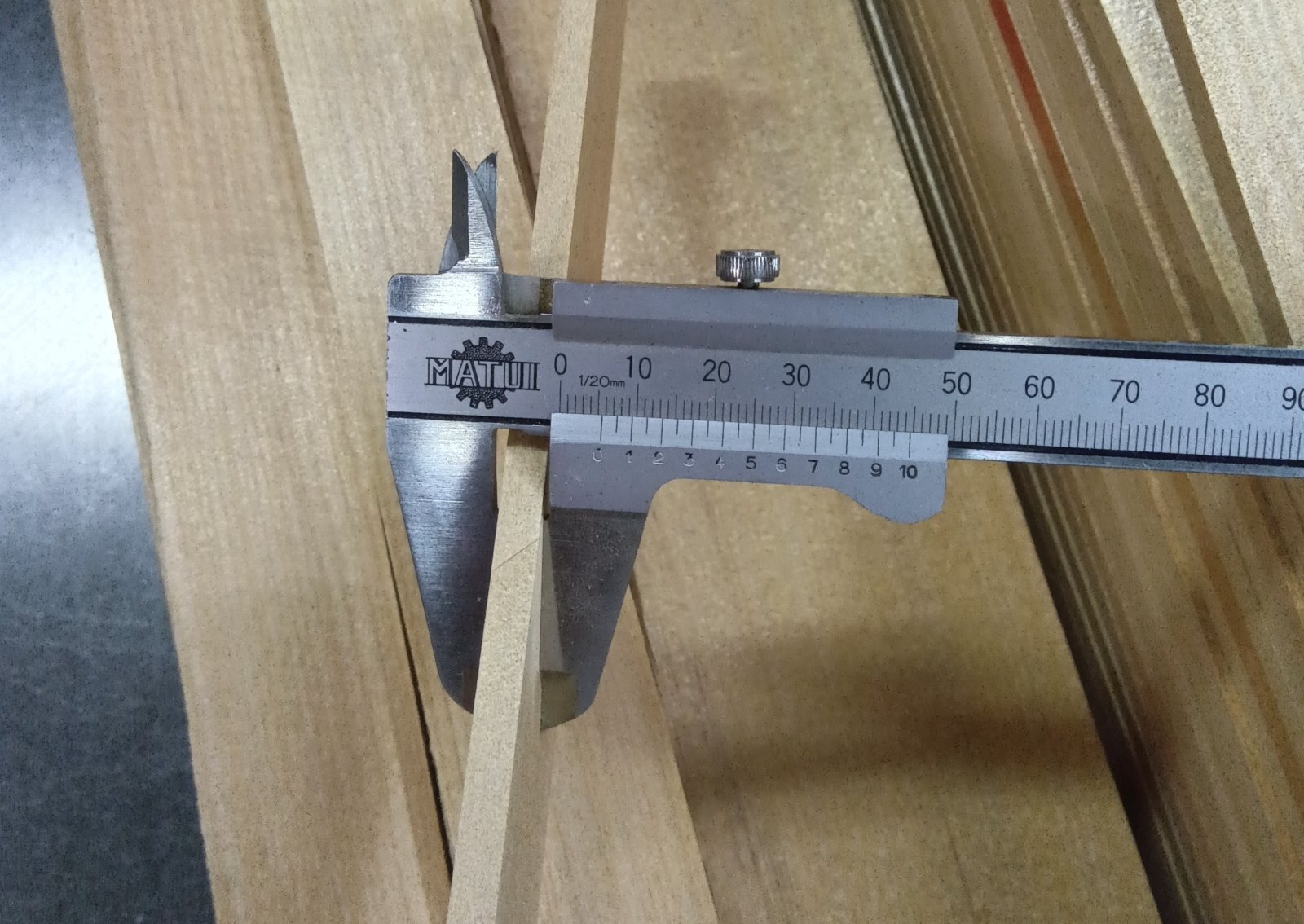
This 3-sun 12-step puzzle box uses thinner Aruki panels compared to slightly larger boxes such as the 4-sun size. Since the box itself is small, this may seem natural, and in fact the old 2-sun cube boxes I used to make were also made with Aruki panels of the same thickness. When you move the mechanism, smaller boxes are designed to move with a much lighter force. It is not that larger boxes need a lot of force, but because the panels are larger, you naturally have to press a little more firmly. Small boxes move with a very small force, so even thin and small panels work fine as part of the mechanism. However, if too much force is applied to these small mechanisms, or if force is applied in the wrong direction, there is a risk of damaging the mechanism. A long time ago, the Aruki panels on 3-sun boxes sometimes cracked. Because of this, I increased the thickness of the material slightly and have continued making them that way for the past few years. However, at the end of last year, one customer contacted me to say that a 5 mm thick Aruki panel had cracked. It seems the mechanism was moved with force in a different direction. Of course, wood is wood, and no matter how careful you are, it is impossible to make something that will never break. Still, it is better if cracking does not happen. So, starting with this production, I decided to make the side Aruki panels 0.5 mm thicker. It is only 0.5 mm, but it makes a noticeable difference. I could make them even thicker, but that would reduce the inner space and also make the mechanism look less elegant. For this reason, I decided on a thickness of 5.5 mm this time.
The place where it cracks is always the same. It is the part of the side Aruki panel where a groove is cut so that the sliding key can move. Because of this groove, the width of the Aruki panel becomes narrower at that point. The wood is connected over a shorter distance than usual, so it naturally becomes easier to crack. To solve this problem, there are only two options: make the box wider, or make the panel thicker. Making the box larger is not realistic, so this time I changed the panel thickness instead.
This 3-sun 12-step puzzle box uses thinner Aruki panels compared to slightly larger boxes such as the 4-sun size. Since the box itself is small, this may seem natural, and in fact the old 2-sun cube boxes I used to make were also made with Aruki panels of the same thickness. When you move the mechanism, smaller boxes are designed to move with a much lighter force. It is not that larger boxes need a lot of force, but because the panels are larger, you naturally have to press a little more firmly. Small boxes move with a very small force, so even thin and small panels work fine as part of the mechanism. However, if too much force is applied to these small mechanisms, or if force is applied in the wrong direction, there is a risk of damaging the mechanism. A long time ago, the Aruki panels on 3-sun boxes sometimes cracked. Because of this, I increased the thickness of the material slightly and have continued making them that way for the past few years. However, at the end of last year, one customer contacted me to say that a 5 mm thick Aruki panel had cracked. It seems the mechanism was moved with force in a different direction. Of course, wood is wood, and no matter how careful you are, it is impossible to make something that will never break. Still, it is better if cracking does not happen. So, starting with this production, I decided to make the side Aruki panels 0.5 mm thicker. It is only 0.5 mm, but it makes a noticeable difference. I could make them even thicker, but that would reduce the inner space and also make the mechanism look less elegant. For this reason, I decided on a thickness of 5.5 mm this time.
The place where it cracks is always the same. It is the part of the side Aruki panel where a groove is cut so that the sliding key can move. Because of this groove, the width of the Aruki panel becomes narrower at that point. The wood is connected over a shorter distance than usual, so it naturally becomes easier to crack. To solve this problem, there are only two options: make the box wider, or make the panel thicker. Making the box larger is not realistic, so this time I changed the panel thickness instead.