Attaching small wooden pieces
Today was another cold day, but the humidity was low, so it was a good day for making things. However, because it is so cold, my hands get stiff, and this is also the season when it is hard to do delicate work in the morning 😂
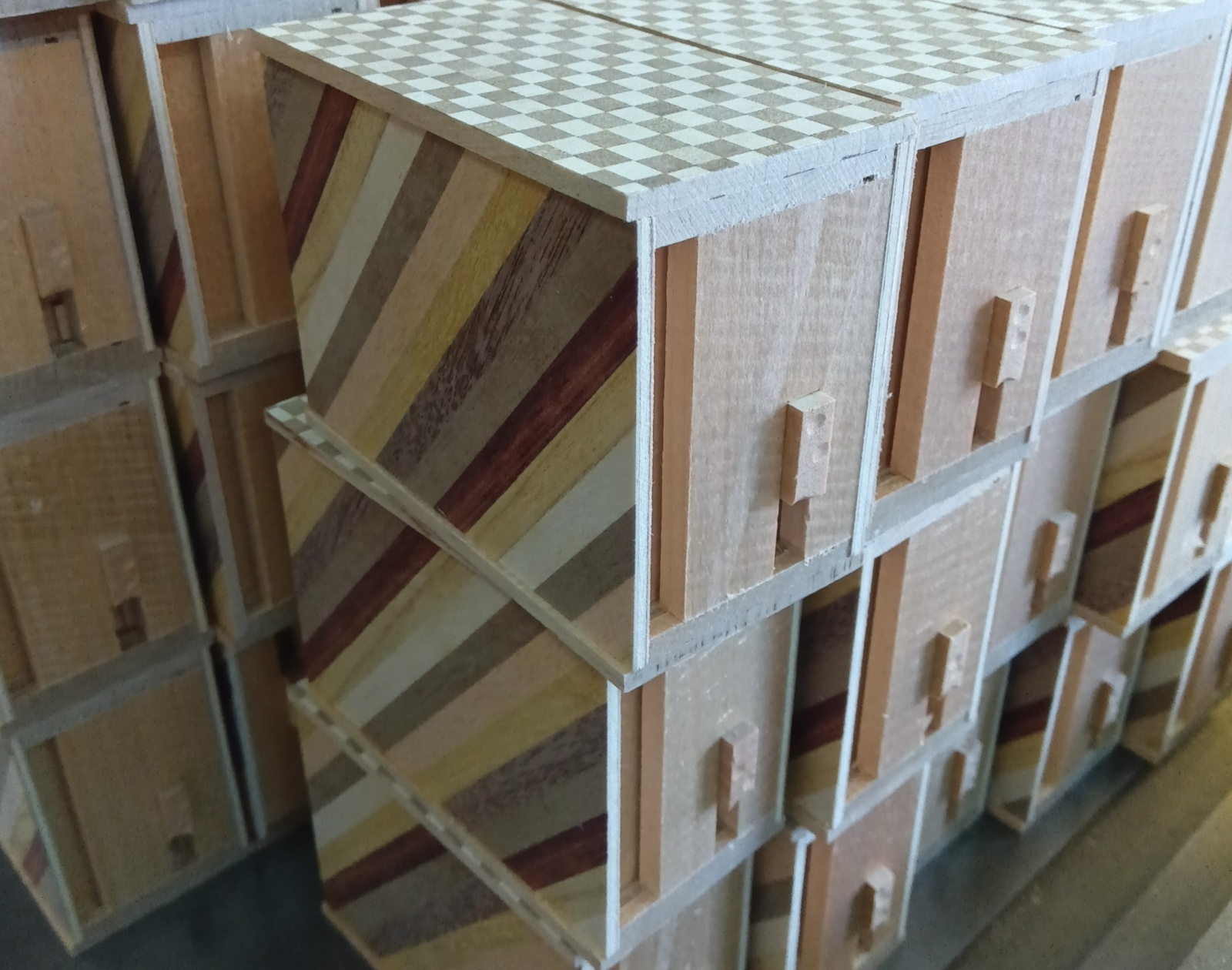
Today, I attached the Aruki panels and the top and bottom panels with striped yosegi to the 4-sun puzzle boxes that I prepared yesterday. In the afternoon, I also attached one side of the sliding key panels. The schedule was a little tight, but I managed to finish it in time. I will attach the other side tomorrow. The humidity is low right now, so this is a good time to do this kind of panel work. It is around 40% at the moment, which is quite low for Japan. The average humidity in Japan is said to be around 60 to 70 percent, although it changes depending on the area and the season.
The photo shows the process of attaching small wooden parts that move together with the sliding key, before flattening the surface where the sliding key will be glued. These small parts are sometimes called bocchi. There are many ways to attach them, and each craftsperson has their own method. I have tried several approaches myself, and I have been using my current method for about six or seven years now. In my method, the first part is attached a little tightly, and then it is adjusted so that it becomes looser once the sliding key starts to move. This is one of the more difficult parts of making puzzle boxes. If it becomes too loose, the sliding key will move and rattle on its own before it is touched by hand, which is not good.
In addition, the ichimatsu pattern used this time must be glued so that the lines of the pattern match perfectly. Because of this, the small wooden piece is attached at the deepest part of the groove in the Aruki panel, in a position where it cannot move any further. The panel must be glued in this fixed position. If this is not done, the pattern lines can shift after the panel is attached. When gluing these parts, there are several points that require careful attention.
Today, I attached the Aruki panels and the top and bottom panels with striped yosegi to the 4-sun puzzle boxes that I prepared yesterday. In the afternoon, I also attached one side of the sliding key panels. The schedule was a little tight, but I managed to finish it in time. I will attach the other side tomorrow. The humidity is low right now, so this is a good time to do this kind of panel work. It is around 40% at the moment, which is quite low for Japan. The average humidity in Japan is said to be around 60 to 70 percent, although it changes depending on the area and the season.
The photo shows the process of attaching small wooden parts that move together with the sliding key, before flattening the surface where the sliding key will be glued. These small parts are sometimes called bocchi. There are many ways to attach them, and each craftsperson has their own method. I have tried several approaches myself, and I have been using my current method for about six or seven years now. In my method, the first part is attached a little tightly, and then it is adjusted so that it becomes looser once the sliding key starts to move. This is one of the more difficult parts of making puzzle boxes. If it becomes too loose, the sliding key will move and rattle on its own before it is touched by hand, which is not good.
In addition, the ichimatsu pattern used this time must be glued so that the lines of the pattern match perfectly. Because of this, the small wooden piece is attached at the deepest part of the groove in the Aruki panel, in a position where it cannot move any further. The panel must be glued in this fixed position. If this is not done, the pattern lines can shift after the panel is attached. When gluing these parts, there are several points that require careful attention.