A New insight into Ichimatsu yosegi
It was very sunny again from the morning today. I came to the workshop in the afternoon to finish the 5-sun puzzle boxes. There are only two days left in this year. This year, I do not have any unfinished work, so it feels nice to move into the new year with a clean slate 🤣 I have already started preparing for the first work of next year, which will be 4-sun striped yosegi puzzle boxes. This time, I will make only as many boxes as the striped yosegi sheets I have, so it will be about 40 boxes. This striped yosegi was made quite a long time ago and has been stored already attached to panels. Striped yosegi is harder to slice than checkered yosegi because the wood grain pattern is not divided as finely. However, this striped yosegi has been sliced nicely and turned out well. If possible, I would like to continue making this in the future, so I plan to sell it as a regular item, not a limited one.
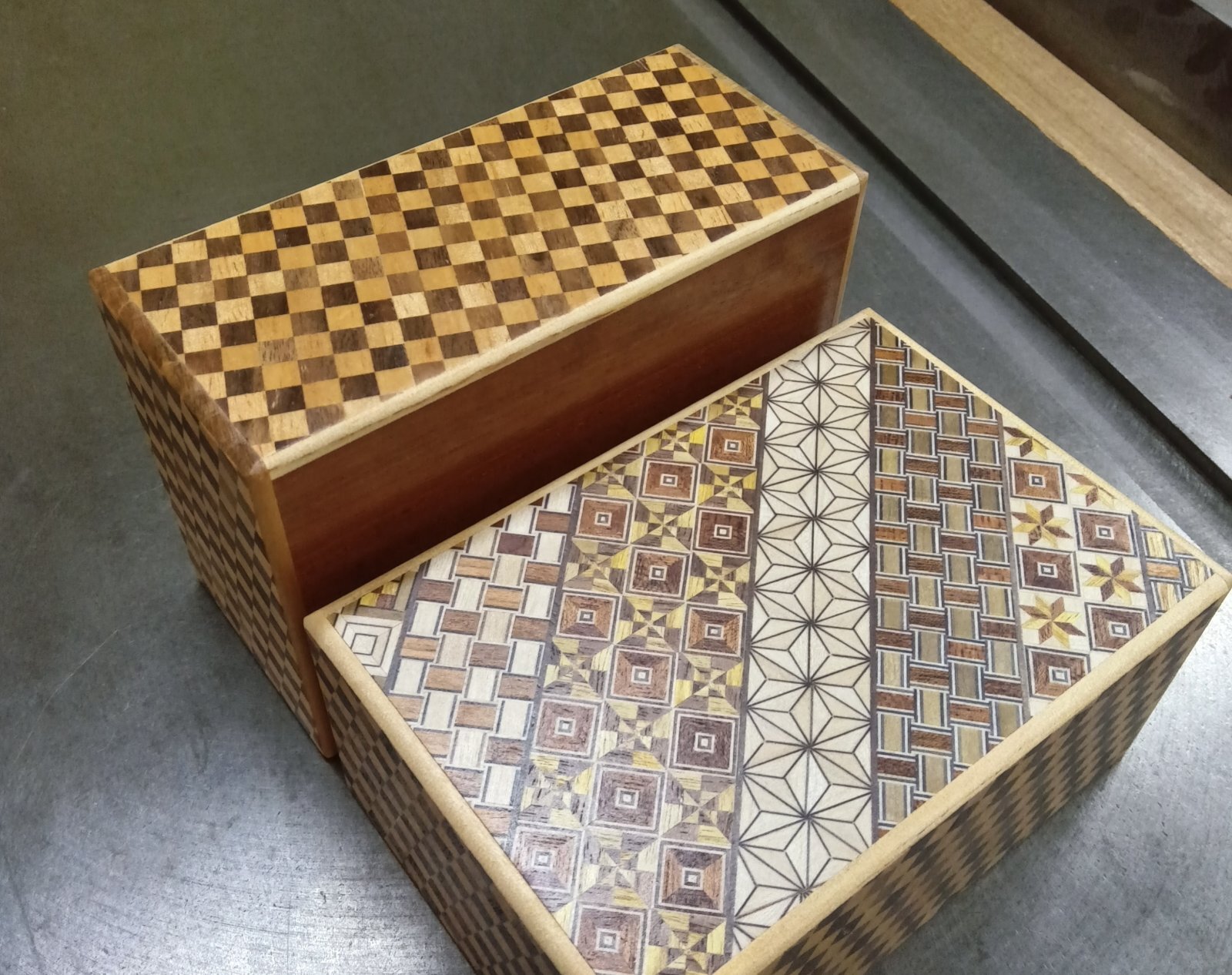
And in the evening, the 5-sun puzzle box was fully finished after the finish coating was applied. This time, it has a 14-step mechanism. Recently, a customer who bought a 6-sun puzzle box (made this month) that uses the same checkered yosegi (ichimatsu) on the side panels said, “This checkered yosegi feels like a retro style from the 1950s. It’s beautiful!” I hadn’t noticed that myself until they said it...haha 😅. But yes, I agree—it has a calm, tasteful, and slightly subdued feeling. I have used walnut and nato wood many times before, but I may not have combined only these two woods together until now. It was a new and interesting discovery for me. Thank you! 🙏
For this 5-sun puzzle box, I used a wood sheet on the bottom panel, just like I did for the previous 6-sun puzzle box. For the 4-sun and square puzzle boxes, I used solid wood, but I chose a wood sheet for the 5-sun and 6-sun boxes because the panels are larger and a bit harder to handle. Especially with a 14-step mechanism like this one, the bottom panel does not have an Aruki moving panel, unlike an 18-step mechanism where the bottom moves. Because of that, the bottom panel can curve slightly (only very slightly), and if solid wood is used, it becomes difficult to sand with machines during the finishing process. For this reason, using plywood with a wood sheet attached gives better productivity, so I think I will continue using this method in the future.
And in the evening, the 5-sun puzzle box was fully finished after the finish coating was applied. This time, it has a 14-step mechanism. Recently, a customer who bought a 6-sun puzzle box (made this month) that uses the same checkered yosegi (ichimatsu) on the side panels said, “This checkered yosegi feels like a retro style from the 1950s. It’s beautiful!” I hadn’t noticed that myself until they said it...haha 😅. But yes, I agree—it has a calm, tasteful, and slightly subdued feeling. I have used walnut and nato wood many times before, but I may not have combined only these two woods together until now. It was a new and interesting discovery for me. Thank you! 🙏
For this 5-sun puzzle box, I used a wood sheet on the bottom panel, just like I did for the previous 6-sun puzzle box. For the 4-sun and square puzzle boxes, I used solid wood, but I chose a wood sheet for the 5-sun and 6-sun boxes because the panels are larger and a bit harder to handle. Especially with a 14-step mechanism like this one, the bottom panel does not have an Aruki moving panel, unlike an 18-step mechanism where the bottom moves. Because of that, the bottom panel can curve slightly (only very slightly), and if solid wood is used, it becomes difficult to sand with machines during the finishing process. For this reason, using plywood with a wood sheet attached gives better productivity, so I think I will continue using this method in the future.