Side panel production method update
The weather was nice again today, and it felt warm during the day. I came to the workshop a little later than usual and did some work, as well as some cleaning and organizing. Today,I listed the 5-sun puzzle boxes on my website that were finished with the final coating yesterday. This year ended with a good stopping point for work 😄
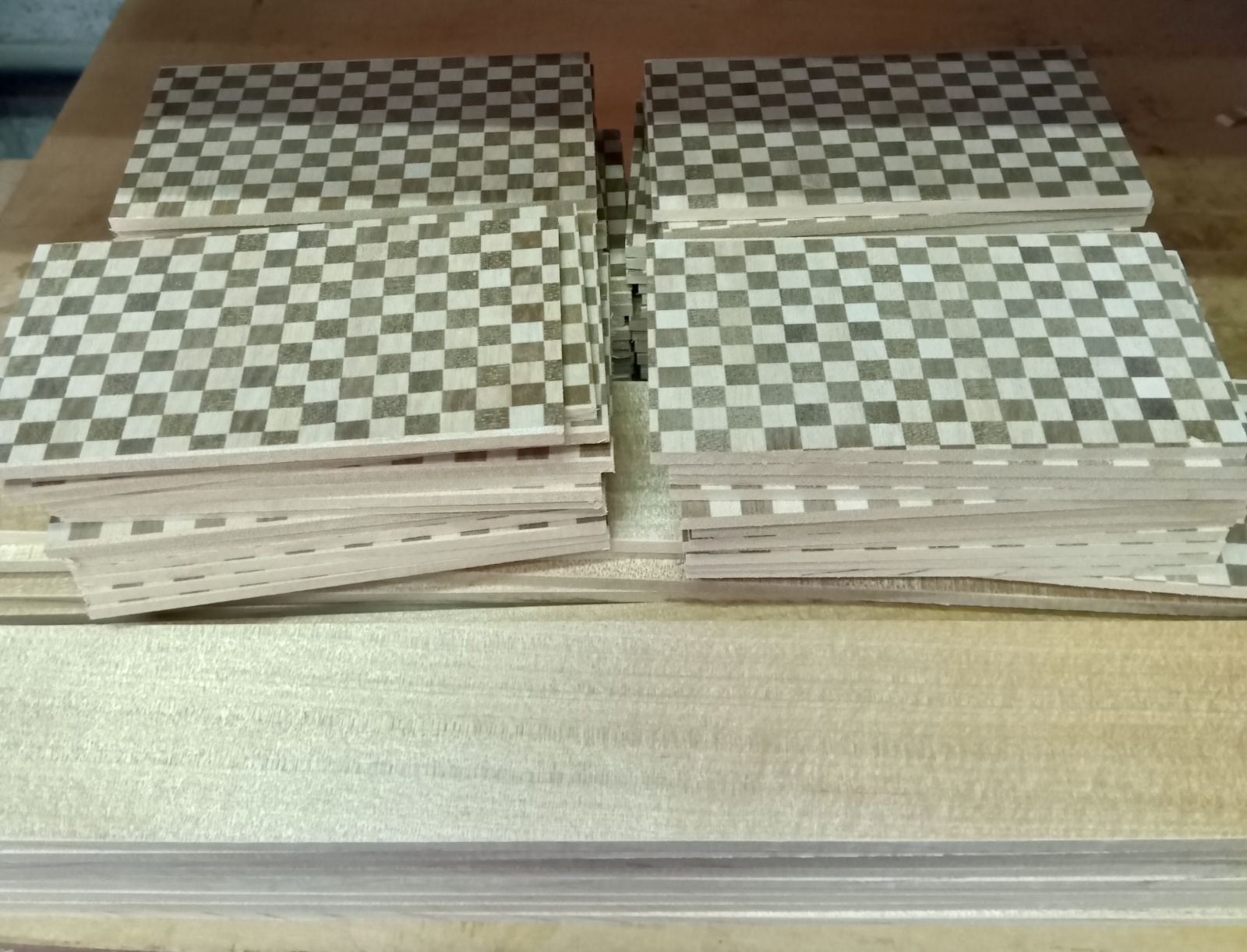
Since I had some extra time, I also prepared for the next project. The next boxes will be 4-sun puzzle boxes, so I glued the side panels for them. By keeping pressure on them with clamps, the panels will stabilize, and I will be able to start making the boxes at any time. This time again, I am using two-color checkered yosegi on the side panels of the boxes (photo).
Around this spring, I went back to this method of production. In this approach, I first glue the two pieces of wood that make up the side panels. I had used this method before, but for the past three or four years, I was using an older method. That older way was to first complete the inner structure of the box and then attach the outer panels one by one. The current method has the advantage of speeding up the assembly process, but that is not the only benefit. It also improves the overall accuracy of the box. When panels are attached one by one, it is quite difficult to keep the precision perfectly aligned each time a panel is added.
In the middle of all this, I made another new discovery last month when making two boards and gluing them together. Before, I would first decide the size of the outer side panels (the yosegi panels), glue the two pieces together, and then cut the inner structural side panels to match the size. However, because of a small mistake, I had to do it the other way around that time. That meant cutting the inner structural panels accurately first, and then adjusting the size of the outer yosegi panels afterward. When I did this, I found that the inner panels were finished much more cleanly. Because of that, I am now using this method.
In the past, new production methods have sometimes come from small mistakes like this, but this time it turned out to be a very good result. With the previous method, marks from the blade often remained on the edges of the inner structural panels, and it was very difficult to finish them perfectly. That part of the box had been bothering me for a long time, so this new method solved an issue I had been concerned about.
It also made me feel that changes in production methods can still happen in the future, and it reminded me again that there is no single fixed way to make these Japanese puzzle boxes.
Since I had some extra time, I also prepared for the next project. The next boxes will be 4-sun puzzle boxes, so I glued the side panels for them. By keeping pressure on them with clamps, the panels will stabilize, and I will be able to start making the boxes at any time. This time again, I am using two-color checkered yosegi on the side panels of the boxes (photo).
Around this spring, I went back to this method of production. In this approach, I first glue the two pieces of wood that make up the side panels. I had used this method before, but for the past three or four years, I was using an older method. That older way was to first complete the inner structure of the box and then attach the outer panels one by one. The current method has the advantage of speeding up the assembly process, but that is not the only benefit. It also improves the overall accuracy of the box. When panels are attached one by one, it is quite difficult to keep the precision perfectly aligned each time a panel is added.
In the middle of all this, I made another new discovery last month when making two boards and gluing them together. Before, I would first decide the size of the outer side panels (the yosegi panels), glue the two pieces together, and then cut the inner structural side panels to match the size. However, because of a small mistake, I had to do it the other way around that time. That meant cutting the inner structural panels accurately first, and then adjusting the size of the outer yosegi panels afterward. When I did this, I found that the inner panels were finished much more cleanly. Because of that, I am now using this method.
In the past, new production methods have sometimes come from small mistakes like this, but this time it turned out to be a very good result. With the previous method, marks from the blade often remained on the edges of the inner structural panels, and it was very difficult to finish them perfectly. That part of the box had been bothering me for a long time, so this new method solved an issue I had been concerned about.
It also made me feel that changes in production methods can still happen in the future, and it reminded me again that there is no single fixed way to make these Japanese puzzle boxes.