Differences in the 14-steps mechanism
Today was the delivery day for the 6-sun puzzle boxes that I have been working on since last week, so I came in the morning at about my usual time. Most businesses already seemed to be on holiday, and the roads were quiet. In the morning, I was able to hand the 6-sun boxes directly to the Hakone dealer, and I safely completed the work on the 6-sun wood-inlay design boxes. It seems that the horse-pattern wood inlay used this time is quite old and was apparently found by chance in a warehouse in Hakone. No one knows who originally made it, but I am glad it was not lost to history. It has now become a proper product and will be displayed in shops. You may happen to see it one day in a Hakone shop or in an online store.
After that, I sliced two-color checkered yosegi (ichimatsu) for the next production. It was still cold in the morning, so I avoided other machine work and did this task instead. For the next project, I plan to make 4-sun striped puzzle boxes, and I will use this two-color checkered yosegi for the side panels. I had already used this yosegi recently for 4-sun 18-step puzzle boxes and square boxes, so there was not enough left for this new production. Because of that, I made more in a hurry. Since this yosegi will be attached first, I also prepared the base boards for that work today.
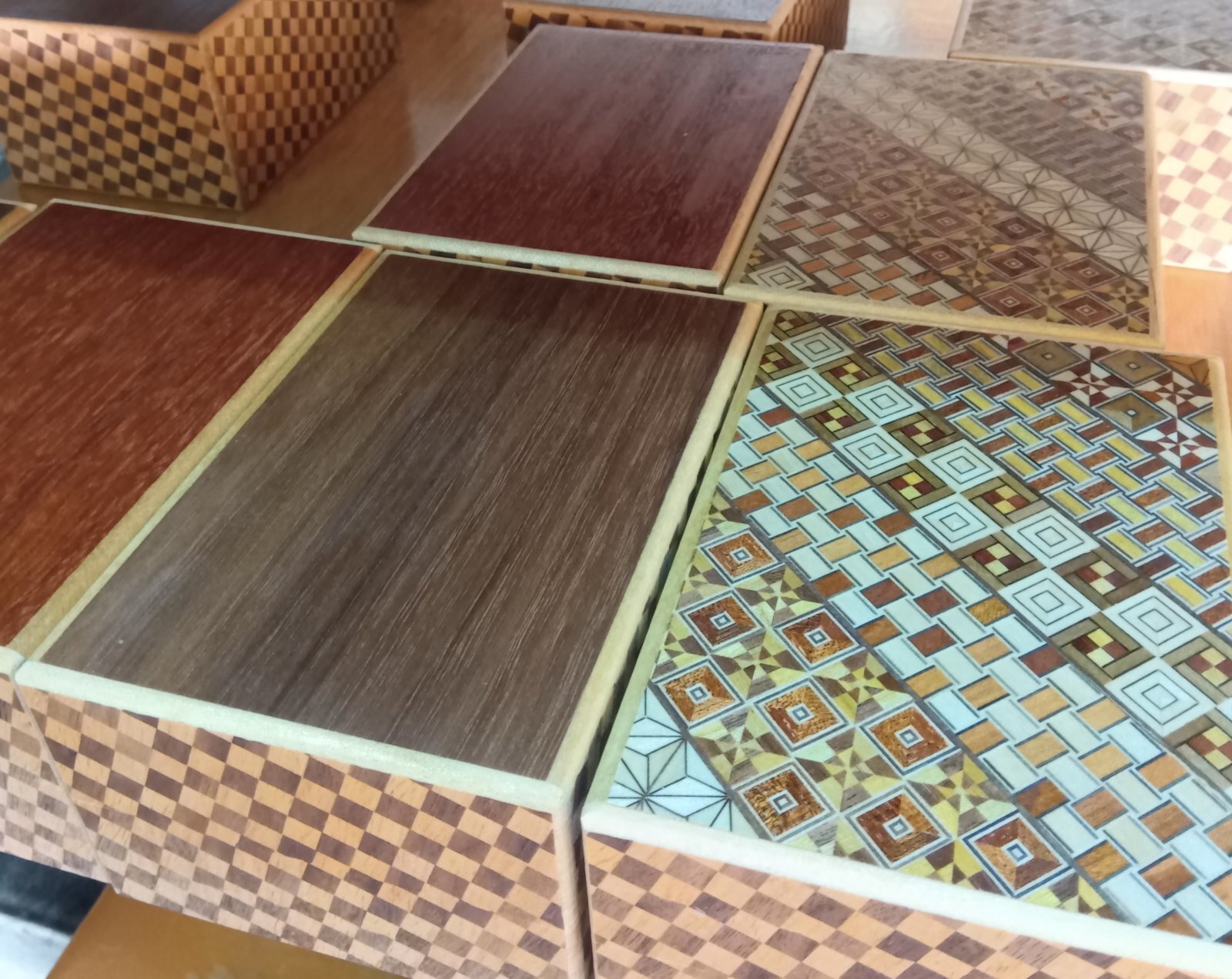
After that, I worked on the finishing process for the 5-sun puzzle boxes in the afternoon. It became a little drier and the temperature went up, so I was a bit worried, but everything was completed without any problems. It looks like I will be able to finish these boxes within the year. This time again, I used traditional yosegi on the top panels, and the bottom panels are covered with walnut or makore sheets (as shown in the photo). I checked the movement, and since it has been a while since I made 14-step puzzle boxes, I was a little nervous 🤣, but it seems to move smoothly. Recently, I made a 14-step mechanism in a square box, but doing the same 14-step mechanism in a 4-sun size and in this 5-sun size feels completely different. When the moving distance of the mechanism and the size of the parts change, even with the same 14 steps, it feels like making a completely different puzzle box.
After that, I sliced two-color checkered yosegi (ichimatsu) for the next production. It was still cold in the morning, so I avoided other machine work and did this task instead. For the next project, I plan to make 4-sun striped puzzle boxes, and I will use this two-color checkered yosegi for the side panels. I had already used this yosegi recently for 4-sun 18-step puzzle boxes and square boxes, so there was not enough left for this new production. Because of that, I made more in a hurry. Since this yosegi will be attached first, I also prepared the base boards for that work today.
After that, I worked on the finishing process for the 5-sun puzzle boxes in the afternoon. It became a little drier and the temperature went up, so I was a bit worried, but everything was completed without any problems. It looks like I will be able to finish these boxes within the year. This time again, I used traditional yosegi on the top panels, and the bottom panels are covered with walnut or makore sheets (as shown in the photo). I checked the movement, and since it has been a while since I made 14-step puzzle boxes, I was a little nervous 🤣, but it seems to move smoothly. Recently, I made a 14-step mechanism in a square box, but doing the same 14-step mechanism in a 4-sun size and in this 5-sun size feels completely different. When the moving distance of the mechanism and the size of the parts change, even with the same 14 steps, it feels like making a completely different puzzle box.