Thickness of Yosegi sheets
Today the weather was clear from the morning, and the air was very dry. I worked in my workshop all day. I finished the final steps of the square 14-steps puzzle boxes, and the assembly is now complete. Next, they will move on to the painting process. I plan to list them later this week.
I also started preparing for the next production today. Next, I will make 5-sun puzzle boxes. I haven’t decided on the exact number yet, but it will probably be around 30 to 35 pieces. Recently, I have not been able to prepare stock of the traditional yosegi design for the 5-sun wholesale boxes. This is because the makers cannot produce the yosegi sheets fast enough. For this batch, the traditional yosegi will be used only for the top panel, and for the other sides I plan to use wood sheets and checkered yosegi (ichimatsu) sheets.
The checkered yosegi sheets I am using this time are the ones I originally made for the 6-sun puzzle boxes I worked on recently. The pattern turned out a little smaller than I planned, so from now on I decided to use them for 5-sun boxes instead. However, I hadn’t finished slicing them yet, so today I sliced the remaining part. Even though I say “the remaining part,” about 90% was still left, so it was almost all of it 😅 When I made the 6-sun boxes, I only sliced the amount I needed, glued it onto the boards, and used it. Today the air was quite dry, but I managed to slice all of the sheets. I feel that slicing this kind of yosegi sheet is better done on days with higher humidity. The sliced sheets are very sensitive to dryness, and if they lose too much moisture before I press them flat, they can fall apart. So today I had to be very careful and worked with a lot of attention.
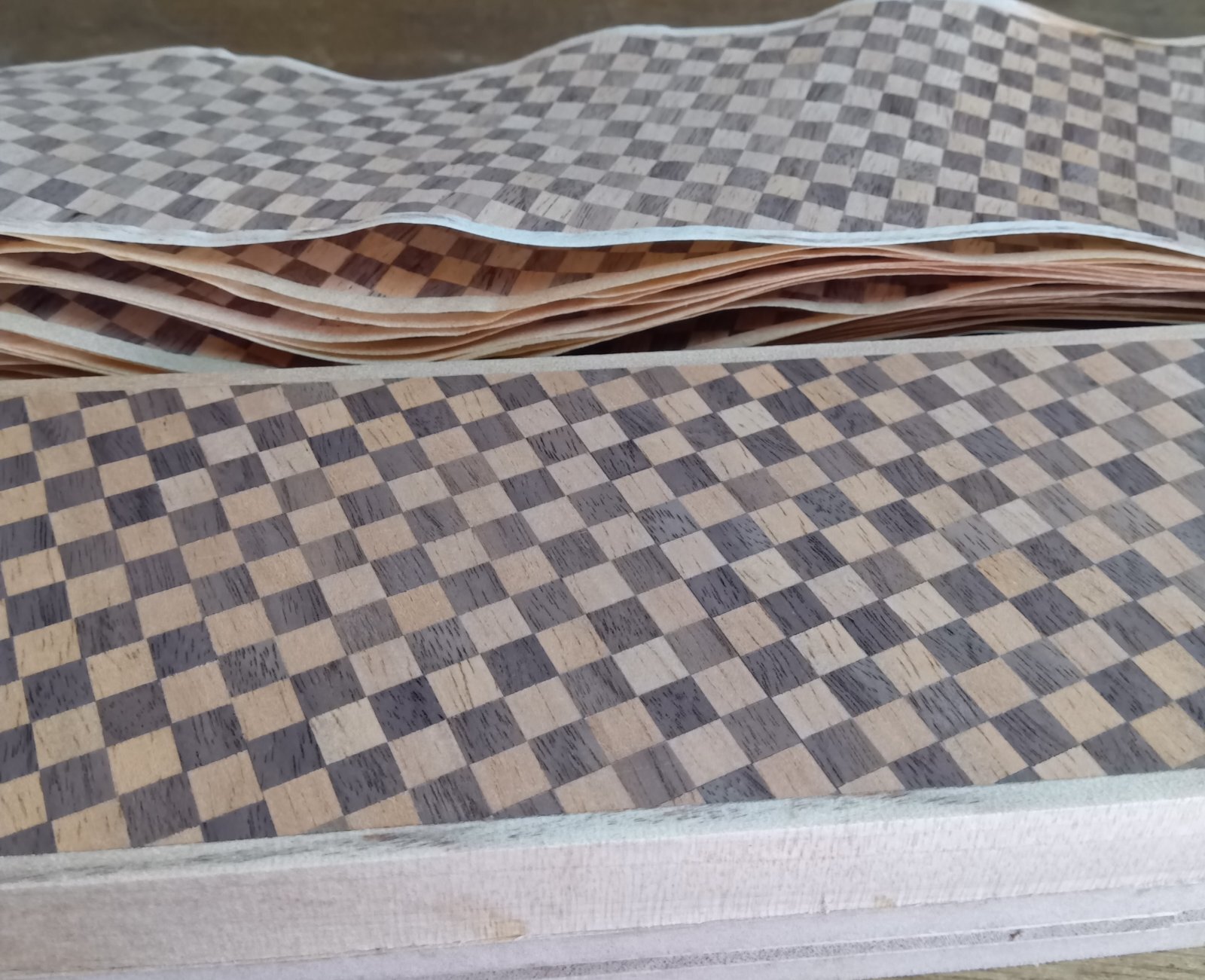
The photo shows the checkered yosegi sheet while it is being sliced. At first, it is a block about 2 to 3 centimeters thick. I slice this block using a machine with a special plane blade. The sliced sheets are about 0.2 mm thick. Usually, I make the block about 2 cm thick, but this time it accidentally became about 3 cm. Because of that, I could slice more sheets than usual—it was quite a lot of slicing 😂 Since I am making 5-sun boxes this time, which are larger and a bit wider, I sliced the sheets slightly thicker to make the wood colors look nicer. It’s only from about 0.2 mm to around 0.25 mm, but you can feel the difference when you touch it. If I slice the sheets thinner, I can get more pieces from one block, which is good from a production point of view. But if the sheets are too thin, the base wood can show through after gluing, and the finish does not look beautiful. Some makers slice them as thin as possible to reduce cost, but the quality of the boxes is not very good in that case. On the other hand, making the sheets thicker gives the checkered pattern better color and depth. However, thicker is not always better, if they are too thick, they become hard to glue onto the board, and later they can even cause the board to warp. Finding the right balance in thickness is part of the skill of the craftsman.
I also started preparing for the next production today. Next, I will make 5-sun puzzle boxes. I haven’t decided on the exact number yet, but it will probably be around 30 to 35 pieces. Recently, I have not been able to prepare stock of the traditional yosegi design for the 5-sun wholesale boxes. This is because the makers cannot produce the yosegi sheets fast enough. For this batch, the traditional yosegi will be used only for the top panel, and for the other sides I plan to use wood sheets and checkered yosegi (ichimatsu) sheets.
The checkered yosegi sheets I am using this time are the ones I originally made for the 6-sun puzzle boxes I worked on recently. The pattern turned out a little smaller than I planned, so from now on I decided to use them for 5-sun boxes instead. However, I hadn’t finished slicing them yet, so today I sliced the remaining part. Even though I say “the remaining part,” about 90% was still left, so it was almost all of it 😅 When I made the 6-sun boxes, I only sliced the amount I needed, glued it onto the boards, and used it. Today the air was quite dry, but I managed to slice all of the sheets. I feel that slicing this kind of yosegi sheet is better done on days with higher humidity. The sliced sheets are very sensitive to dryness, and if they lose too much moisture before I press them flat, they can fall apart. So today I had to be very careful and worked with a lot of attention.
The photo shows the checkered yosegi sheet while it is being sliced. At first, it is a block about 2 to 3 centimeters thick. I slice this block using a machine with a special plane blade. The sliced sheets are about 0.2 mm thick. Usually, I make the block about 2 cm thick, but this time it accidentally became about 3 cm. Because of that, I could slice more sheets than usual—it was quite a lot of slicing 😂 Since I am making 5-sun boxes this time, which are larger and a bit wider, I sliced the sheets slightly thicker to make the wood colors look nicer. It’s only from about 0.2 mm to around 0.25 mm, but you can feel the difference when you touch it. If I slice the sheets thinner, I can get more pieces from one block, which is good from a production point of view. But if the sheets are too thin, the base wood can show through after gluing, and the finish does not look beautiful. Some makers slice them as thin as possible to reduce cost, but the quality of the boxes is not very good in that case. On the other hand, making the sheets thicker gives the checkered pattern better color and depth. However, thicker is not always better, if they are too thick, they become hard to glue onto the board, and later they can even cause the board to warp. Finding the right balance in thickness is part of the skill of the craftsman.