Making the top and bottom outer panels
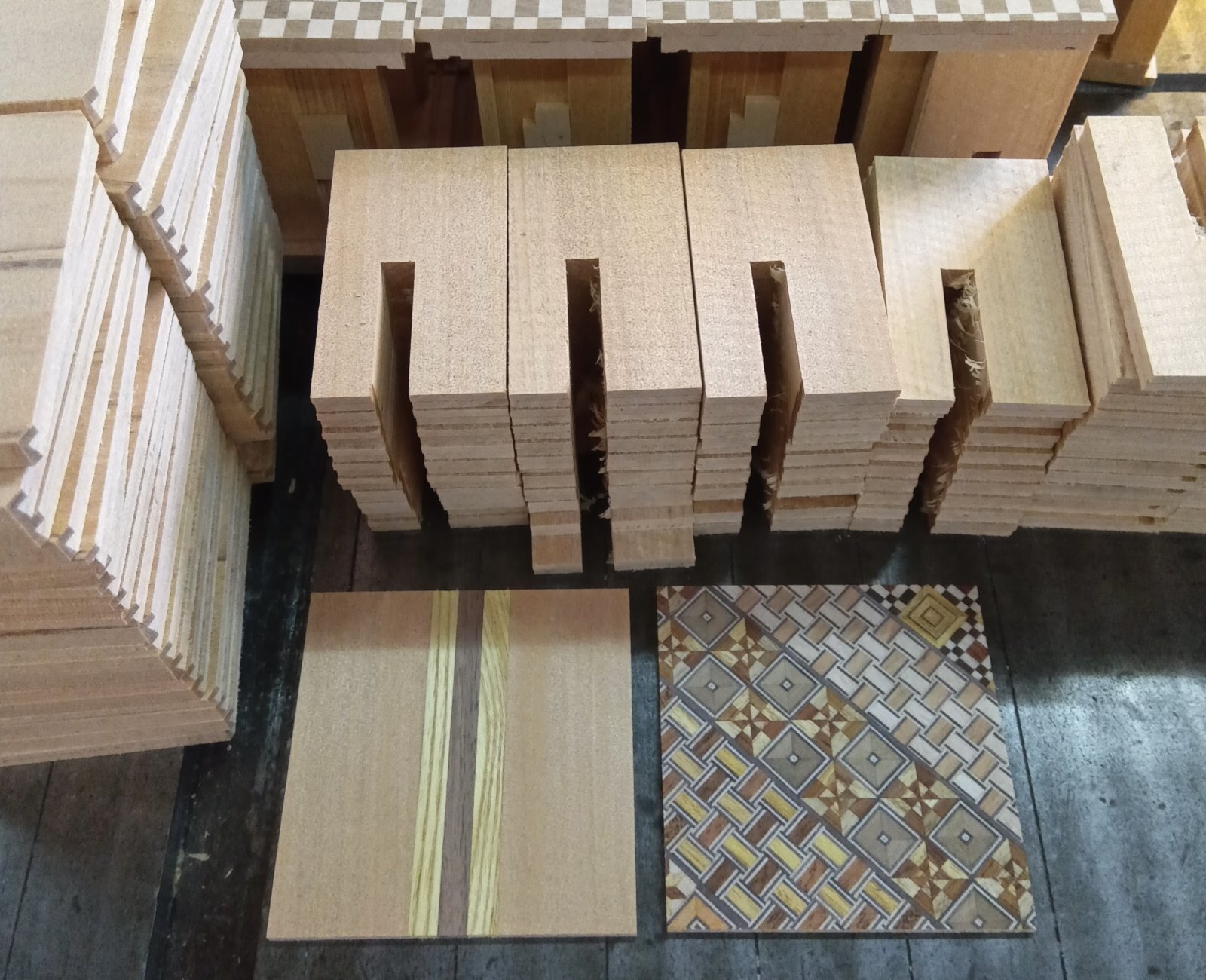
Last night we had very strong winds, but there was no damage, and this morning the weather became calm again. The morning cold from the past few days has also eased a little, and today it was about 6°C in the morning. I worked on several tasks in my workshop today. I had something to do in the afternoon, so from the morning I made the Aruki moving panels and the top and bottom panels for the square puzzle boxes. At this stage, I have not attached them yet. Since these are 14-steps boxes, there are three Aruki panels.
Because the square boxes have no long side, the top Aruki panels are short, and sometimes they tend to become loose. The good thing is that the tightness of the top panels can be adjusted even after the box is completed, so at this stage it is important to make them slightly tight. However, if I make them too tight, attaching all top aruki panels later (42 pieces this time) becomes very difficult, so I keep the tightness at a reasonable level.
As you can see in the photo, the outer panels for this box will have natural wood on the bottom side and traditional yosegi on the top side. After I finish attaching the Aruki panels, I will attach these panels next. Rather than “glue,” it may be better to say I “fit” them in place. I wrote about this a long time ago, but since this autumn I changed part of my production method and returned to the older way of attaching the side panels first. There is no single “correct” traditional method for making Japanese puzzle boxes, but it seems that attaching the top and bottom panels first was more common in the past. The method I use now may be considered more suitable for producing several boxes at once. It lets me work more efficiently when making many pieces. There are other advantages as well, but I will explain those another time.
When making these top and bottom panels, one thing I pay close attention to is fitting them slightly tight. It requires careful balance—too tight is a problem, of course, but too loose is even worse. For each box, I attach two panels: the bottom panel is fixed and does not move in this mechanism. So I fit it a little loosely. The reason is that bottom panel can warp. In this structure, the bottom of the box has no Aruki panels and is hollow, so if the panel is made too tight, the center will sink and the board will warp. To avoid putting stress on the bottom panel during assembly, I cut it to a size that fits without forcing it. This is something that cannot be measured by exact numbers—it is mostly based on experience and feeling.
On the other hand, the top panel has an Aruki panel underneath the yosegi panel, so that structure supports the outer panel from below. Because of that, I can fit it a bit tighter. Later, when pressing it into place, it will settle flat. Also, the top side moves in this mechanism, so if the outer panel is too loose, it will not function properly. A slightly tight fit is better. If it ends up too tight, I can shave a little at the end to adjust it. But again, this must be done with balance; too much tight adjustment can cause several problems. Moderation is important.
I hope you have a good weekend! 😄
Because the square boxes have no long side, the top Aruki panels are short, and sometimes they tend to become loose. The good thing is that the tightness of the top panels can be adjusted even after the box is completed, so at this stage it is important to make them slightly tight. However, if I make them too tight, attaching all top aruki panels later (42 pieces this time) becomes very difficult, so I keep the tightness at a reasonable level.
As you can see in the photo, the outer panels for this box will have natural wood on the bottom side and traditional yosegi on the top side. After I finish attaching the Aruki panels, I will attach these panels next. Rather than “glue,” it may be better to say I “fit” them in place. I wrote about this a long time ago, but since this autumn I changed part of my production method and returned to the older way of attaching the side panels first. There is no single “correct” traditional method for making Japanese puzzle boxes, but it seems that attaching the top and bottom panels first was more common in the past. The method I use now may be considered more suitable for producing several boxes at once. It lets me work more efficiently when making many pieces. There are other advantages as well, but I will explain those another time.
When making these top and bottom panels, one thing I pay close attention to is fitting them slightly tight. It requires careful balance—too tight is a problem, of course, but too loose is even worse. For each box, I attach two panels: the bottom panel is fixed and does not move in this mechanism. So I fit it a little loosely. The reason is that bottom panel can warp. In this structure, the bottom of the box has no Aruki panels and is hollow, so if the panel is made too tight, the center will sink and the board will warp. To avoid putting stress on the bottom panel during assembly, I cut it to a size that fits without forcing it. This is something that cannot be measured by exact numbers—it is mostly based on experience and feeling.
On the other hand, the top panel has an Aruki panel underneath the yosegi panel, so that structure supports the outer panel from below. Because of that, I can fit it a bit tighter. Later, when pressing it into place, it will settle flat. Also, the top side moves in this mechanism, so if the outer panel is too loose, it will not function properly. A slightly tight fit is better. If it ends up too tight, I can shave a little at the end to adjust it. But again, this must be done with balance; too much tight adjustment can cause several problems. Moderation is important.
I hope you have a good weekend! 😄