Finished vs. Unfinished Boxes
A new week started today, but like yesterday, I was out all day and did not go to the workshop. It has become much cooler since November began, and the rain this morning made it feel even chillier. The rain stopped around noon, but the humidity remained high, so it may not have been a very good day for workshop work anyway. The 5-sun puzzle boxes and Mame puzzle boxes I am currently making are stored in humidity-controlled cases, waiting for work to resume.
Recently, I had a chance to compare how two Japanese puzzle boxes were affected by humidity and dry air under the same conditions. One had a protective finish, and the other did not. It reminded me of the difference between them, and I was surprised by how large that difference was. If you regularly read my blog, you probably know that I apply a finish to protect the surface of the boxes. This protection has two main purposes: keeping the surface clean and protecting the mechanism. As you touch the wooden panels repeatedly to operate the mechanism, the surface can become dirty. A finish helps prevent much of this. It forms a layer similar to a plastic coating, making dirt less likely to stick. Even if the surface does get dirty, it can often be cleaned by wiping it with a cloth. Bare wood has tiny bumps and gaps on its surface. Once dirt gets into them, it can be difficult to remove without sanding the wood.
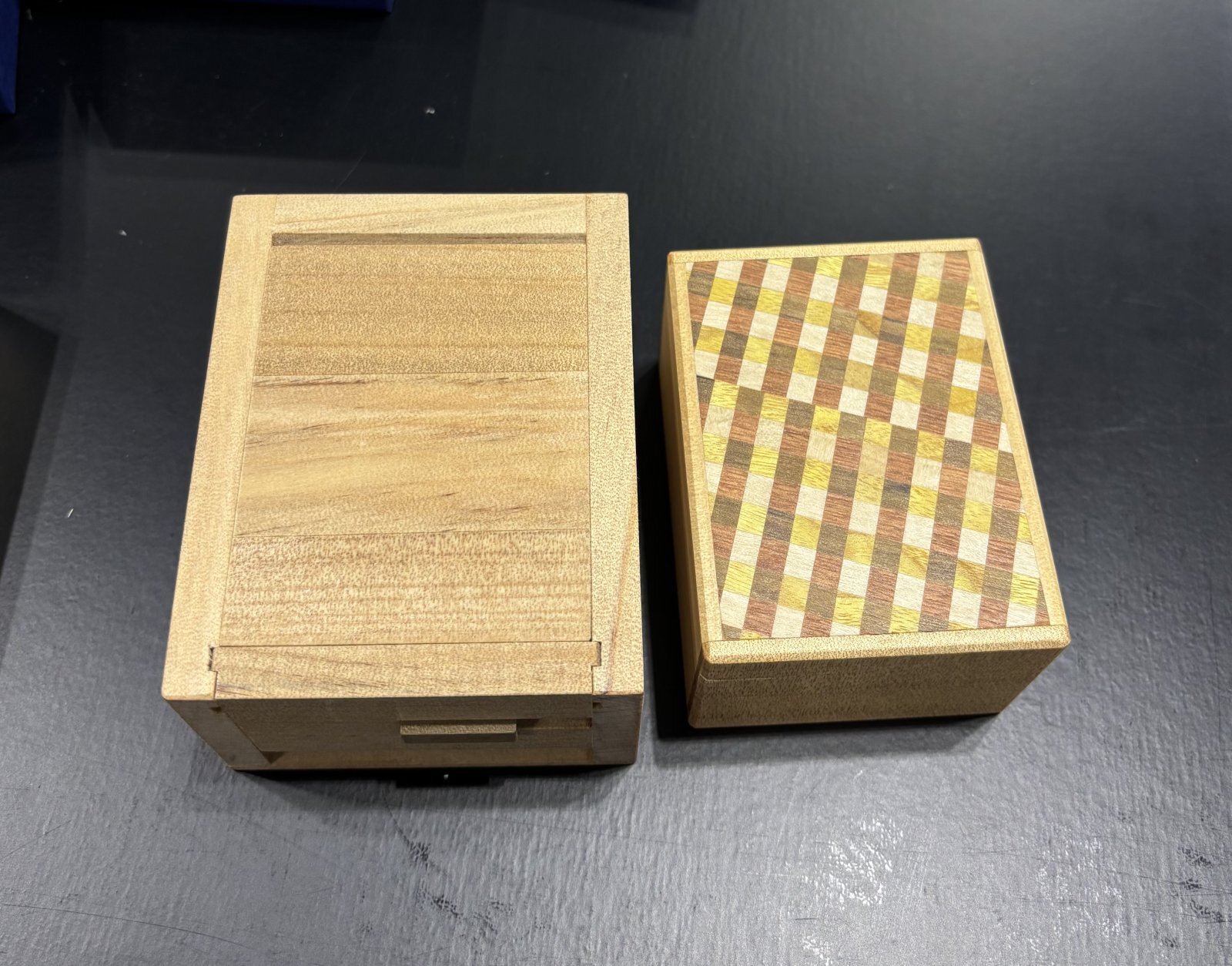
The other main purpose is to protect the mechanism. As I often write, the mechanism can be sensitive to very high humidity or extreme dryness. Since the parts are made of wood, they can swell or shrink as the surrounding conditions change. To understand how much a protective finish can reduce these effects, I need to observe the changes over time. This time, I had a chance to compare two boxes in the same inside place, and the difference was easy to see. The box on the left in the photo is made entirely of agathis. It has the same shape as the main structure of a Japanese puzzle box and is almost completely unfinished. On the right is a 3-sun 12-steps puzzle box with a checkered top panel and my usual clear finish. I tried the mechanisms of both boxes many times over two to three days in the same place. The panels on the agathis box did not warp, but they became much looser. Friction from moving the panels may have played a part, but I think the main reason was that the unfinished wood lost moisture and shrank as it dried. The checkered box, on the other hand, felt almost the same as it did at the start. Its mechanism is protected inside the box, which may have helped. I think the clear finish also helped by slowing down moisture loss from the wood. Japanese puzzle boxes use thin pieces of wood in many places, both in the outer panels and in the structure. This comparison reminded me how much a finish can help protect the wood and keep the mechanism working as intended.