The 2.5-sun Puzzle Box
It seems the rain over the past few days was caused by a typhoon. It apparently did not make landfall in Japan, but came close enough to bring rain. In any case, typhoon season should be coming to an end soon. The rain stopped today, and the weather began to improve with sunshine. I was out taking care of some personal matters, so I did not do any work in the workshop.
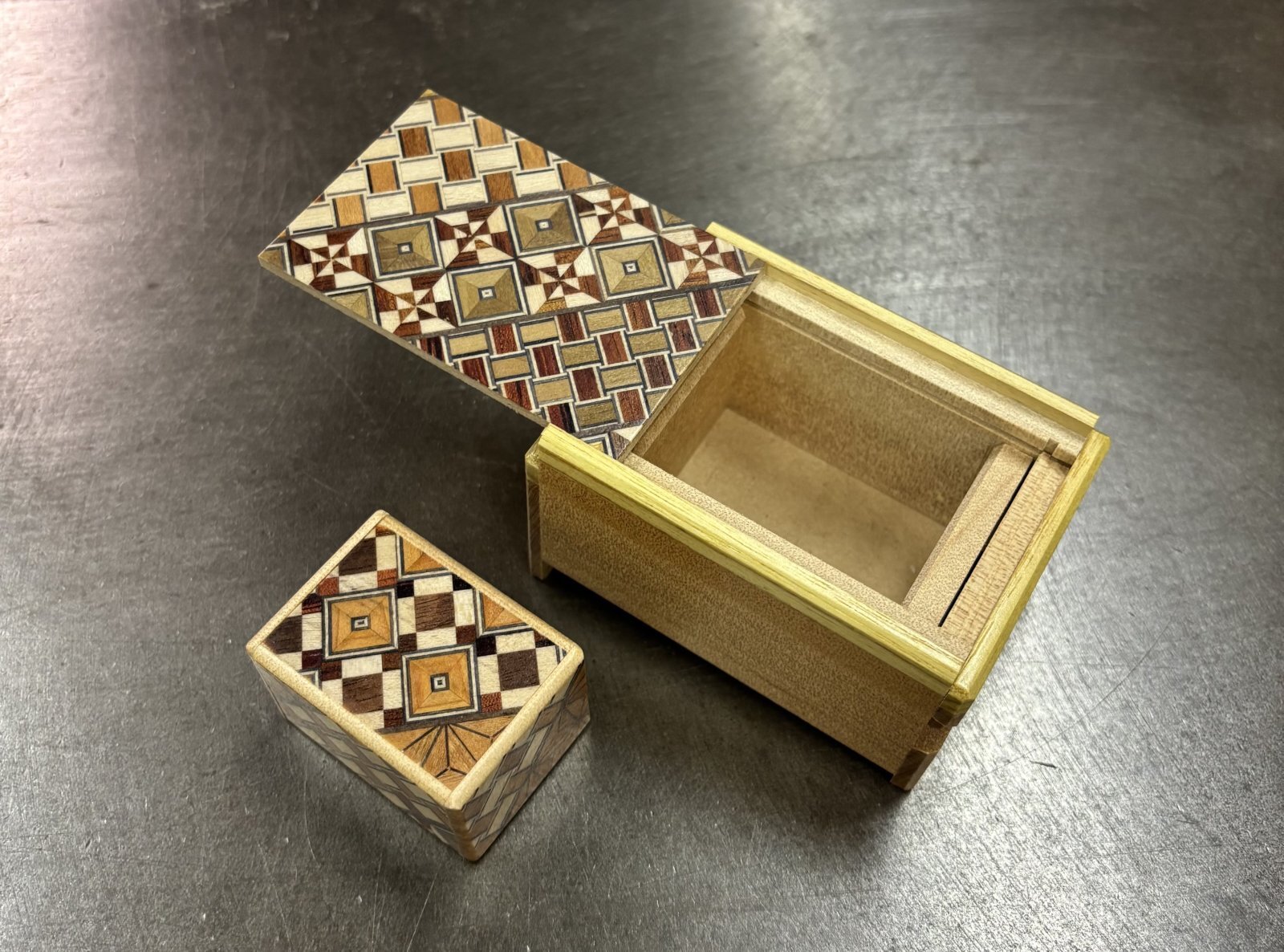
I started making Mame puzzle boxes yesterday, and I feel I have been making them quite often since around this summer. They are not all for my own shop, but several requests have come around the same time. On my website, I rarely sell Mame puzzle boxes on their own these days. Instead, I often sell them inside larger puzzle boxes as a nested set. Mame puzzle boxes have a different mechanism from standard Japanese puzzle boxes. They have no sliding key, and even the models with more steps open little by little, with the moves following a sequence around the box. These nested sets are popular with people who also want to experience the movement of a standard Japanese puzzle box, as they can enjoy both types of mechanism in one set. Since the outer box is made to fit a Mame puzzle box snugly inside, you can probably imagine that it is not very large either. Its outside length is about 7.5 cm (3 inches), so I sell it as a 2.5-sun box. It is a somewhat unusual size, and I use it only for this nested model. Because the outer box is small, there is limited room for a mechanism with many steps, so it opens in five steps. Even with just five steps, it has a sliding key on one side and moving panels on three faces, making it a slightly unusual 5-step mechanism.
I have been making quite a lot of Mame puzzle boxes, but I have not made many of these 2.5-sun boxes recently. As a result, I now have only one nested set left. I hope to make another batch of the 2.5-sun boxes this month if possible. As I wrote quite some time ago, these boxes have slightly different proportions from standard Japanese puzzle boxes, with a longer shape in relation to their width. This makes the movement very stable, and I find them satisfying to make!..haha. They are one of my favorite boxes. As you can see in the photo, the recent batches have had solid-wood side panels and yellow wood around the edge of the top panel. However, this yellow wood is a little difficult to work with and tends to split, so I am thinking of using a different wood for the next batch.
Have a great weekend!