Choosing Wood for the Borders
Today was also humid outside and felt quite hot, but it stayed cloudy all day and looked like it might rain at any time. Another typhoon is approaching the southern part of Japan, and because of its influence, we are expecting rain from now through the beginning of next week. Recently, more areas have been having very heavy rain, so I am a little worried. I have just started a new production batch, so today I was making parts. Both the 5-sun and 3-sun puzzle boxes are ready to start, but I decided to begin with the 3-sun boxes first.
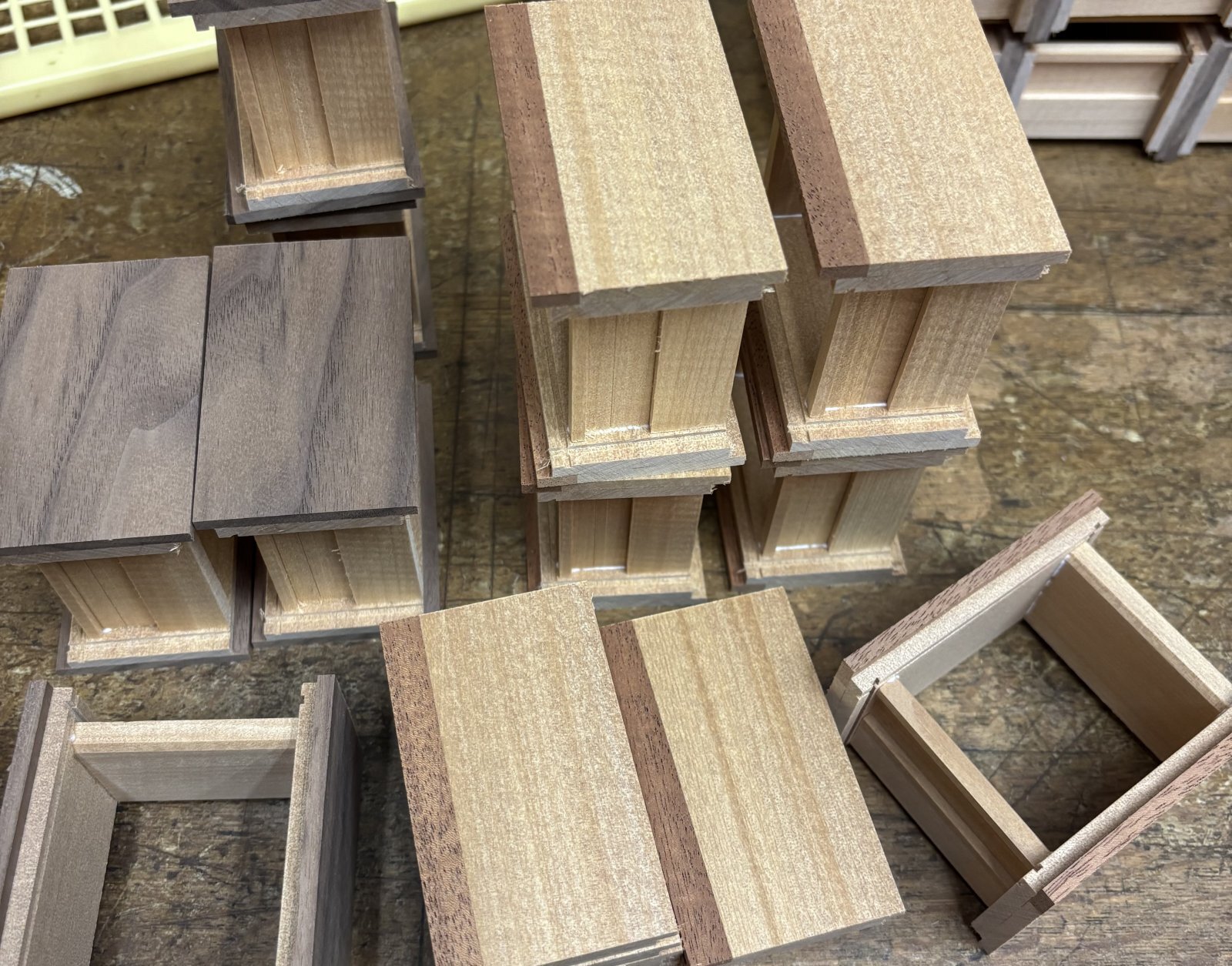
Today, I made the parts for the frames and assembled them. This time, I am making a mix of several different designs that were ordered, with about 60 boxes in total. The photo shows the frames. Most of them are for the Walnut design, but there are also a few that I call the “natural wood type.” Of course, Walnut is also natural wood, but I use this name simply to tell the two designs apart. For this design, the main frame is made from Agathis, with a different wood used only for the border around the top. This time, I am using Mahogany. The wood used for this border changes from time to time depending on what I have available, and this time Mahogany was the best choice. I previously made some using Nyatoh, and the customer saw those and ordered a similar design this time, so I chose Mahogany because it has a similar color. The customer said either wood would be fine. I had also explained beforehand that the wood used for this border may change. So if someone orders this natural wood type in the future, I may use a different wood again.
I have used this border design on many different puzzle boxes over the years. As long as the wood is not extremely hard, I can use many different kinds of wood for it, although there are some limits. In the past, I sometimes used Karin wood. It is very hard and the grain can be difficult to work with, so I had quite a hard time with it! 😅 It has a beautiful and high-quality look, but as a material for puzzle boxes, it is not always very suitable. I have also used light-colored woods such as Mizuki, and they work quite well. However, some woods split easily, and even if the wood itself is soft, this can make the work difficult. Rengas is probably the wood that gives me the most trouble with this. It has a beautiful deep red color and is also a nice material for Yosegi. The reason it is difficult to use here is that this upper border is directly next to the top panel. When I apply the finish, the finish can make the border stick to the top panel. When I separate them afterward, the wood can easily split along its fibers. If that happens, part of the border can break away, and it is quite difficult to repair. Purpleheart, which has a purple color, and Urushi wood, which has a yellow color, can also have the same problem. For the past few years, I have been using Urushi wood for the borders of my 2.5-sun puzzle boxes, so this has sometimes made the work a little difficult. Because of this, I plan to change to a different wood from the next batch.
Today, I made the parts for the frames and assembled them. This time, I am making a mix of several different designs that were ordered, with about 60 boxes in total. The photo shows the frames. Most of them are for the Walnut design, but there are also a few that I call the “natural wood type.” Of course, Walnut is also natural wood, but I use this name simply to tell the two designs apart. For this design, the main frame is made from Agathis, with a different wood used only for the border around the top. This time, I am using Mahogany. The wood used for this border changes from time to time depending on what I have available, and this time Mahogany was the best choice. I previously made some using Nyatoh, and the customer saw those and ordered a similar design this time, so I chose Mahogany because it has a similar color. The customer said either wood would be fine. I had also explained beforehand that the wood used for this border may change. So if someone orders this natural wood type in the future, I may use a different wood again.
I have used this border design on many different puzzle boxes over the years. As long as the wood is not extremely hard, I can use many different kinds of wood for it, although there are some limits. In the past, I sometimes used Karin wood. It is very hard and the grain can be difficult to work with, so I had quite a hard time with it! 😅 It has a beautiful and high-quality look, but as a material for puzzle boxes, it is not always very suitable. I have also used light-colored woods such as Mizuki, and they work quite well. However, some woods split easily, and even if the wood itself is soft, this can make the work difficult. Rengas is probably the wood that gives me the most trouble with this. It has a beautiful deep red color and is also a nice material for Yosegi. The reason it is difficult to use here is that this upper border is directly next to the top panel. When I apply the finish, the finish can make the border stick to the top panel. When I separate them afterward, the wood can easily split along its fibers. If that happens, part of the border can break away, and it is quite difficult to repair. Purpleheart, which has a purple color, and Urushi wood, which has a yellow color, can also have the same problem. For the past few years, I have been using Urushi wood for the borders of my 2.5-sun puzzle boxes, so this has sometimes made the work a little difficult. Because of this, I plan to change to a different wood from the next batch.