Handling Mame Puzzle Boxes
Today is the start of another new week, but it is also the last day of August. Like yesterday, the past few days have been cooler and much more comfortable. It was around 27°C (81°F) today. However, it is cloudy and looks like it may rain, so the humidity is still quite high. For many elementary and junior high schools in Japan, today is the last day of summer vacation. The end of summer always feels a little sad, but at my age, I’m also a little relieved that the hot weather is coming to an end! 🤣
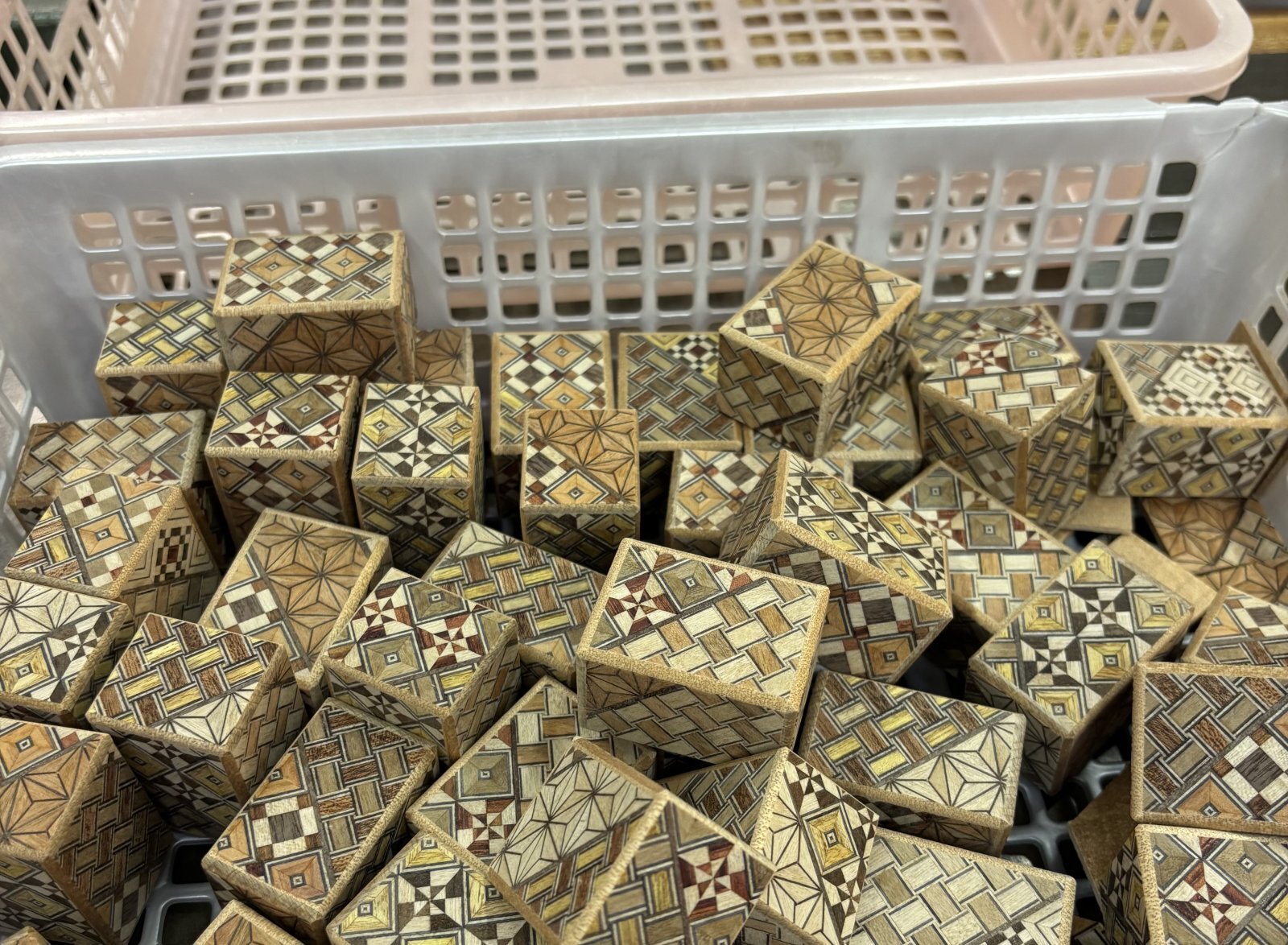
Today I worked on the final steps of the Mame 10-step puzzle boxes that I have been making for the past few days. This time, I made only about half the usual number. September starts tomorrow, and I already have plans to begin making something else, so I decided to make only as many as I could finish before then. In the photo, the corners have been rounded and the boxes have had their final sanding. They are now ready for the finishing process.
You may think they look a little messy in the basket even though the finishing work is done. But this is actually the usual way I handle Mame puzzle boxes while making them. Of course, when I attach the panels or apply the finish, I line them up neatly and sometimes hold them together with rubber bands. But during most other steps, I keep them in baskets like this. For example, when I round the corners as part of the final work, I finish one box and then simply move it into the basket next to me. The reason I can do this is, of course, because they are so small. With regular-size puzzle boxes, I always keep them lined up and stacked during any kind of work. If I put many larger boxes together in a basket, their weight would cause them to hit each other and possibly leave scratches. Mame puzzle boxes are very light, so as long as I don’t handle them too roughly, they will not be damaged even if they bump into each other. Mame puzzle boxes are only about 4 cm (1.6 inches) across, so stacking such small boxes is not very practical. Even a small vibration or accidentally touching them with my hand can easily make the stack fall over. That is why I usually handle them in baskets, as you can see in the photo. It is also safer and faster to carry them together in a basket than to move many larger puzzle boxes while keeping them neatly lined up.
Today, I also attached Yosegi sheets to the boards for the 5-sun puzzle boxes. The 36-step puzzle box is currently sold out on my website, so I plan to make more of them in September. I still have some boards with Yosegi sheets attached from the last batch, so this time I only needed to prepare a few more. From now on, I don’t think we will have as many extremely hot days, so it should be easier to work on puzzle boxes with detailed mechanisms like this. However, September often has many rainy days in Japan, so I will also need to adjust my work depending on the weather.
Today I worked on the final steps of the Mame 10-step puzzle boxes that I have been making for the past few days. This time, I made only about half the usual number. September starts tomorrow, and I already have plans to begin making something else, so I decided to make only as many as I could finish before then. In the photo, the corners have been rounded and the boxes have had their final sanding. They are now ready for the finishing process.
You may think they look a little messy in the basket even though the finishing work is done. But this is actually the usual way I handle Mame puzzle boxes while making them. Of course, when I attach the panels or apply the finish, I line them up neatly and sometimes hold them together with rubber bands. But during most other steps, I keep them in baskets like this. For example, when I round the corners as part of the final work, I finish one box and then simply move it into the basket next to me. The reason I can do this is, of course, because they are so small. With regular-size puzzle boxes, I always keep them lined up and stacked during any kind of work. If I put many larger boxes together in a basket, their weight would cause them to hit each other and possibly leave scratches. Mame puzzle boxes are very light, so as long as I don’t handle them too roughly, they will not be damaged even if they bump into each other. Mame puzzle boxes are only about 4 cm (1.6 inches) across, so stacking such small boxes is not very practical. Even a small vibration or accidentally touching them with my hand can easily make the stack fall over. That is why I usually handle them in baskets, as you can see in the photo. It is also safer and faster to carry them together in a basket than to move many larger puzzle boxes while keeping them neatly lined up.
Today, I also attached Yosegi sheets to the boards for the 5-sun puzzle boxes. The 36-step puzzle box is currently sold out on my website, so I plan to make more of them in September. I still have some boards with Yosegi sheets attached from the last batch, so this time I only needed to prepare a few more. From now on, I don’t think we will have as many extremely hot days, so it should be easier to work on puzzle boxes with detailed mechanisms like this. However, September often has many rainy days in Japan, so I will also need to adjust my work depending on the weather.