Mame 10-Step Aruki Panels
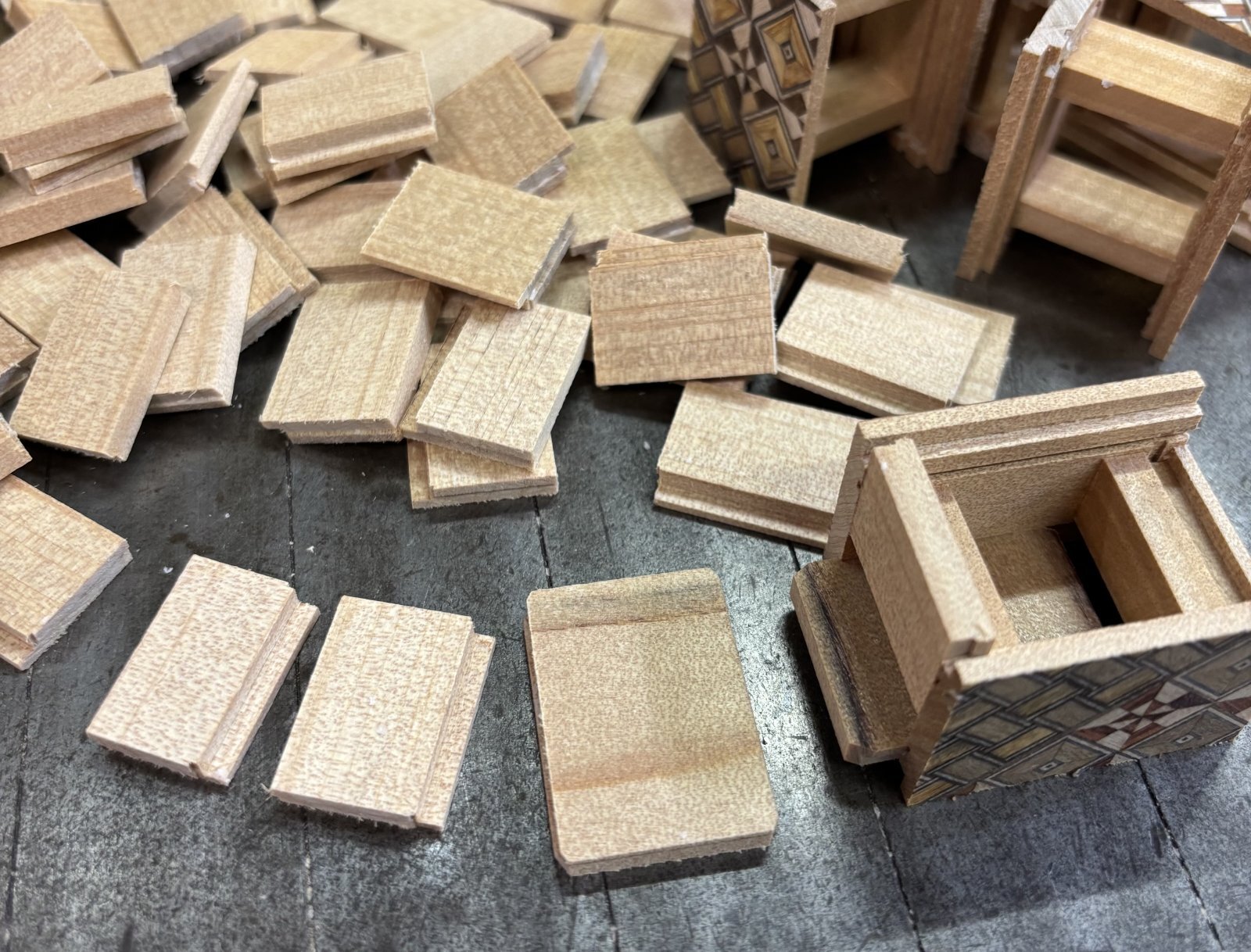
The weather is expected to be much more comfortable during the second half of this week, with lower temperatures. After the intense heat we had recently, that is certainly a welcome change. I had a few errands to take care of today, so I only had a limited amount of time to work in the workshop. Even so, I continued making the 10-step Mame puzzle boxes. Today I mainly made the Aruki panels and assembled the remaining frame panels. The photo shows the Aruki panels.
Like my other Mame puzzle boxes, the Aruki sliding panels are cut with stepped grooves. Since this is the 10-step version, the side Aruki panels have only two steps. Even with just two steps, the four sliding panels produce a total of 10 moves. The Aruki panels are the same thickness as those used in the 14-step version, at 4.3 mm. This means each movement is longer, making the mechanism less demanding to adjust during production. The biggest feature of this Aruki panel is that the top and bottom Aruki panels have a completely flat shape. On versions with more steps, the top and bottom Aruki panels have stepped cuts toward the front, but this version does not. As a result, they can be attached in either direction. Incidentally, if I were to make the same four-panel sequential mechanism with fewer steps, it would become a 6-step puzzle box. In that case, the side Aruki panels would not have any stepped cuts either.
I have always liked the 10-step mechanism. I enjoy making it because it feels like a very well-balanced design. It is not simply that it is more efficient to produce. Rather, the movement of the mechanism itself feels especially stable. In general, Aruki panels are thought to be more stable when their supporting legs are longer. However, the Aruki panels used in the 10-step mechanism are actually shorter than those used in versions such as the 14-step puzzle box. Perhaps it is only my own impression, but since the stepped cuts do not actually touch the moving parts of the mechanism, I wonder if the stability comes from the relationship between the travel distance and the length of the panel. I cannot really prove this physically, but there may be an ideal balance between those proportions. When making puzzle boxes like these, many things are based on a craftsman's experience and intuition. I think there are often subtle interactions—little "magic" between the different parts—that even the maker does not fully realize, yet they help create a better mechanism.
The 4-sun 14-step puzzle boxes are scheduled to be finished this weekend. In addition to the standard Yosegi version, I also made a small number of the random wood design. I expect to list them on my website early next week.
Have a great weekend!
Like my other Mame puzzle boxes, the Aruki sliding panels are cut with stepped grooves. Since this is the 10-step version, the side Aruki panels have only two steps. Even with just two steps, the four sliding panels produce a total of 10 moves. The Aruki panels are the same thickness as those used in the 14-step version, at 4.3 mm. This means each movement is longer, making the mechanism less demanding to adjust during production. The biggest feature of this Aruki panel is that the top and bottom Aruki panels have a completely flat shape. On versions with more steps, the top and bottom Aruki panels have stepped cuts toward the front, but this version does not. As a result, they can be attached in either direction. Incidentally, if I were to make the same four-panel sequential mechanism with fewer steps, it would become a 6-step puzzle box. In that case, the side Aruki panels would not have any stepped cuts either.
I have always liked the 10-step mechanism. I enjoy making it because it feels like a very well-balanced design. It is not simply that it is more efficient to produce. Rather, the movement of the mechanism itself feels especially stable. In general, Aruki panels are thought to be more stable when their supporting legs are longer. However, the Aruki panels used in the 10-step mechanism are actually shorter than those used in versions such as the 14-step puzzle box. Perhaps it is only my own impression, but since the stepped cuts do not actually touch the moving parts of the mechanism, I wonder if the stability comes from the relationship between the travel distance and the length of the panel. I cannot really prove this physically, but there may be an ideal balance between those proportions. When making puzzle boxes like these, many things are based on a craftsman's experience and intuition. I think there are often subtle interactions—little "magic" between the different parts—that even the maker does not fully realize, yet they help create a better mechanism.
The 4-sun 14-step puzzle boxes are scheduled to be finished this weekend. In addition to the standard Yosegi version, I also made a small number of the random wood design. I expect to list them on my website early next week.
Have a great weekend!