Side Panel Yosegi Sheets
Today was another extremely hot day, just like yesterday. I went out for a while during the day, and it felt almost dangerous to be outside because of the heat. The strong sunshine made it feel even hotter. As a result, brief but heavy evening showers developed in many places after sunset.
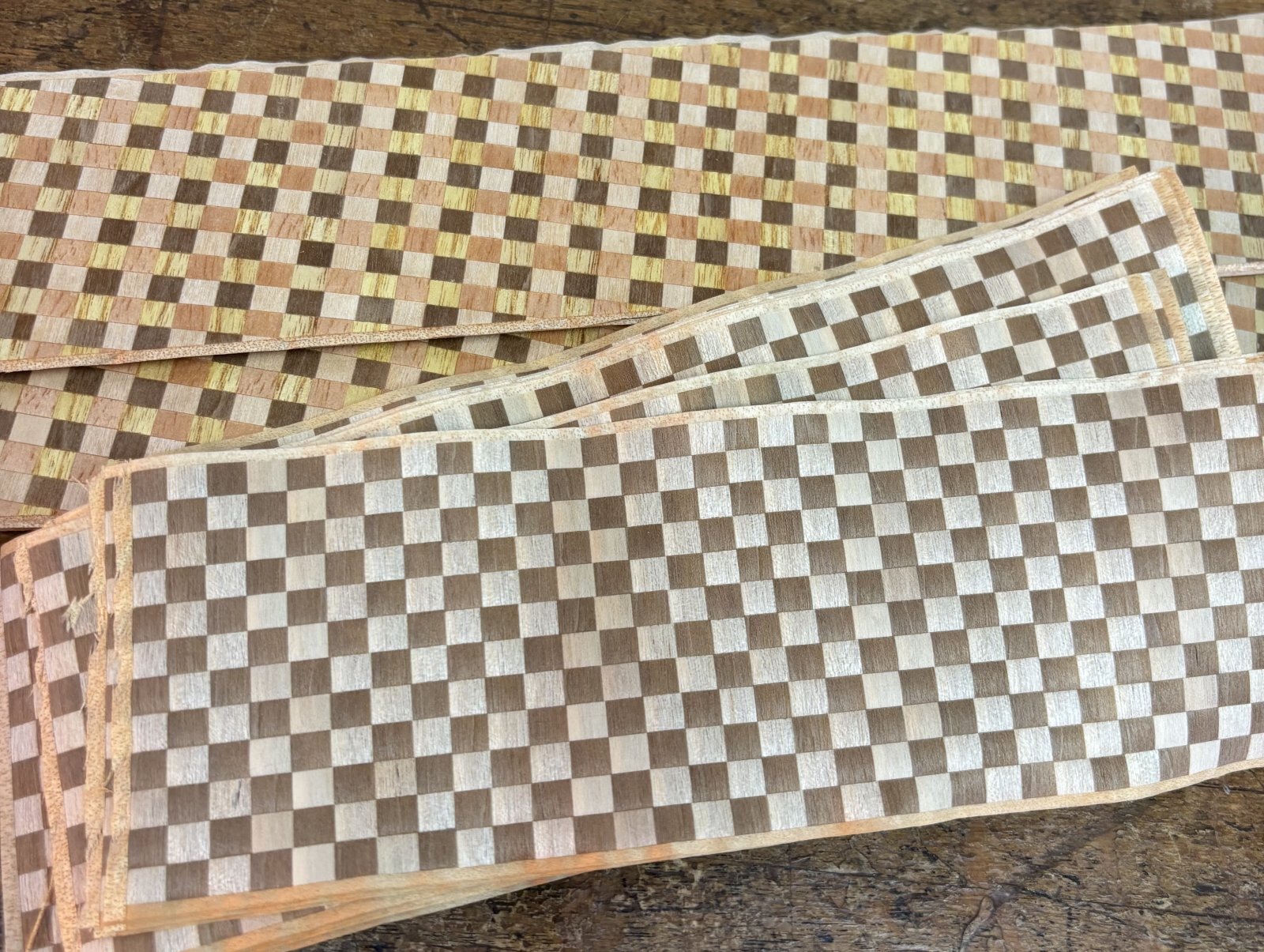
Today, as I did yesterday, I attached the sliding key panels for the 4-sun puzzle boxes. With that, the assembly of this batch is now complete. From here, I will let the boxes settle for a while before moving on to the finishing process. On a hot day like today, I cannot do the finishing work. Instead, I will wait for a rainy day with higher humidity before starting that stage. I have already planned several projects for September, but I cannot start them just yet because some of the materials still need to be prepared. While I am waiting, I decided to make another batch of 10-step Mame puzzle boxes. One of the biggest shortages at the moment is the Yosegi sheets for the side panels. Recently, I have been using a lot of checkered Yosegi sheets, and my supply has become quite low. Of course, I will start making more soon, but it takes a little time. It is not that I have completely run out. I still have enough sheets to make a few boxes in each pattern. However, I normally need to make at least thirty boxes in a batch, and I do not have enough material for that. In other words, I need to make more Yosegi sheets before I can begin those projects. Compared with the number of sheets I can produce at one time, they are used up surprisingly quickly, so I often find myself needing to make more. In the meantime, I decided to continue with the 10-step Mame puzzle boxes. They require only a small amount of Yosegi, and for this traditional Yosegi style, the decorative sheets are made by a specialist craftsman, so I do not have to prepare them myself.
The 10-step Mame puzzle box is the easiest Mame puzzle box for me to make. There is also a 4-step version, but its structure is quite different from that of the standard Mame puzzle box. Among the Mame puzzle boxes with four sliding panels that move in sequence, the 10-step version has the largest movement in its mechanism. Because of that, the adjustment is less critical than on the other versions. Even so, the difference is only about 0.1 to 0.2 mm. On a Mame puzzle box, however, such a small difference has a significant effect on how the mechanism works.
https://www.japanesepuzzlebox.jp/product/2
Today, as I did yesterday, I attached the sliding key panels for the 4-sun puzzle boxes. With that, the assembly of this batch is now complete. From here, I will let the boxes settle for a while before moving on to the finishing process. On a hot day like today, I cannot do the finishing work. Instead, I will wait for a rainy day with higher humidity before starting that stage. I have already planned several projects for September, but I cannot start them just yet because some of the materials still need to be prepared. While I am waiting, I decided to make another batch of 10-step Mame puzzle boxes. One of the biggest shortages at the moment is the Yosegi sheets for the side panels. Recently, I have been using a lot of checkered Yosegi sheets, and my supply has become quite low. Of course, I will start making more soon, but it takes a little time. It is not that I have completely run out. I still have enough sheets to make a few boxes in each pattern. However, I normally need to make at least thirty boxes in a batch, and I do not have enough material for that. In other words, I need to make more Yosegi sheets before I can begin those projects. Compared with the number of sheets I can produce at one time, they are used up surprisingly quickly, so I often find myself needing to make more. In the meantime, I decided to continue with the 10-step Mame puzzle boxes. They require only a small amount of Yosegi, and for this traditional Yosegi style, the decorative sheets are made by a specialist craftsman, so I do not have to prepare them myself.
The 10-step Mame puzzle box is the easiest Mame puzzle box for me to make. There is also a 4-step version, but its structure is quite different from that of the standard Mame puzzle box. Among the Mame puzzle boxes with four sliding panels that move in sequence, the 10-step version has the largest movement in its mechanism. Because of that, the adjustment is less critical than on the other versions. Even so, the difference is only about 0.1 to 0.2 mm. On a Mame puzzle box, however, such a small difference has a significant effect on how the mechanism works.
https://www.japanesepuzzlebox.jp/product/2