The Glue Surface
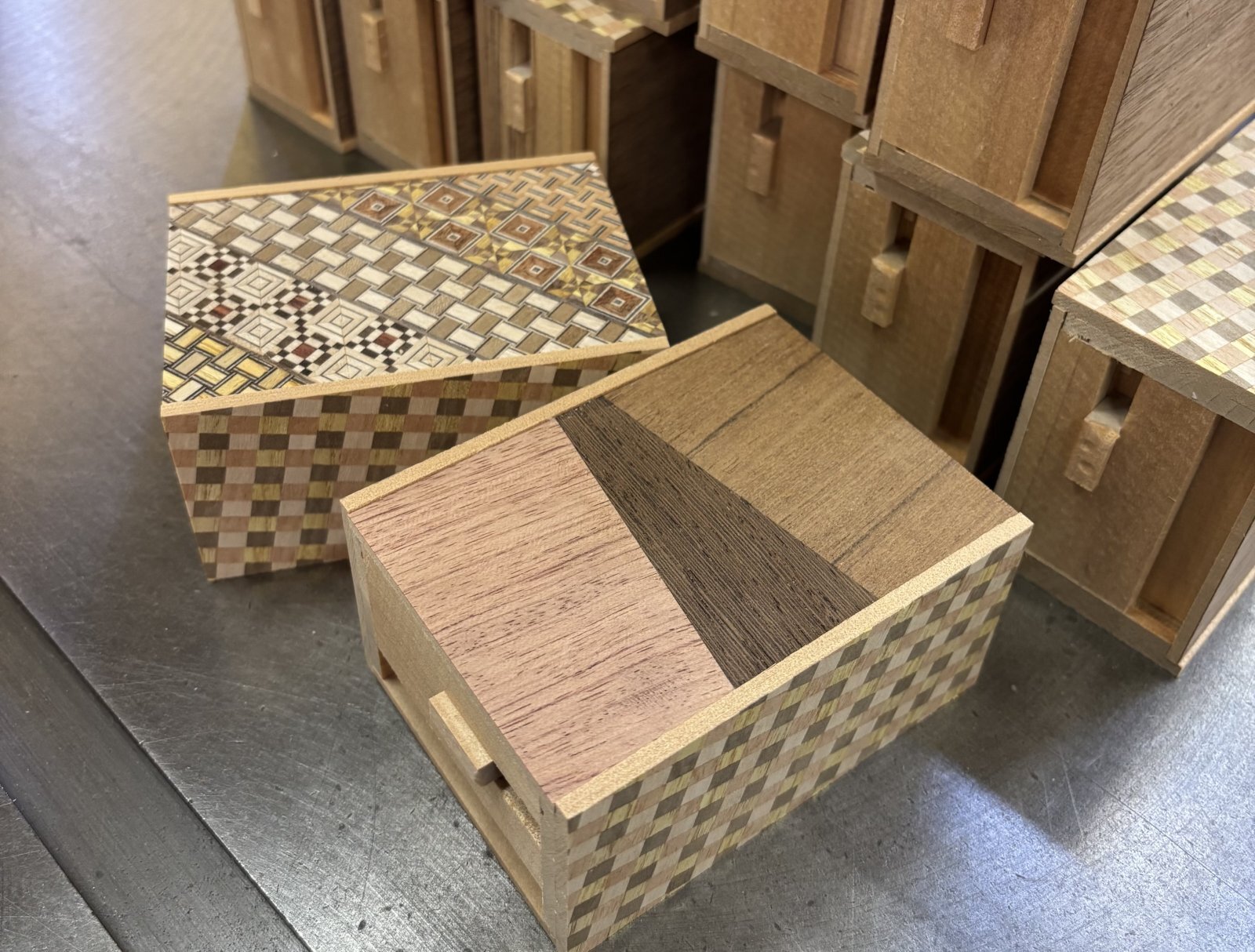
Today brought another peak in the summer heat. The temperature climbed to around 35°C, and the intense heat returned. Fortunately, the humidity was a little lower, which made it a better day for working. Today I made and attached the sliding key panels for the 4-sun 14-step puzzle boxes.
This time I am making two versions, as shown in the photo: the traditional Yosegi model and the random wood design. The random wood version is limited to about ten boxes. Both versions use the same four-color checkered Yosegi for the side panels. Since today's weather was hot but relatively dry, I attached the side with the smaller glue surface first. After leaving it overnight, I will attach the other side tomorrow. The side with the smaller glue surface is more likely to warp later, so I always pay extra attention to it. That is why I try to do this step on days with lower humidity whenever possible.
Even without this issue, the 4-sun puzzle box has a challenging balance between the size of the panels and the available glue surface. Compared with the size of the panels, the top and bottom glue areas are quite narrow. Because of this, deciding the proportions of the three sections of the sliding key panel has always been an important part of the design. For the past few years, I have kept these dimensions almost unchanged. Before that, however, I adjusted the sizes of the three sections many times. The center section is the moving part, known as the sliding key. Ideally, I want to make the largest lower section as large as possible because it provides the greatest glue surface and is the part most likely to warp. To do that, however, the sliding key itself and the narrow upper section would both have to be made even thinner, and there is a practical limit to how far that can be taken. In other words, the ideal solution would be to make the 4-sun puzzle box slightly taller. To address this issue, I used to make a 4.2-sun version, which was slightly larger and had a stronger structure. For this batch, I also increased the height by about 0.5 mm compared with the earlier design to gain a little more glue surface. Although 0.5 mm sounds like a very small change, it makes a noticeable difference. The design of the 4-sun sliding key panel is that sensitive to small changes in the available glue area.
This time I am making two versions, as shown in the photo: the traditional Yosegi model and the random wood design. The random wood version is limited to about ten boxes. Both versions use the same four-color checkered Yosegi for the side panels. Since today's weather was hot but relatively dry, I attached the side with the smaller glue surface first. After leaving it overnight, I will attach the other side tomorrow. The side with the smaller glue surface is more likely to warp later, so I always pay extra attention to it. That is why I try to do this step on days with lower humidity whenever possible.
Even without this issue, the 4-sun puzzle box has a challenging balance between the size of the panels and the available glue surface. Compared with the size of the panels, the top and bottom glue areas are quite narrow. Because of this, deciding the proportions of the three sections of the sliding key panel has always been an important part of the design. For the past few years, I have kept these dimensions almost unchanged. Before that, however, I adjusted the sizes of the three sections many times. The center section is the moving part, known as the sliding key. Ideally, I want to make the largest lower section as large as possible because it provides the greatest glue surface and is the part most likely to warp. To do that, however, the sliding key itself and the narrow upper section would both have to be made even thinner, and there is a practical limit to how far that can be taken. In other words, the ideal solution would be to make the 4-sun puzzle box slightly taller. To address this issue, I used to make a 4.2-sun version, which was slightly larger and had a stronger structure. For this batch, I also increased the height by about 0.5 mm compared with the earlier design to gain a little more glue surface. Although 0.5 mm sounds like a very small change, it makes a noticeable difference. The design of the 4-sun sliding key panel is that sensitive to small changes in the available glue area.