Adjusting the Aruki Sides
Although today is Monday, some people may already be on their Obon holiday. In Japan, many people are off work until August 16 during this holiday period. At this time of year, there are often many traffic accidents on the expressways, so even when driving to my workshop, I have to be careful. Traffic jams caused by accidents can make the journey much longer than expected. Because of that, I often leave at a different time and regularly check traffic information using an app. This morning, just as I was heading to the workshop, there was an accident on the expressway, and it was completely closed for several hours. Fortunately, it was in the opposite direction from where I was going. As a result, many cars waiting for the expressway to reopen formed long lines on the local roads.
Today I worked on the Aruki panels for the 18-step Mame puzzle boxes. Recently, I have often split this process into two days, but this time I finished it all in one day. The reason is that the stepped mechanism of the 18-step design requires much finer machining, which takes more time and can be quite tiring. This time, however, I had enough time, so I completed the work by dividing it between the morning and the afternoon. The width of each step is the same as on the 14-step version, about 1.4 mm, but the 18-step version has more steps. The 22-step version that I used to make was even finer, at about 1.2 mm. As I mentioned before, that design is not very suitable for larger production. It needs to be made in smaller quantities and requires more time for each box.
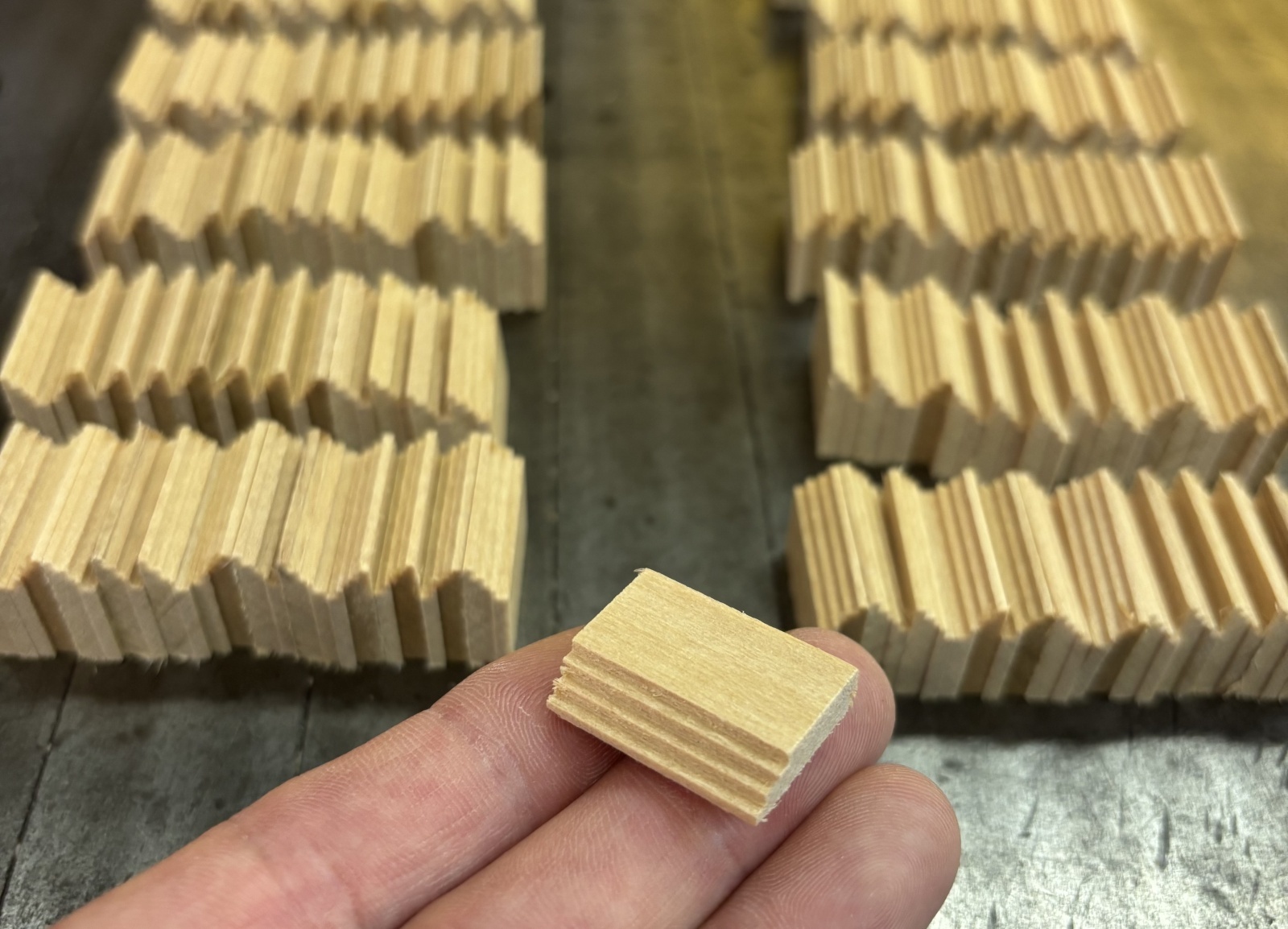
The photo shows the final step of making the Aruki sliding panels. This is where I cut the sides of the panels to form the small edges that fit into the sliding grooves. You might wonder why I cut away part of the edges after taking the time to make them. The reason is that if I install the Aruki panels as they are, they cannot slide far enough. In these Mame puzzle boxes, the grooves for the Aruki panels are intentionally cut only partway, which causes the panels to stop at a specific point. This is an essential part of the mechanism, but the panels need to travel just a little farther for the mechanism to work properly. To achieve that, I carefully trim the edges of the Aruki panel so it can slide a little farther. I remove only the minimum amount because cutting too much would weaken the panel's support.
On the 18-step version, I normally trim only the edge of the smaller of the two Aruki panels. I adjust it while actually fitting the panels into the box and checking how far they move. It is a very delicate adjustment, and depending on how the panels were made, I sometimes need to adjust the other panel as well. It really is a matter of tiny differences. If the other panel cannot move far enough, the next panel will not move. On the other hand, if I trim the edge too much, the next panel could slide out completely, so the adjustment has to be made very carefully.
Today I worked on the Aruki panels for the 18-step Mame puzzle boxes. Recently, I have often split this process into two days, but this time I finished it all in one day. The reason is that the stepped mechanism of the 18-step design requires much finer machining, which takes more time and can be quite tiring. This time, however, I had enough time, so I completed the work by dividing it between the morning and the afternoon. The width of each step is the same as on the 14-step version, about 1.4 mm, but the 18-step version has more steps. The 22-step version that I used to make was even finer, at about 1.2 mm. As I mentioned before, that design is not very suitable for larger production. It needs to be made in smaller quantities and requires more time for each box.
The photo shows the final step of making the Aruki sliding panels. This is where I cut the sides of the panels to form the small edges that fit into the sliding grooves. You might wonder why I cut away part of the edges after taking the time to make them. The reason is that if I install the Aruki panels as they are, they cannot slide far enough. In these Mame puzzle boxes, the grooves for the Aruki panels are intentionally cut only partway, which causes the panels to stop at a specific point. This is an essential part of the mechanism, but the panels need to travel just a little farther for the mechanism to work properly. To achieve that, I carefully trim the edges of the Aruki panel so it can slide a little farther. I remove only the minimum amount because cutting too much would weaken the panel's support.
On the 18-step version, I normally trim only the edge of the smaller of the two Aruki panels. I adjust it while actually fitting the panels into the box and checking how far they move. It is a very delicate adjustment, and depending on how the panels were made, I sometimes need to adjust the other panel as well. It really is a matter of tiny differences. If the other panel cannot move far enough, the next panel will not move. On the other hand, if I trim the edge too much, the next panel could slide out completely, so the adjustment has to be made very carefully.