The Fit of the Top Panel
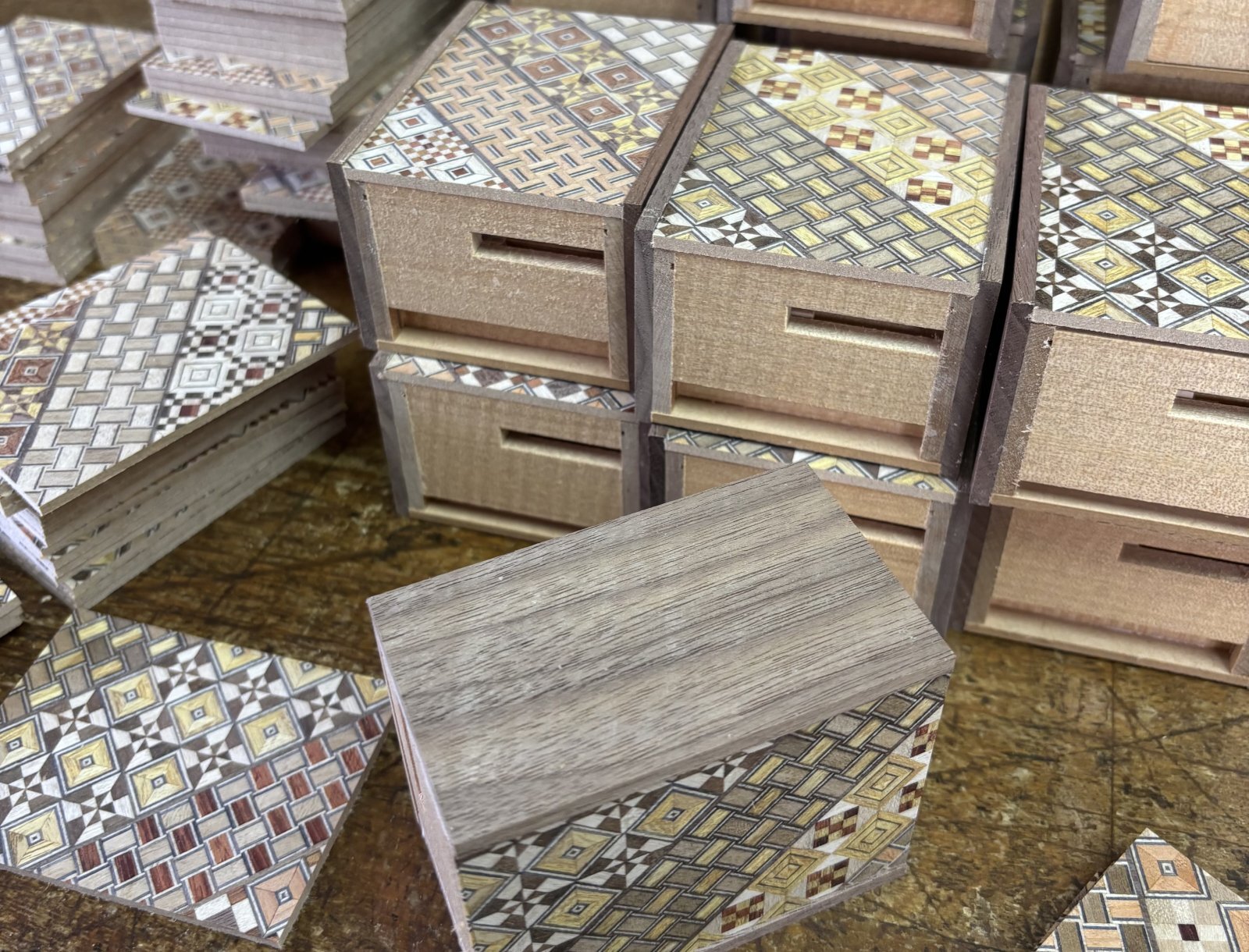
It is a new week, and I am continuing the production of the 3-sun 12-step puzzle boxes. Today, I attached the top and bottom panels. Since there are quite a lot of boxes this time, after finishing that work, I plan to move on first with the natural wood design boxes. From this point, I will make the two designs separately. The photo shows the panel attaching work. Most of the boxes are the traditional yosegi type, but I also attached some natural wood panels.
When I make these panels, I cut them all to the same size. That may sound obvious, but in practice, it is difficult and can cause problems. Even if the panels are the same size, the boxes they are attached to are all slightly different in size. When I try fitting one panel to several boxes, it may be too tight for some and too loose for others. So, when making the panels, I take out about ten boxes that are still in production and adjust the panel size so that it fits all of them reasonably well. I cut the panels to a middle size, so that none of them are too loose and none are too tight.
Even though I say the boxes are slightly different in size, the difference is not large enough to see with the eye. It is only a very small difference. So, I actually test the panels on about ten, and sometimes twenty, boxes without glue, checking the fit again and again as I cut them. At this point, it is no longer something that can be decided only by measurements. It is a way of making Japanese puzzle boxes by feel, which is very important in this kind of work. The fit of this panel also affects how smoothly the top panel slides, so it is an important adjustment. In general, it is better for the top panel to be slightly tight at first, because it is easier to loosen it later, and it also tends to become looser over time. One main reason is that the top panel moves in the same direction as the grain of the supporting panel, which is the long side panel of the box.
When I make these panels, I cut them all to the same size. That may sound obvious, but in practice, it is difficult and can cause problems. Even if the panels are the same size, the boxes they are attached to are all slightly different in size. When I try fitting one panel to several boxes, it may be too tight for some and too loose for others. So, when making the panels, I take out about ten boxes that are still in production and adjust the panel size so that it fits all of them reasonably well. I cut the panels to a middle size, so that none of them are too loose and none are too tight.
Even though I say the boxes are slightly different in size, the difference is not large enough to see with the eye. It is only a very small difference. So, I actually test the panels on about ten, and sometimes twenty, boxes without glue, checking the fit again and again as I cut them. At this point, it is no longer something that can be decided only by measurements. It is a way of making Japanese puzzle boxes by feel, which is very important in this kind of work. The fit of this panel also affects how smoothly the top panel slides, so it is an important adjustment. In general, it is better for the top panel to be slightly tight at first, because it is easier to loosen it later, and it also tends to become looser over time. One main reason is that the top panel moves in the same direction as the grain of the supporting panel, which is the long side panel of the box.