Durable Puzzle Box?
Today we had one of those pleasant sunny breaks in the rainy season, and the temperature rose as well. In Japan, a sunny day during the rainy season is sometimes called Satsuki-bare, as the weather is said to resemble the clear days of May. With the humidity dropping to a more comfortable level, I took the opportunity to complete several important steps on the special-order boxes for the Japanese market. I attached the Aruki sliding panels and then made and attached the top and bottom panels, all in one day. The weather should remain fair during the daytime tomorrow, but rain is expected to return tomorrow night, bringing back the typical rainy-season conditions. That is why I decided to get this work done today.
Attaching the Aruki panels is certainly affected by humidity, but the top and bottom panel process is even more sensitive. The reason is that the top and bottom panels—the outer Yosegi panels attached to the structure box—are very thin, only about 3 mm thick. Because of this, they are highly affected by changes in the environment. They can easily absorb moisture and expand, or dry out and shrink. They are very delicate parts. When you look at old Japanese puzzle boxes, you can sometimes see gaps between the side panels and the top or bottom panels where the wood has shrunk. In other cases, the edges of the panels have warped and lifted slightly. This kind of damage is often caused by environmental conditions. Even when a box is kept indoors, problems can occur if it is placed near a sunny window or in a location where air-conditioning blows directly onto it. Ideally, puzzle boxes should be stored out of direct sunlight and kept in a plastic bag when not in use. This helps preserve their condition for a much longer time. For this reason, I try to do the machining and installation of these panels on clear, dry days like today, when the conditions are more stable.
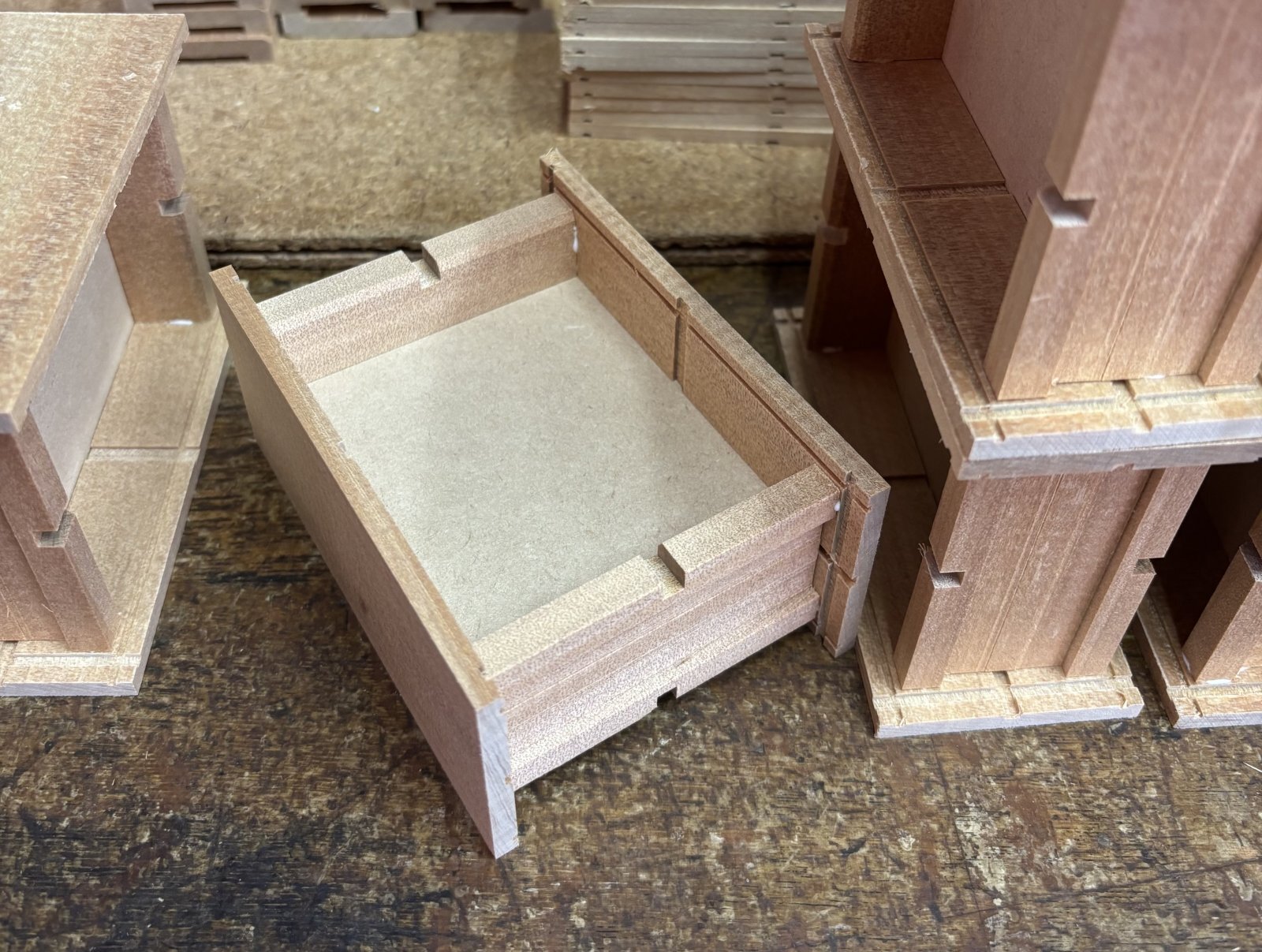
I spent most of the day on those tasks, but before finishing work I was able to spend a little time assembling the frame structure of the 4-Compartment Boxes. As you can see in the photo, this box has a horizontal divider in the middle that separates the upper and lower sections. At this stage, the structure is similar to a double-compartment box. It may be difficult to tell from the photo, but the box is about the same length as a 4-sun box, although it is slightly wider and taller. Since the mechanism moves in the same way on both the left and right sides, the overall size was increased slightly to accommodate the design. The last time I made this box was more than 10 years ago. At that time, I had already redesigned it to be somewhat smaller than the original version. Before that, the box was even larger. After the frame structure is assembled, vertical divider panels are inserted into the center. The slots for those dividers can be seen in the photo. Two dividers are needed for each box, one for the upper section and one for the lower section. If I remember correctly, the dividers in the previous version were about 3 mm thick. This time I increased the thickness to 4 mm to make the structure stronger. As a result, the standard four-panel frame structure used in Japanese puzzle boxes contains three internal divider panels, making it a very sturdy box. Of course, these dividers are fitted as closely as possible to the inside of the frame and are also glued in place. The goal was simply to create the unique four-compartment structure, but as a result, the box ended up becoming quite sturdy as well... haha😅
Attaching the Aruki panels is certainly affected by humidity, but the top and bottom panel process is even more sensitive. The reason is that the top and bottom panels—the outer Yosegi panels attached to the structure box—are very thin, only about 3 mm thick. Because of this, they are highly affected by changes in the environment. They can easily absorb moisture and expand, or dry out and shrink. They are very delicate parts. When you look at old Japanese puzzle boxes, you can sometimes see gaps between the side panels and the top or bottom panels where the wood has shrunk. In other cases, the edges of the panels have warped and lifted slightly. This kind of damage is often caused by environmental conditions. Even when a box is kept indoors, problems can occur if it is placed near a sunny window or in a location where air-conditioning blows directly onto it. Ideally, puzzle boxes should be stored out of direct sunlight and kept in a plastic bag when not in use. This helps preserve their condition for a much longer time. For this reason, I try to do the machining and installation of these panels on clear, dry days like today, when the conditions are more stable.
I spent most of the day on those tasks, but before finishing work I was able to spend a little time assembling the frame structure of the 4-Compartment Boxes. As you can see in the photo, this box has a horizontal divider in the middle that separates the upper and lower sections. At this stage, the structure is similar to a double-compartment box. It may be difficult to tell from the photo, but the box is about the same length as a 4-sun box, although it is slightly wider and taller. Since the mechanism moves in the same way on both the left and right sides, the overall size was increased slightly to accommodate the design. The last time I made this box was more than 10 years ago. At that time, I had already redesigned it to be somewhat smaller than the original version. Before that, the box was even larger. After the frame structure is assembled, vertical divider panels are inserted into the center. The slots for those dividers can be seen in the photo. Two dividers are needed for each box, one for the upper section and one for the lower section. If I remember correctly, the dividers in the previous version were about 3 mm thick. This time I increased the thickness to 4 mm to make the structure stronger. As a result, the standard four-panel frame structure used in Japanese puzzle boxes contains three internal divider panels, making it a very sturdy box. Of course, these dividers are fitted as closely as possible to the inside of the frame and are also glued in place. The goal was simply to create the unique four-compartment structure, but as a result, the box ended up becoming quite sturdy as well... haha😅