Machining Delicate Parts
The hot weather continues today. When it gets this hot, I worry that the box panels may warp, so I try not to leave items that are still being made in high temperatures for long periods of time.
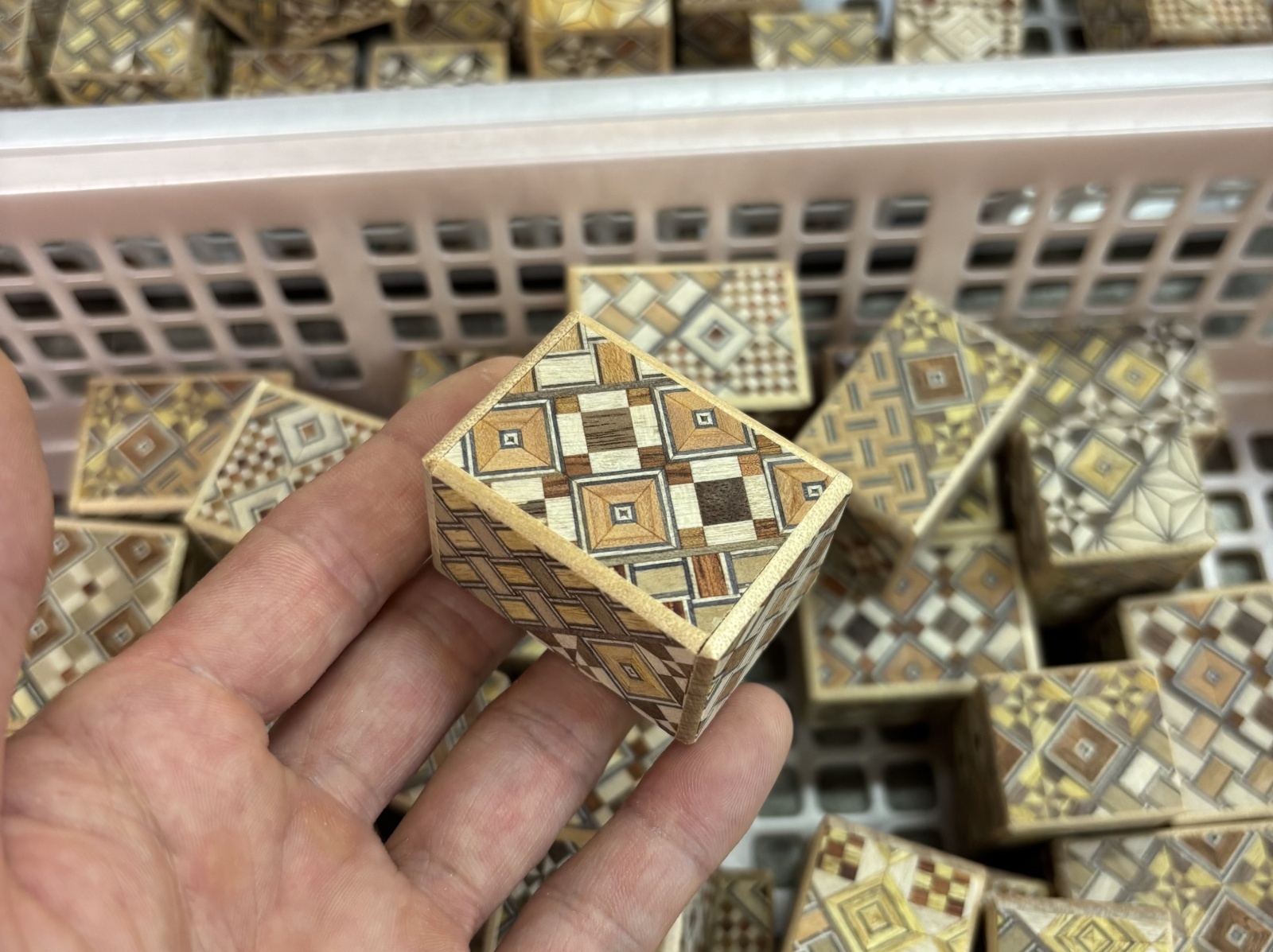
Today, I completed the assembly of the Mame puzzle boxes I had been working on, so I moved on to the finishing work. I am making about 90 boxes this time. The finishing process for Mame puzzle boxes is the same as for my other boxes. I round the edges and sand the surfaces until they are smooth. When a yosegi sheet is first attached, its surface is quite rough, so I sand it once with coarse sandpaper. I then cut it to the required panel size and attach it to the box. However, glue and dust can stick to the surface during production, so I sand it again at this stage to remove them. This time, I use a finer grade of sandpaper. If I tried to remove all the original roughness of the yosegi sheet at this stage, I would probably sand too much. If too much is removed, the yosegi sheet disappears and the base wood underneath becomes exposed.When sanding a completed box, too much pressure can easily be applied to the corners, causing the yosegi to be sanded away. The yosegi sheet is very thin, only about 0.2 mm, so it can sometimes be removed with just one stroke of sandpaper. At the same time, some side panels may still be slightly raised above the surface after the edges have been rounded, so they must be sanded flush with the box. Therefore, I carefully work on each box one by one, removing the raised areas without sanding through the yosegi sheet.
This edge-rounding process also requires special care with Mame puzzle boxes. I use the same woodworking machine to round the corners, but because these boxes are so small, they are naturally weaker than larger boxes. The side panels are also very thin, at about 2 mm, so they can easily chip during this process. I use backing pieces and take various precautions, but occasionally a corner of a box still chips. One reason is the thinness of the panels, but another important reason is that the corners of the panels are not fully fixed. Because of the mechanism, part of the yosegi panel on the surface of the Aruki panel is not attached to the box. This makes it unstable, and it may not withstand the impact from the machine. Care during production is very important, but choosing the right material from the beginning is also essential. I select wood grain that is less likely to chip at this stage for the boards to which the yosegi sheets are attached. Of course, they are all made from the same Agathis wood, but the characteristics can vary considerably depending on the part of the wood.
Today, I completed the assembly of the Mame puzzle boxes I had been working on, so I moved on to the finishing work. I am making about 90 boxes this time. The finishing process for Mame puzzle boxes is the same as for my other boxes. I round the edges and sand the surfaces until they are smooth. When a yosegi sheet is first attached, its surface is quite rough, so I sand it once with coarse sandpaper. I then cut it to the required panel size and attach it to the box. However, glue and dust can stick to the surface during production, so I sand it again at this stage to remove them. This time, I use a finer grade of sandpaper. If I tried to remove all the original roughness of the yosegi sheet at this stage, I would probably sand too much. If too much is removed, the yosegi sheet disappears and the base wood underneath becomes exposed.When sanding a completed box, too much pressure can easily be applied to the corners, causing the yosegi to be sanded away. The yosegi sheet is very thin, only about 0.2 mm, so it can sometimes be removed with just one stroke of sandpaper. At the same time, some side panels may still be slightly raised above the surface after the edges have been rounded, so they must be sanded flush with the box. Therefore, I carefully work on each box one by one, removing the raised areas without sanding through the yosegi sheet.
This edge-rounding process also requires special care with Mame puzzle boxes. I use the same woodworking machine to round the corners, but because these boxes are so small, they are naturally weaker than larger boxes. The side panels are also very thin, at about 2 mm, so they can easily chip during this process. I use backing pieces and take various precautions, but occasionally a corner of a box still chips. One reason is the thinness of the panels, but another important reason is that the corners of the panels are not fully fixed. Because of the mechanism, part of the yosegi panel on the surface of the Aruki panel is not attached to the box. This makes it unstable, and it may not withstand the impact from the machine. Care during production is very important, but choosing the right material from the beginning is also essential. I select wood grain that is less likely to chip at this stage for the boards to which the yosegi sheets are attached. Of course, they are all made from the same Agathis wood, but the characteristics can vary considerably depending on the part of the wood.