Side panel Production process
It seems that today will be the last extremely hot day for now. Just as the forecast said, it felt like summer again today, and the temperature reached as high as 29°C. It already feels like a sign of the heat we may experience this summer 😅 Starting in the morning, I worked on the finishing process for the 5-sun puzzle boxes. As I often write, the finishing method changes slightly depending on the specifications of the side panels. This time, all of the boxes use the Ichimatsu yosegi sheets made for the 5-sun size, so I rounded the corners in the traditional style used for standard Japanese Himitsu-bako. After that, I sanded the entire boxes again with sandpaper, and in the afternoon I was able to successfully complete the first coating process. As I am writing this blog now, the late afternoon sunlight coming from the west is very strong, and in this condition I feel it would be impossible to do careful finishing work. I think it is definitely better to do this kind of work earlier in the morning.
Today, most of my work focused on the finishing process for the 5-sun puzzle boxes, but in between those tasks, I also prepared the internal parts for the 2-sun cube puzzle boxes and worked on preparing the side panels for the 4-sun puzzle boxes. I still had some parts left over from the last time I made the 2-sun cube puzzle boxes, so this time it looks like I will only need to make a few additional parts. Since I am not making a large quantity this time, that should be enough.
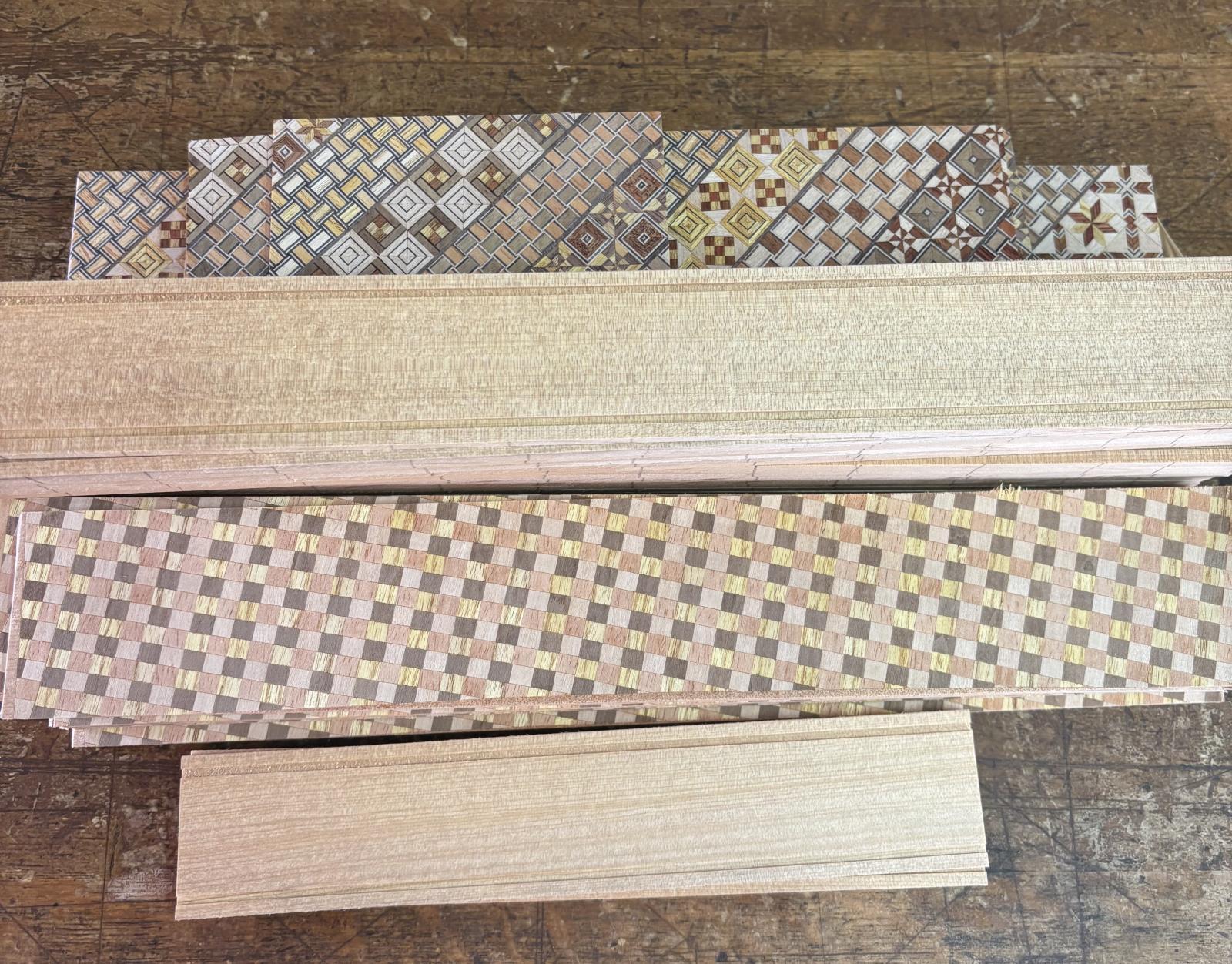
The photo shows the preparation work for the 4-sun side panels, where I am gluing two boards together. Recently, before attaching the panels, I started processing the grooves for the top and bottom Aruki panels in advance like this. I actually used this method of gluing the two boards together first for many years in the past, although there was also a period when I stopped using it. The structure of Japanese Himitsu-bako is basically like a double-layer construction. First, there is the inner structural box, and then decorative panels with yosegi work and other designs are attached to the outside of that structure. With this method, instead of attaching the decorative panels after the structural box has already been completed, I prepare and glue these layers together beforehand. The main reason for doing this is simply to improve production efficiency and speed. Of course, it is not only advantages. This method can also create various problems, so because of that, I need to slightly change some of the techniques used in the traditional construction process.
A Himitsu-bako works by sliding panels fitted into the frame, and through those movements the mechanism eventually opens the box. However, even if you carefully assemble everything exactly according to the measurements and drawings, the panels still will not move smoothly very easily. Not many people would probably try it themselves 😏, but if you do, you quickly understand how difficult it is. Because of that, it is necessary to add many small adjustments and ideas during each step of the production process. These techniques are different for every craftsman, and they are usually not shared publicly very often (probably not even here either...). When changing the production method like I did this time, those “tricks” and adjustments also need to be changed. Since returning to this method at the beginning of last year, I have continued making my puzzle boxes this way. However, for very large sizes such as 7-sun or 8-sun puzzle boxes, I do not think this method would work very well.
Today, most of my work focused on the finishing process for the 5-sun puzzle boxes, but in between those tasks, I also prepared the internal parts for the 2-sun cube puzzle boxes and worked on preparing the side panels for the 4-sun puzzle boxes. I still had some parts left over from the last time I made the 2-sun cube puzzle boxes, so this time it looks like I will only need to make a few additional parts. Since I am not making a large quantity this time, that should be enough.
The photo shows the preparation work for the 4-sun side panels, where I am gluing two boards together. Recently, before attaching the panels, I started processing the grooves for the top and bottom Aruki panels in advance like this. I actually used this method of gluing the two boards together first for many years in the past, although there was also a period when I stopped using it. The structure of Japanese Himitsu-bako is basically like a double-layer construction. First, there is the inner structural box, and then decorative panels with yosegi work and other designs are attached to the outside of that structure. With this method, instead of attaching the decorative panels after the structural box has already been completed, I prepare and glue these layers together beforehand. The main reason for doing this is simply to improve production efficiency and speed. Of course, it is not only advantages. This method can also create various problems, so because of that, I need to slightly change some of the techniques used in the traditional construction process.
A Himitsu-bako works by sliding panels fitted into the frame, and through those movements the mechanism eventually opens the box. However, even if you carefully assemble everything exactly according to the measurements and drawings, the panels still will not move smoothly very easily. Not many people would probably try it themselves 😏, but if you do, you quickly understand how difficult it is. Because of that, it is necessary to add many small adjustments and ideas during each step of the production process. These techniques are different for every craftsman, and they are usually not shared publicly very often (probably not even here either...). When changing the production method like I did this time, those “tricks” and adjustments also need to be changed. Since returning to this method at the beginning of last year, I have continued making my puzzle boxes this way. However, for very large sizes such as 7-sun or 8-sun puzzle boxes, I do not think this method would work very well.