5-sun Lid panel Adjustment
It was a very sunny day from the morning today, and it even felt a little hot. I spent the whole day working in the workshop and continued several different projects. For this month’s schedule, besides the 5-sun drawer puzzle boxes I am currently making, I also have 2-sun cube puzzle boxes and 4-sun puzzle boxes to work on. Today, while continuing the 5-sun boxes, I also decided to start making the 2-sun cube puzzle boxes.
As I mentioned before, this 2-sun cube puzzle box is a custom order, so I will only make the number that was ordered. Because of that, I will not make as many as usual. Normally, for smaller puzzle boxes like 2-sun or 3-sun sizes, I often make around 50 boxes at a time, but this time it will be different. Still, because there can sometimes be a rare mistake during production 😅 I will make two or three extra boxes just in case. If there are any left over, I will sell them on this website later. Today, I first prepared the materials and planed them down to the correct thickness. After that, to make the frame sections, I glued together the inner and outer boards for the side panels as preparation work. Then I made the shaft panels. For this project, all of the side panels will use a walnut wood design.
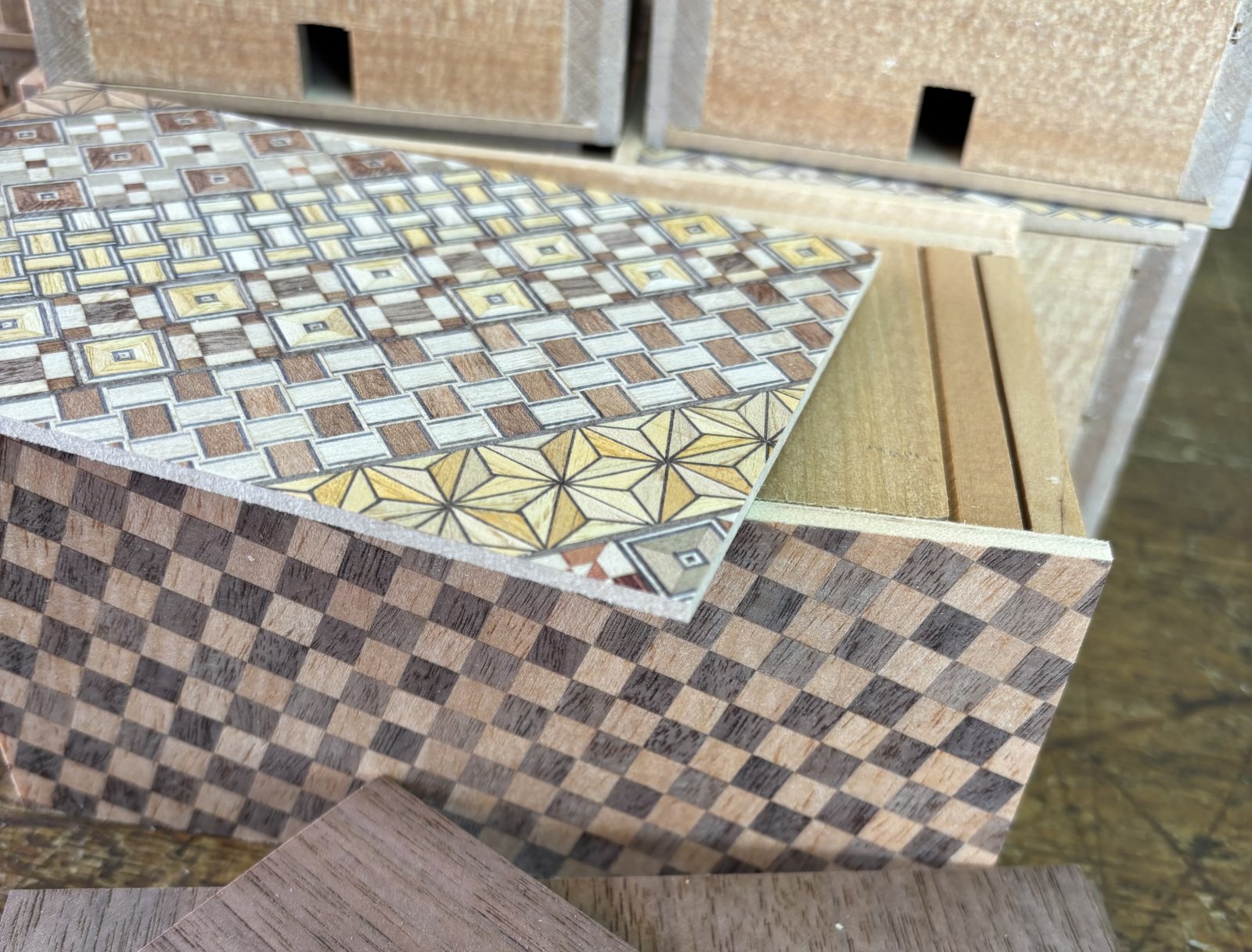
After that, I worked on making and attaching the top and bottom panels for the 5-sun drawer puzzle boxes. This time, there are two slightly different kinds of traditional small yosegi patterns that I usually use for these 5-sun boxes, but the top panels for others use traditional small yosegi arranged diagonally with random patterns. This production was not made from a specific customer order, but drawer puzzle boxes are always in high demand, so the main purpose of this project is for wholesale to shops. Of course, I also plan to sell them on my website.
Yesterday, I attached the Aruki panels, and today I continued fitting the panels to each puzzle box body. When the boxes become larger, around the 5-sun size, the differences between each individual box become more noticeable, and it becomes difficult to make every panel exactly the same width. In other words, even if I cut all of the panels to exactly the same size, one panel may fit too tightly on one box while feeling too loose on another box. Of course, these differences are actually very small, only around 0.1 or 0.2 millimeters, but even such a tiny difference can greatly change how the panels move. As I often write, it is usually better to install the panels slightly tighter and then adjust them later, because the top panel can still be removed at the end. However, if the fit is too tight, the panel may not even go into the top fitting section properly, and forcing it can sometimes cause the wood to crack. This time I am making 40 boxes, so I tested the standard-sized panels on each box one by one. For boxes that felt looser, I cut slightly larger panels and attached those instead.For the bottom panels, this “looseness” is especially important. In this drawer puzzle box design, one side of the shaft panel does not touch the bottom panel, so if the bottom panel is fitted too tightly, there is not enough support and the bottom surface can bend or warp. Because of that, I intentionally attach panels that are cut slightly looser. The attaching work finished successfully, and I think the next step will probably continue sometime next week.
Well then, I hope you have a wonderful weekend 😊
As I mentioned before, this 2-sun cube puzzle box is a custom order, so I will only make the number that was ordered. Because of that, I will not make as many as usual. Normally, for smaller puzzle boxes like 2-sun or 3-sun sizes, I often make around 50 boxes at a time, but this time it will be different. Still, because there can sometimes be a rare mistake during production 😅 I will make two or three extra boxes just in case. If there are any left over, I will sell them on this website later. Today, I first prepared the materials and planed them down to the correct thickness. After that, to make the frame sections, I glued together the inner and outer boards for the side panels as preparation work. Then I made the shaft panels. For this project, all of the side panels will use a walnut wood design.
After that, I worked on making and attaching the top and bottom panels for the 5-sun drawer puzzle boxes. This time, there are two slightly different kinds of traditional small yosegi patterns that I usually use for these 5-sun boxes, but the top panels for others use traditional small yosegi arranged diagonally with random patterns. This production was not made from a specific customer order, but drawer puzzle boxes are always in high demand, so the main purpose of this project is for wholesale to shops. Of course, I also plan to sell them on my website.
Yesterday, I attached the Aruki panels, and today I continued fitting the panels to each puzzle box body. When the boxes become larger, around the 5-sun size, the differences between each individual box become more noticeable, and it becomes difficult to make every panel exactly the same width. In other words, even if I cut all of the panels to exactly the same size, one panel may fit too tightly on one box while feeling too loose on another box. Of course, these differences are actually very small, only around 0.1 or 0.2 millimeters, but even such a tiny difference can greatly change how the panels move. As I often write, it is usually better to install the panels slightly tighter and then adjust them later, because the top panel can still be removed at the end. However, if the fit is too tight, the panel may not even go into the top fitting section properly, and forcing it can sometimes cause the wood to crack. This time I am making 40 boxes, so I tested the standard-sized panels on each box one by one. For boxes that felt looser, I cut slightly larger panels and attached those instead.For the bottom panels, this “looseness” is especially important. In this drawer puzzle box design, one side of the shaft panel does not touch the bottom panel, so if the bottom panel is fitted too tightly, there is not enough support and the bottom surface can bend or warp. Because of that, I intentionally attach panels that are cut slightly looser. The attaching work finished successfully, and I think the next step will probably continue sometime next week.
Well then, I hope you have a wonderful weekend 😊