Hand sanding and machine sanding
It has been warm since this morning, and it feels like the really cold days are mostly over now. Because of that, I cleaned and put away one of the two kerosene fan heaters I had been using. The other one still has a little kerosene left inside, so I plan to use it in the morning until it runs empty, and then put it away as well. Even if it gets a bit chilly again, an electric heater should be enough.
As planned, I was able to finish the work on the 18-steps Mame puzzle boxes today. There are two types this time: a standard version and one with a hexagon yosegi on the top. I am making around 40 of the hexagon yosegi type, so attaching these solid yosegi pieces before finishing took quite a bit of time. Actually, I don’t use any special jig for attaching these hexagon pieces—I place them by feel. In other words, I align them by eye. The surface is very small, so there shouldn’t be any big misalignment. Also, since it is just a decorative part and does not affect the mechanism, it’s not a problem. Thinking about working by eye reminds me of when I was learning guitar making. Near the head of the guitar, there is a part called the nut, where the strings sit. When cutting the grooves for the strings, you can use a jig to some extent, but in the end, I was told to adjust the spacing of the six string grooves by eye. I still remember my teacher saying, “The human eye is surprisingly accurate for this kind of work.” I still believe that, and I try to use it in my work even now.
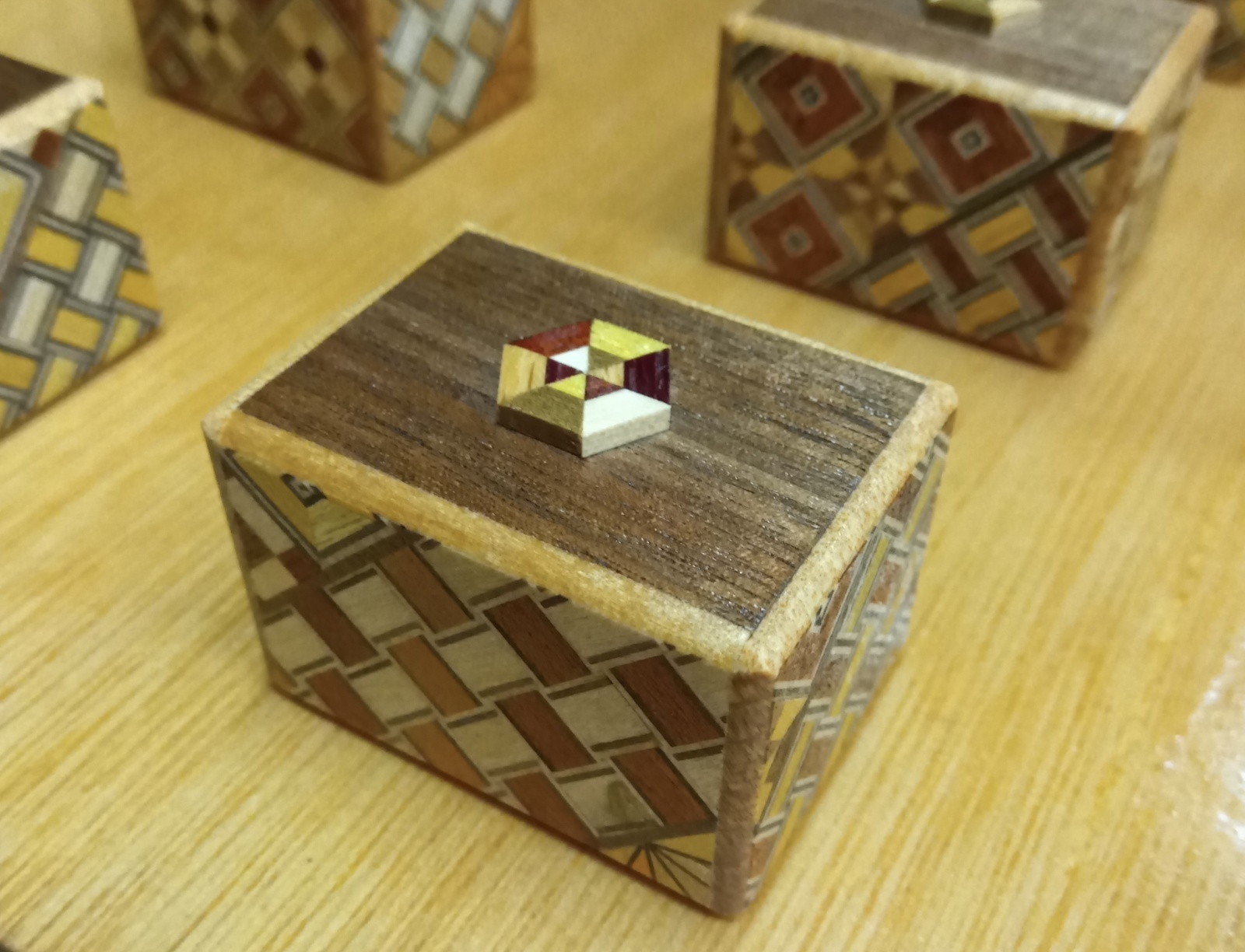
I went a bit off topic, but the photo shows the Mame puzzle boxes after the base coat. Only the hexagon lid needs to be sanded carefully by hand. The other surfaces can be sanded with a small hobby sander, but this part sticks out, so I can’t use a machine. I lay the sandpaper flat and sand it little by little. Mame puzzle boxes should not be sanded too strongly anyway, so hand sanding is enough. The key is to avoid leaving any rough spots, but also not to sand too much.
As planned, I was able to finish the work on the 18-steps Mame puzzle boxes today. There are two types this time: a standard version and one with a hexagon yosegi on the top. I am making around 40 of the hexagon yosegi type, so attaching these solid yosegi pieces before finishing took quite a bit of time. Actually, I don’t use any special jig for attaching these hexagon pieces—I place them by feel. In other words, I align them by eye. The surface is very small, so there shouldn’t be any big misalignment. Also, since it is just a decorative part and does not affect the mechanism, it’s not a problem. Thinking about working by eye reminds me of when I was learning guitar making. Near the head of the guitar, there is a part called the nut, where the strings sit. When cutting the grooves for the strings, you can use a jig to some extent, but in the end, I was told to adjust the spacing of the six string grooves by eye. I still remember my teacher saying, “The human eye is surprisingly accurate for this kind of work.” I still believe that, and I try to use it in my work even now.
I went a bit off topic, but the photo shows the Mame puzzle boxes after the base coat. Only the hexagon lid needs to be sanded carefully by hand. The other surfaces can be sanded with a small hobby sander, but this part sticks out, so I can’t use a machine. I lay the sandpaper flat and sand it little by little. Mame puzzle boxes should not be sanded too strongly anyway, so hand sanding is enough. The key is to avoid leaving any rough spots, but also not to sand too much.