Balancing Two Factors
Maybe you could call it a break in the rain. It was sunny from the morning today, and it felt like a true spring day. The humidity from the past few days was gone. It looks like the weather will turn bad again from tomorrow, so today was a valuable day.
So I started working on the tasks I had been waiting to do until the humidity dropped. I attached the Aruki panels to the 4-sun puzzle boxes that had been stored, and also attached the Aruki panels for the Mame puzzle boxes to the frame panels I made yesterday. In the morning, I was still a bit concerned that the boxes might have absorbed some moisture, so I spent that time making the Aruki panels for the Mame puzzle boxes. Then in the afternoon, I attached all of the panels. Attaching the Aruki panels requires checking the movement of each mechanism one by one, so it takes quite a bit of fingertip strength. I attached panels for 40 pieces of the 4-sun boxes and 84 pieces of the Mame puzzle boxes, so my hands became a bit sore..haha😅 But I was able to finish attaching all the panels before sunset.
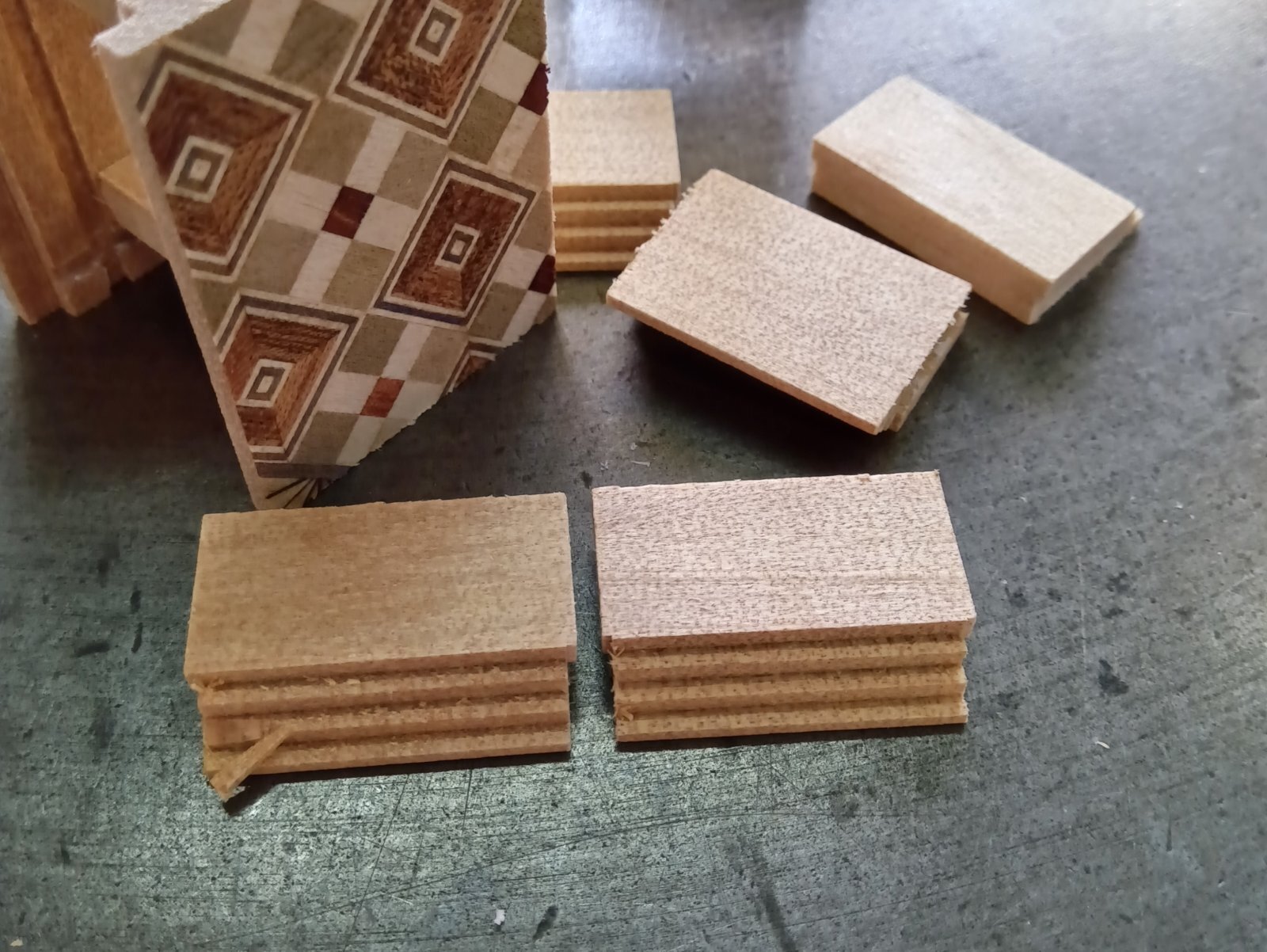
The photo shows the process of attaching the Aruki panels to the Mame puzzle boxes. If you look closely, you may notice that a small part of the corner of the stepped area on the left side is slightly chipped. In this case, since the chipped piece is still there, it can be glued back in place. However, sometimes the piece is completely missing. This happened quite often with this batch of Aruki panels. It is probably due to differences in the agathis wood, as even within the same material, some parts are more likely to chip than others. Of course, I do not use any parts where a piece is missing (although I may occasionally overlook one). For this reason, I prepare a few extra Aruki panels for the Mame puzzle boxes.This kind of issue rarely happens with larger boxes, but because the Mame puzzle boxes are so small, it occurs more easily. Just to be clear, even if there is a small chip, it does not affect the movement of the mechanism at all. However, I do not use them because it affects the appearance.
There is another reason why this happens, and it is related to the order of the process. If I first shape the “legs” (the small side protrusions that fit into the grooves of the frame panels) of the Aruki panels and then do the stepped cutting afterward, this chipping would not occur. However, I do the stepped cutting first, so when I later shape the legs, chipping can happen. I follow this order because it is more efficient for production. If I did the stepped cutting afterward, it would take much more time. Since I make a certain number of pieces, I choose this method. Making puzzle boxes is not just a hobby for me, but my work for a living, so balancing efficiency and quality is always a challenge, and this is one of the areas I continue to refine.
Have a nice weekend!
So I started working on the tasks I had been waiting to do until the humidity dropped. I attached the Aruki panels to the 4-sun puzzle boxes that had been stored, and also attached the Aruki panels for the Mame puzzle boxes to the frame panels I made yesterday. In the morning, I was still a bit concerned that the boxes might have absorbed some moisture, so I spent that time making the Aruki panels for the Mame puzzle boxes. Then in the afternoon, I attached all of the panels. Attaching the Aruki panels requires checking the movement of each mechanism one by one, so it takes quite a bit of fingertip strength. I attached panels for 40 pieces of the 4-sun boxes and 84 pieces of the Mame puzzle boxes, so my hands became a bit sore..haha😅 But I was able to finish attaching all the panels before sunset.
The photo shows the process of attaching the Aruki panels to the Mame puzzle boxes. If you look closely, you may notice that a small part of the corner of the stepped area on the left side is slightly chipped. In this case, since the chipped piece is still there, it can be glued back in place. However, sometimes the piece is completely missing. This happened quite often with this batch of Aruki panels. It is probably due to differences in the agathis wood, as even within the same material, some parts are more likely to chip than others. Of course, I do not use any parts where a piece is missing (although I may occasionally overlook one). For this reason, I prepare a few extra Aruki panels for the Mame puzzle boxes.This kind of issue rarely happens with larger boxes, but because the Mame puzzle boxes are so small, it occurs more easily. Just to be clear, even if there is a small chip, it does not affect the movement of the mechanism at all. However, I do not use them because it affects the appearance.
There is another reason why this happens, and it is related to the order of the process. If I first shape the “legs” (the small side protrusions that fit into the grooves of the frame panels) of the Aruki panels and then do the stepped cutting afterward, this chipping would not occur. However, I do the stepped cutting first, so when I later shape the legs, chipping can happen. I follow this order because it is more efficient for production. If I did the stepped cutting afterward, it would take much more time. Since I make a certain number of pieces, I choose this method. Making puzzle boxes is not just a hobby for me, but my work for a living, so balancing efficiency and quality is always a challenge, and this is one of the areas I continue to refine.
Have a nice weekend!