Solid Yosegi Accent
It was still rainy until around noon today, and the humidity remained high. The Aruki panels for the 4-sun 14-steps puzzle boxes that I made yesterday have not been attached yet and are still set aside. It looks like it will be sunny tomorrow, so I plan to keep them until then. So today, I started the next project, the 18-steps Mame puzzle boxes. Yes, I will be working on Mame puzzle boxes again. This time, I will make two different design types for the 18-step model.
One design is the usual traditional yosegi pattern, and the other will be a type with a small solid hexagonal yosegi accent on the top panel, which I have not made for a while. I think it has been about a few months since the last time. This hexagonal yosegi is not related to the mechanism and is simply a design element, but many people find it charming, and it has become a popular Mame puzzle box. In the past, I even had a customer in Japan who bought several of them as gifts for friends and acquaintances. I started working on these today. I had already prepared for this production by attaching yosegi sheets to boards for the Mame puzzle boxes. By keeping them in this form, I can make different types of Mame puzzle boxes (especially those with traditional yosegi side panels). I spent the whole day working on the Mame puzzle boxes. I prepared all the materials, reduced them to the required thickness, made the frame parts, and assembled them.
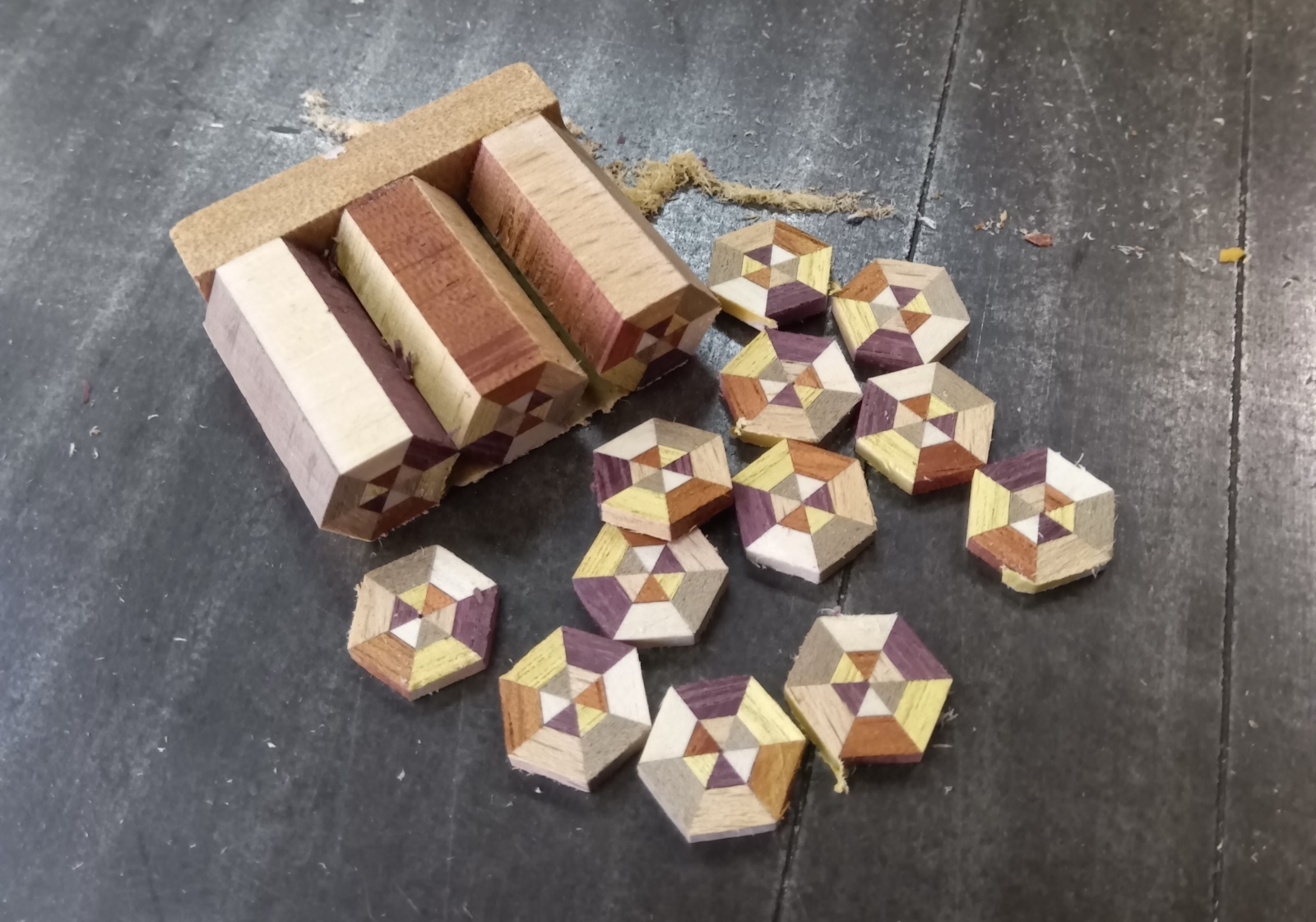
I also prepared the hexagonal yosegi pieces that will be added as decoration. Preparation simply means cutting the hexagonal rods into thin slices of about 2 mm. These hexagonal rods were made earlier, and I had some left, but with these three pieces, they are now finished. So next time, I will need to start again by making the hexagonal rods. When I cut these three rods, I cut them together like this. A single rod is unstable, so grouping them like this makes the work more stable. However, the three rods are not glued to each other. They are only lightly fixed together at one end with a small piece of wood. Each hexagonal rod is made from six triangular pieces. There are three different colors, arranged so that the same colors face each other. Before attaching these small hexagonal yosegi pieces, I lightly sand them. This is done at the final stage, just before finishing the Mame puzzle boxes.
One design is the usual traditional yosegi pattern, and the other will be a type with a small solid hexagonal yosegi accent on the top panel, which I have not made for a while. I think it has been about a few months since the last time. This hexagonal yosegi is not related to the mechanism and is simply a design element, but many people find it charming, and it has become a popular Mame puzzle box. In the past, I even had a customer in Japan who bought several of them as gifts for friends and acquaintances. I started working on these today. I had already prepared for this production by attaching yosegi sheets to boards for the Mame puzzle boxes. By keeping them in this form, I can make different types of Mame puzzle boxes (especially those with traditional yosegi side panels). I spent the whole day working on the Mame puzzle boxes. I prepared all the materials, reduced them to the required thickness, made the frame parts, and assembled them.
I also prepared the hexagonal yosegi pieces that will be added as decoration. Preparation simply means cutting the hexagonal rods into thin slices of about 2 mm. These hexagonal rods were made earlier, and I had some left, but with these three pieces, they are now finished. So next time, I will need to start again by making the hexagonal rods. When I cut these three rods, I cut them together like this. A single rod is unstable, so grouping them like this makes the work more stable. However, the three rods are not glued to each other. They are only lightly fixed together at one end with a small piece of wood. Each hexagonal rod is made from six triangular pieces. There are three different colors, arranged so that the same colors face each other. Before attaching these small hexagonal yosegi pieces, I lightly sand them. This is done at the final stage, just before finishing the Mame puzzle boxes.